- 501 Orchard Road, #04-08 Wheelock Place, Singapore 238880
- (65) 6235 4429
- hello@vidaskinclinic.com
- (65) 9830 0597
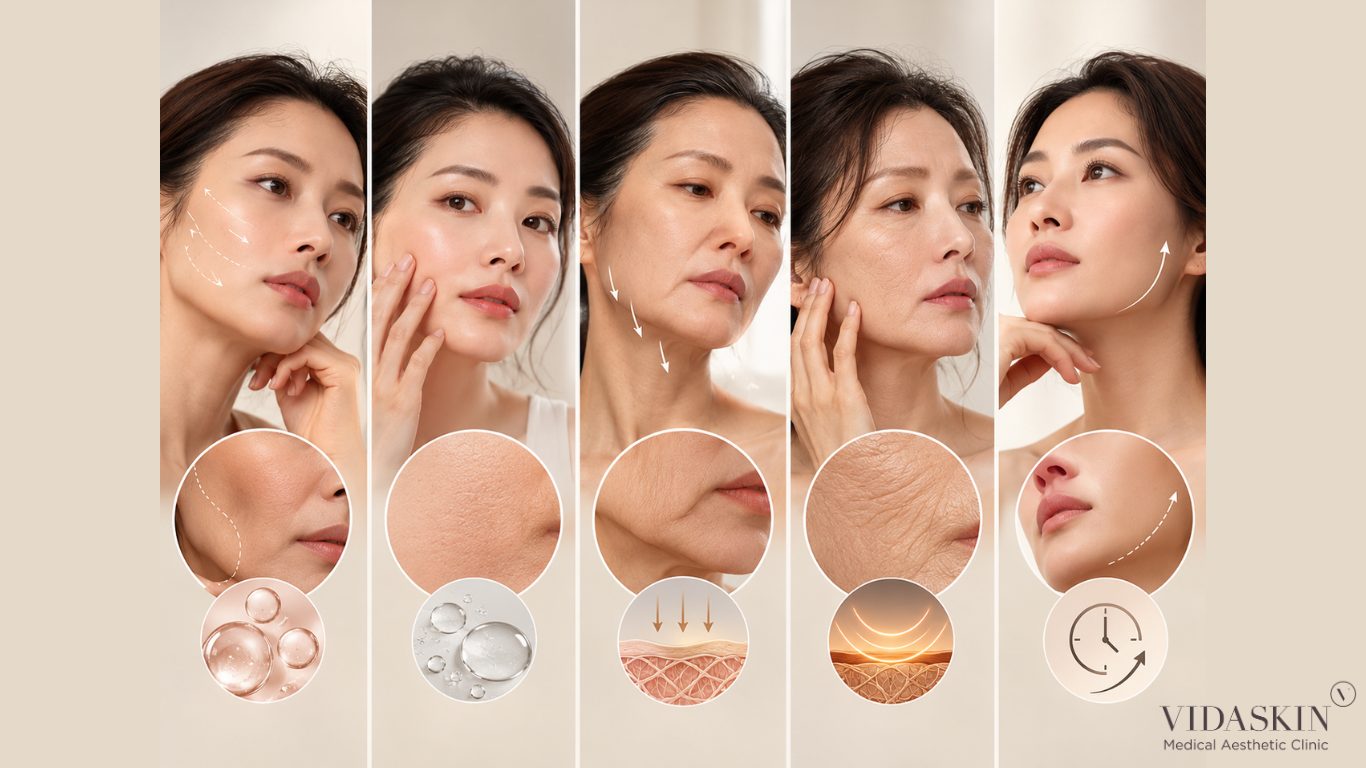
You may have spent months reading about Ultherapy before deciding to book a consultation. Then the doctor examines your face and suggests a different starting point. It can feel unexpected, especially when you were hoping for a straightforward answer to a softer jawline or a more tired appearance.
A considered recommendation should make that decision understandable. Facial ageing can involve changes in fullness, skin quality and tissue support, and these do not all respond to the same treatment. The value of a consultation is finding the approach that addresses the change bothering you most.
The five situations below are common types of concern, rather than accounts of individual patients. They explain why Ultherapy may not be the appropriate first step, even when someone is interested in a non-surgical lift.
VIDASKIN is an official training clinic for the Ultherapy See Plan Treat protocol, led by Dr Vicki Leong.[1] That clinical focus includes recognising when ultrasound treatment is unlikely to deliver the improvement a patient wants.
For you, the value of medical assessment is the explanation behind the decision. If Ultherapy is unlikely to address your main concern, that should be made clear before treatment. You should also understand what the doctor recommends instead and whether doing nothing for now is reasonable.
A face that has lost fullness can look less supported. You might notice flatter cheeks or more visible hollows. Where reduced volume contributes to the change in contour, restoring that fullness may be more relevant than tightening the skin.[2]
When reduced fullness is the main concern, carefully selected dermal filler may be considered to restore volume in specific areas. Conservative placement is important because adding more volume than needed can alter facial proportions.[2]
The distinction matters if your goal is to look less tired. Tightening alone may leave a hollow cheek looking much the same, while indiscriminate filling can make the face look heavier. The assessment should identify where fullness has been lost, how that affects your proportions and whether restoring a small amount would be worthwhile.
Sometimes the concern is easiest to describe as skin looking tired. Makeup sits less smoothly, fine lines are more noticeable or the surface appears dull. During assessment, it may become clear that texture or hydration is the main priority, with little laxity to address.
Skin boosters may be considered for selected skin quality concerns. A randomised trial of one intradermal hyaluronic acid product found improvements in cheek smoothness, fine lines and hydration. Those findings are product-specific; they do not mean that every injectable marketed as a skin booster has the same evidence or effect.[3]
VIDASKIN’s article on skin quality explores this distinction further. A useful plan starts with the specific problem. It may involve adjusting skincare, addressing an underlying skin condition or discussing a suitable injectable. The purpose is to improve the quality that is bothering you, with each step justified by what the examination shows.
Ultrasound treatment can offer a degree of tightening, but it cannot remove excess skin. Where substantial looseness or tissue descent is the main concern, a surgical assessment may provide a more realistic discussion of the change you hope to achieve.[4]
If avoiding surgery is important to you, that preference still belongs at the centre of the discussion. You may decide that a modest non-surgical improvement is enough. You may also decide that the likely benefit would not justify the cost or recovery. Both choices are easier when the limitations have been explained before treatment.
Sometimes the appropriate recommendation is simply to arrange a surgical opinion before spending on a series of treatments that may leave the original concern largely unchanged. A referral is an opportunity to understand your options; it is not a commitment to surgery.
Fine, closely spaced lines can give skin a crepey appearance, even when there is relatively little tissue descent. This deserves a focused assessment of texture and skin quality. The distinction is not absolute: Ultherapy can influence skin quality as well as firmness, but suitability depends on the main concern and the improvement being sought.[5]
Thermage uses radiofrequency energy and may be considered for selected concerns involving firmness.[6] Titanium Lift, also offered at VIDASKIN, is a laser-based treatment.[7] They use different technologies and should be discussed according to their own indications, evidence, and limitations.
The next step depends on what is producing the crepey appearance and where it occurs. Dryness, fine surface lines and reduced firmness may need different forms of care. A recommendation for Thermage, Titanium Lift or another treatment should explain the expected benefit for that particular finding, rather than rely on the device name alone.
You may be medically suitable for a treatment and still be unlikely to feel satisfied with the result you expect from it. This is particularly relevant when the goal is a dramatic lift, a very specific facial shape, or a major change before an event that is only days away.
Ultherapy results develop gradually, often becoming clearer over approximately two to three months. The response varies, and treatment cannot promise a particular amount of lifting by a fixed date.[8]
Before proceeding, describe the result that would make the treatment worthwhile for you. A useful conversation should address the size of the likely change as well as its timing. If the expected benefit falls short of your goal, postponing the decision is more helpful than proceeding with an unresolved misunderstanding.
Manufacturer contraindications include open wounds, severe or cystic acne, and specified implants. Pregnancy and breastfeeding have not been evaluated; elective treatment should be deferred.[9]
Tell the doctor about your medical conditions, medicines, implants, and previous procedures. Do not stop prescribed medication to make yourself eligible. A medical reason to defer Ultherapy also needs consideration before choosing another procedure; changing devices does not automatically resolve it.
VIDASKIN’s Ultherapy safety article provides further background. Your own suitability still requires an assessment of the exact area and treatment being proposed.
The next step should follow the assessment rather than a fixed sequence of replacement treatments. This guide summarises the discussion; it is not a prescription for everyone with a similar concern.
| Main finding | What the next discussion may involve |
|---|---|
| Volume loss is the main concern | Conservative volume restoration where appropriate, with attention to facial proportions and injectable risks. |
| Hydration or texture is the priority | Targeted skincare, management of skin conditions or a suitable skin booster. |
| Significant excess skin or descent | A surgical opinion, or a clear agreement to accept the limits of non-surgical care. |
| Crepiness is more prominent than laxity | Assessment for skin quality treatment, radiofrequency or an appropriate laser approach. |
| The desired result exceeds what treatment can offer | Revisit the goal and timing; postpone treatment if expectations remain incompatible. |
The alternatives above require their own suitability assessment; each has different benefits, limitations and risks.
More than one finding may be present. When this happens, ask which concern should be addressed first and what the doctor expects that first step to achieve. A staged plan gives you time to see what the first treatment achieves before deciding whether another step is needed.
Start by describing the change you notice, rather than trying to diagnose it yourself. Explain where it is most visible, when you first noticed it, and what improvement you hope to see. Photographs can help communicate the concern, but they cannot replace an examination.
Ask the doctor to identify the main finding and connect it to the recommendation. You should leave understanding what the proposed treatment can address, what is likely to remain, and why an alternative might be more suitable. That explanation is more useful than being given a list of available devices.
Age alone does not describe the degree of laxity, tissue quality, or the result someone hopes to achieve. Non-surgical tightening is generally better suited to a limited amount of looseness, while substantial excess skin may require a different approach.[4]
It is therefore more useful to ask what the examination shows than whether you fall within a preferred age bracket. A recommendation should explain the likely benefit for your present concern. Being younger does not automatically mean you need treatment, and being older should not substitute for an individual assessment.
No. A naturally slim face does not necessarily have a volume deficit that requires correction. Filler may be considered when restoring lost fullness serves a defined goal, but it should be planned conservatively and with an explanation of its own risks.[2]
You can also prefer to retain a leaner facial shape or decide against injections. Tell the doctor which features you like and which changes concern you. Assessment aims to establish whether treatment would provide a worthwhile benefit, rather than treating slimness itself as a problem.
Neither treatment is automatically better for every person. Thermage uses radiofrequency, while Ultherapy uses focused ultrasound with visualisation. Their applications can overlap, and the choice should reflect the skin findings and the treatment goal rather than a simple ranking of technologies.[6][10]
Ask why one is being recommended for the area that concerns you, what improvement is expected, and what recovery or risks apply. If dryness, inflammation or another skin condition is contributing, that also needs attention. A device recommendation should follow the assessment of the skin.
It may be considered if there is a separate concern that it can reasonably address. Pan-Asian treatment guidance recognises the role of personalised planning, including the place of microfocused ultrasound within a broader approach to facial rejuvenation.[11]
The useful question is what each proposed step adds. Ask why the treatments are being combined, whether they should be staged, and when the first result will be reviewed. A combination should not be presented as necessary simply because several options exist, and you do not need to commit to every stage at the first visit.
Begin with a review of the previous treatment and the concern that remains. Clinical evidence shows that responses vary, and reported improvement does not mean that every patient experiences a noticeable or satisfying result.[5]
Bring the date, treated areas, and any available records or photographs. Ask whether the original concern was suitable for ultrasound treatment and whether enough time has passed to assess the outcome. A repeat session should have a clear rationale. It should not be recommended solely on the assumption that another treatment will produce the change you expected.
No. A recommendation is an opportunity to understand your options. You can ask for more explanation, take time to consider the proposal, seek another opinion or decide that you do not want treatment. Declining one procedure does not create an obligation to have another.
Before deciding, make sure you understand the expected benefit, recovery, risks, likely treatment course, and cost. If the alternative does not fit your priorities, say so. The next step may be a simpler plan, a later review, or no procedure at all.
A realistic goal should describe a limited change that matters to you, such as a modest improvement in firmness or lower facial definition, with room for individual variation. It should not depend on a guaranteed number of years being removed from your appearance or an exact resemblance to someone else.
Ask the doctor to discuss the likely range of improvement in your case and how it will be reviewed. If only a dramatic result would satisfy you, make that clear before booking. Agreeing on the goal is part of deciding whether treatment is worthwhile.
You do not need to arrive knowing whether the answer is Ultherapy, an injectable or another approach. The purpose of consultation is to understand what has changed and choose the next step with that information in mind.
Book an assessment with Dr Nick Wang at VIDASKIN to discuss your concerns, the degree of improvement you want, and the options that fit your needs. A considered recommendation should help you feel clear about both the reason to proceed and the reason to wait.
[1] VIDASKIN. Why VIDASKIN Is the Go-To Clinic for Ultherapy PRIME in Singapore. Cited for the clinic’s statement that Ultherapy PRIME is performed by medical doctors. Accessed 13 October 2026. View source
[2] American Academy of Dermatology. Fillers: FAQs. Patient information on volume restoration and conservative treatment. Accessed 13 October 2026. View source
[3] Alexiades M, Palm MD, Kaufman-Janette J, et al. A Randomized, Multicenter, Evaluator-blind Study to Evaluate the Safety and Effectiveness of VYC-12L Treatment for Skin Quality Improvements. Dermatologic Surgery. 2023;49(7):682–688. doi:10.1097/DSS.0000000000003802. View source
[4] American Academy of Dermatology. Many ways to firm sagging skin. Patient guidance on the scope and limitations of non-surgical tightening. Accessed 13 October 2026. View source
[5] Amiri M, Ajasllari G, Llane A, et al. Microfocused Ultrasound With Visualization (MFU-V) Effectiveness and Safety: A Systematic Review and Meta-Analysis. Aesthetic Surgery Journal. 2025;45(3):NP86–NP94. doi:10.1093/asj/sjae228. View source
[6] Solta Medical. Thermage: treatment information and important safety information. Manufacturer information. Accessed 13 October 2026. View source
[7] VIDASKIN. Titanium Lift. Clinic information identifying the laser-based treatment. Accessed 13 October 2026. View source
[8] Merz Aesthetics. Ultherapy Asia: Frequently Asked Questions. Manufacturer information on results and treatment experience. Accessed 13 October 2026. View source
[9] Ulthera, Inc./Merz Aesthetics. Ulthera System Instructions for Use featuring DeepSEE Technology for Ultherapy PRIME. US edition, 2025. Device precautions, post-market events, transducer care and display functions. Accessed 13 October 2026. View source
[10] VIDASKIN. Ultherapy PRIME Treatment in Singapore. Clinic information on the platform and assessment approach. Accessed 13 October 2026. View source
[11] Park JY, Lin F, Suwanchinda A, et al. Customized Treatment Using Microfocused Ultrasound with Visualization for Optimized Patient Outcomes: A Review of Skin-tightening Energy Technologies and a Pan-Asian Adaptation of the Expert Panel’s Gold Standard Consensus. Journal of Clinical and Aesthetic Dermatology. 2021;14(5):E70–E79. Expert review and consensus. View source

Dr. Kay Low is a UK-trained medical doctor with over 7 years of clinical experience across the UK and Singapore, specialising in aesthetic medicine. A graduate of the University of Cambridge, she has worked across multiple medical and surgical disciplines in the UK and Singapore before completing postgraduate training in Family Medicine and advanced training in aesthetic medicine.
