- 501 Orchard Road, #04-08 Wheelock Place, Singapore 238880
- (65) 6235 4429
- hello@vidaskinclinic.com
- (65) 9830 0597
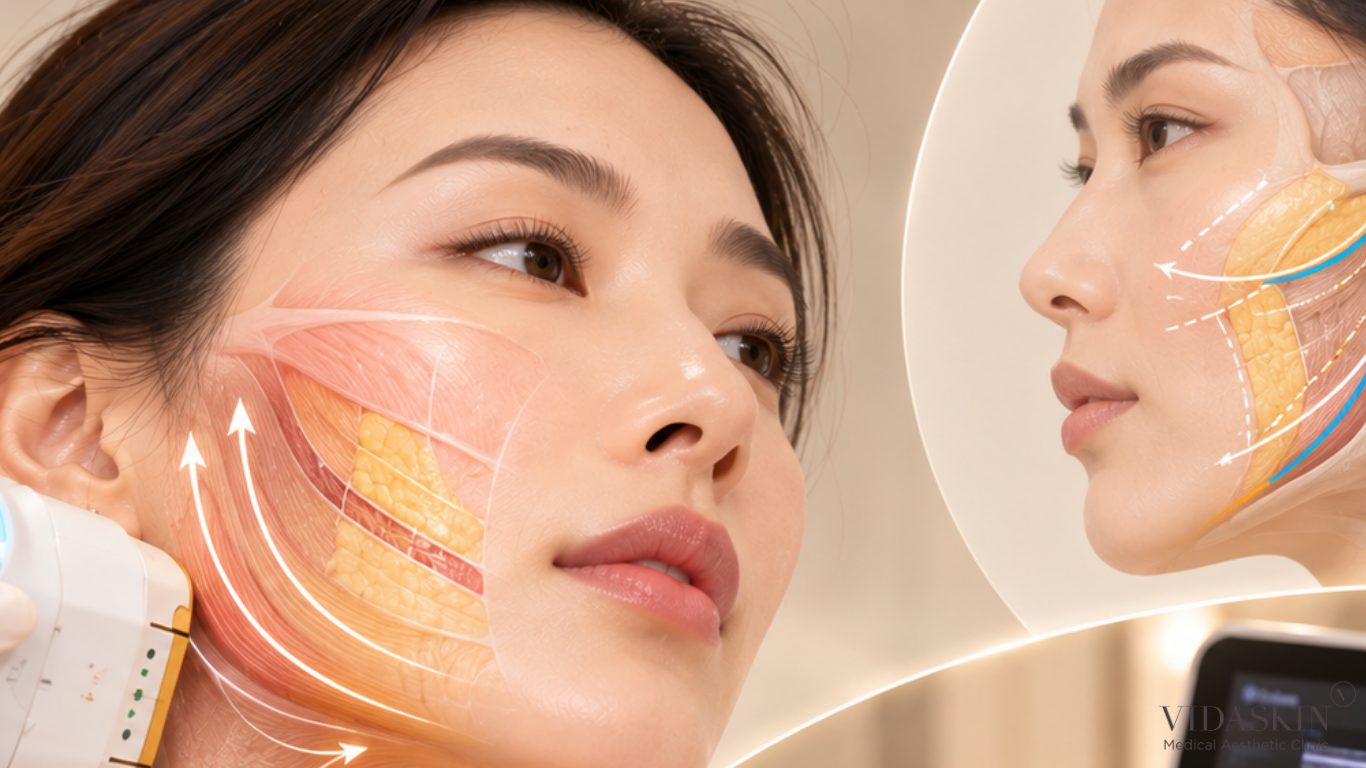
A softer jawline can be easy to notice and difficult to explain. Perhaps your lower face looks heavier in photographs, even though your cheeks feel less full. Or you want a little more definition without losing the softness that makes your face familiar.
For anyone considering Ultherapy skin tightening in Singapore, those details matter. The treatment plan should begin with what has changed in your face and what you hope to preserve. Asian facial anatomy can inform that assessment, but it cannot replace an examination of the person sitting in front of the doctor.
Ultherapy uses microfocused ultrasound with visualisation to deliver energy at selected depths beneath the skin. Treatment planning involves decisions about depth, energy and the distribution of treatment lines. These parameters are adapted to support the individual patient rather than applying an identical protocol to every face.[1]
A useful plan should therefore explain more than how much treatment you will receive. It should explain why particular areas are being treated, why others may be left alone and what kind of improvement is realistic for you.
There is considerable diversity within Asian populations. Published anatomical discussions describe population trends in facial structure, but these cannot tell a doctor how much support, fullness, or skin thickness a particular patient has.[2]
Ethnicity can provide context; your own anatomy determines the plan. The same principles apply to every patient: identify the concern, assess the tissues, and choose treatment that serves a clear purpose. There is no reason to assume that an Asian face automatically needs stronger settings or a larger number of lines.
The skin and the tissues beneath it do not have a uniform thickness across the face. Age and body composition also affect the depth of the superficial fascia, a connective tissue layer relevant to treatment planning. An anatomical study demonstrated substantial variation between facial regions and between individuals.[3]
This is why depth selection is a clinical decision. The doctor needs to establish where the intended tissue lies in each area, rather than assume that one setting will suit the forehead, cheek and neck equally well.
Facial fat is arranged in compartments that contribute to cheek shape and the transition between facial regions. Changes in their volume and position can affect how ageing appears. A hollow-looking cheek and a fuller lower face may coexist, which helps explain why treating every area in the same way can overlook the underlying concern.[2]
A wish for a sharper jawline should therefore be considered alongside the fullness of the cheeks. If you like that softness, or already feel that your face is becoming too lean, tell the doctor. Those preferences help define the areas worth treating and the areas that deserve a more conservative approach.
The cheekbones, chin, and jaw provide the framework beneath the soft tissues. Their shape and projection influence facial proportions and how changes in the overlying tissues appear. Tightening treatment cannot replace the support provided by bone or change the underlying skeleton.[2]
This matters when someone asks for a sharper jawline. The doctor first needs to establish how much of its appearance comes from laxity and how much comes from the existing shape of the chin and jaw. Those findings help define both the treatment plan and its limits.
A personalised plan brings the examination and ultrasound findings together. The aim is to make each treatment choice understandable, so that the recommendation follows naturally from the concern being addressed.
Ultherapy transducers deliver treatment at preset depths such as 1.5, 3.0 and 4.5 mm.[4] These are device settings, not a guarantee that the same anatomical layer lies at that depth in every part of every face. In particular, 4.5 mm should not automatically be described as the SMAS layer everywhere.[3]
Real-time imaging helps the treating doctor assess the tissues beneath the handpiece and plan energy delivery accordingly. This is why visualisation should be used in relation to your anatomy, rather than treated as a feature that is simply mentioned during the consultation.[5]
A treatment line delivers a sequence of focused ultrasound exposures. The distribution of those lines, the depths used, and the areas selected all contribute to the treatment plan. Clinical guidance on treating Asian men, for example, discusses adapting the approach to regional anatomy and individual needs.[6]
The practical implication is that a higher total is not automatically a better prescription. Ask where the proposed lines will be placed and what each area of treatment is intended to achieve. This gives the number a clinical meaning.
In this context, a vector describes the direction considered when planning the treatment pattern and the intended contour change. It should not imply that ultrasound physically pulls and repositions tissue in the way a surgical lift does. Published treatment guidance discusses directional planning as one part of a broader anatomical assessment.[6]
For you, the useful part of this discussion is the expected change in contour. A plan for improving definition along the jawline may differ from one focused on looseness beneath the chin. The doctor should explain how the treatment pattern relates to your concern, while keeping the likely degree of improvement realistic.
A softer jawline is a description of appearance, rather than a diagnosis. Skin laxity, the distribution of facial fat, and underlying skeletal support can each influence the lower facial contour.[2] Treating the most visible area without considering these contributors may leave the main concern unresolved.
The assessment should look beyond the jowl itself. Ask which changes Ultherapy could reasonably improve and whether the likely benefit would be enough to meet your goal.
Begin with the changes you have noticed and the features you want to preserve. Older photographs can help explain a concern, particularly when it is difficult to describe.
A thorough discussion should cover:
Dr Nick Wang’s approach at VIDASKIN begins with the patient’s concerns and the underlying cause, with treatment selected according to individual anatomy and realistic goals.[7] The purpose of assessment is to help you understand the recommendation before deciding whether to proceed.
They need an individual assessment. Pan-Asian guidance supports customising treatment, but being Asian does not establish a particular depth, energy level or line count. Facial structure, the areas of concern, and the tissues seen on imaging are more useful for making those decisions.[1]
If a package is described as specifically designed for Asian faces, ask what will be adapted after your examination. A clear answer should relate to your own features and goals, rather than suggesting that everyone within a broad ethnic group needs the same approach.
The manufacturer lists fat or volume loss among reported post-market events; their frequency and causation cannot be established from those reports.[8] A slim face deserves careful assessment of existing fullness and whether tightening would address the main concern.
Tell the doctor if maintaining cheek volume is a priority. Ask how that concern affects the proposed plan and whether another approach would better address the change you have noticed. Personalised planning can guide risk reduction, but it cannot remove every possibility of an unwanted effect.
Line count is one component of treatment; it does not describe depth, placement or suitability. Expert guidance considers these factors together when planning microfocused ultrasound treatment.[6] Comparing packages by the total alone therefore leaves out information that matters to your face.
Ask for the proposed treatment areas and the purpose of the line distribution. If two recommendations differ, the explanation should help you understand whether they cover different regions or pursue different goals. A larger package should have a clear reason beyond being described as more comprehensive.
No. The superficial musculoaponeurotic system, or SMAS, is part of the facial connective tissue framework, but its relationship to the skin surface varies. Research on superficial fascial depth supports assessing the actual anatomy rather than assuming that a fixed depth identifies the same tissue everywhere.[3]
You do not need to identify this layer on the screen yourself. The useful question is how the doctor uses imaging to select the appropriate target in each area. That explanation is more informative than a promise to treat the deepest layer throughout the face.
They may be, if the assessment identifies a reason. Personalised treatment can take account of differences in the tissues and areas requiring attention.[1] This does not mean that every visible asymmetry should be treated or that identical facial halves are an achievable goal.
Point out the difference that concerns you and ask what contributes to it. The doctor should explain whether treatment could make a worthwhile change, whether the difference is likely to remain and how the result will be reviewed. Photographs taken under consistent conditions can make that discussion clearer.
Share your filler history, including the areas and products used. The manufacturer does not recommend treatment directly over dermal fillers because that use has not been evaluated.[8]
Previous filler does not provide enough information on its own to decide whether the whole face can or cannot be treated. Bring records if available and allow time for the doctor to review the proposed areas. Avoid booking a standard package on the assumption that all previous injectables are irrelevant to the plan.
No. Ultherapy PRIME is a newer platform, but selecting suitable patients and planning around their anatomy remain central to treatment. At VIDASKIN, visualisation supports the doctor’s decisions within a personalised treatment plan.[4]
When discussing a device, it is reasonable to ask both what the technology offers and how it will be used for you. The consultation should still cover your priorities, likely benefit, limitations and alternatives. A newer machine does not make every concern suitable for ultrasound treatment.
Improvement develops gradually as the tissues respond. The manufacturer describes results commonly becoming apparent over about two to three months, although the timing and extent vary.[9] This makes the review appointment an important part of the plan.
Agree in advance on what will be assessed and when. The outcome may be a modest change in firmness or definition rather than a dramatic alteration. If you are preparing for a particular event, share the date during consultation so that the discussion includes realistic timing and room for recovery.
If you are considering Ultherapy in Singapore, a full-face assessment can help clarify what is changing and whether ultrasound treatment is likely to address it. The consultation should leave you with a clear understanding of the expected benefit and the features the plan aims to preserve.
Meet Dr Nick Wang at VIDASKIN to discuss your concerns and develop a treatment plan around your own anatomy, preferences and goals.
[1] Park JY, Lin F, Suwanchinda A, et al. Customized Treatment Using Microfocused Ultrasound with Visualization for Optimized Patient Outcomes: A Review of Skin-tightening Energy Technologies and a Pan-Asian Adaptation of the Expert Panel’s Gold Standard Consensus. Journal of Clinical and Aesthetic Dermatology. 2021;14(5):E70–E79. Expert review and consensus. View source
[2] Liew S, Wu WTL, Chan HH, et al. Consensus on Changing Trends, Attitudes, and Concepts of Asian Beauty. Aesthetic Plastic Surgery. 2016;40:193–201. doi:10.1007/s00266-015-0562-0. View source
[3] Casabona G, Frank K, Koban CC, et al. Influence of Age, Sex, and Body Mass Index on the Depth of the Superficial Fascia in the Face and Neck. Dermatologic Surgery. 2019;45(11):1365–1373. doi:10.1097/DSS.0000000000001909. Anatomical study in a Caucasian population; cited for variation in fascial depth, not Asian population averages. View source
[4] VIDASKIN. Ultherapy PRIME Treatment in Singapore. Clinic information on the platform and assessment approach. Accessed 13 October 2026. View source
[5] Merz Aesthetics. Ultherapy Asia: See Plan Treat. Manufacturer information on visualisation and individualised planning. Accessed 13 October 2026. View source
[6] Park JY, Hong W, Lee KC, et al. Customizing Microfocused Ultrasound With Visualization Treatment for Facial Lifting in Asian Men: Experience and Practical Insights From Korea. Journal of Cosmetic Dermatology. 2025;24:e70278. doi:10.1111/jocd.70278. Clinical experience and practical guidance; not a comparative trial. View source
[7] VIDASKIN. Dr Nick Wang: professional profile and consultation approach. Accessed 13 October 2026. View source
[8] Ulthera, Inc./Merz Aesthetics. Ulthera System Instructions for Use featuring DeepSEE Technology for Ultherapy PRIME. US edition, 2025. Device precautions, post-market events, transducer care and display functions. Accessed 13 October 2026. View source
[9] Merz Aesthetics. Ultherapy Asia: Frequently Asked Questions. Manufacturer information on results and treatment experience. Accessed 13 October 2026. View source

Dr. Kay Low is a UK-trained medical doctor with over 7 years of clinical experience across the UK and Singapore, specialising in aesthetic medicine. A graduate of the University of Cambridge, she has worked across multiple medical and surgical disciplines in the UK and Singapore before completing postgraduate training in Family Medicine and advanced training in aesthetic medicine.
