- 501 Orchard Road, #04-08 Wheelock Place, Singapore 238880
- (65) 6235 4429
- hello@vidaskinclinic.com
- (65) 9830 0597
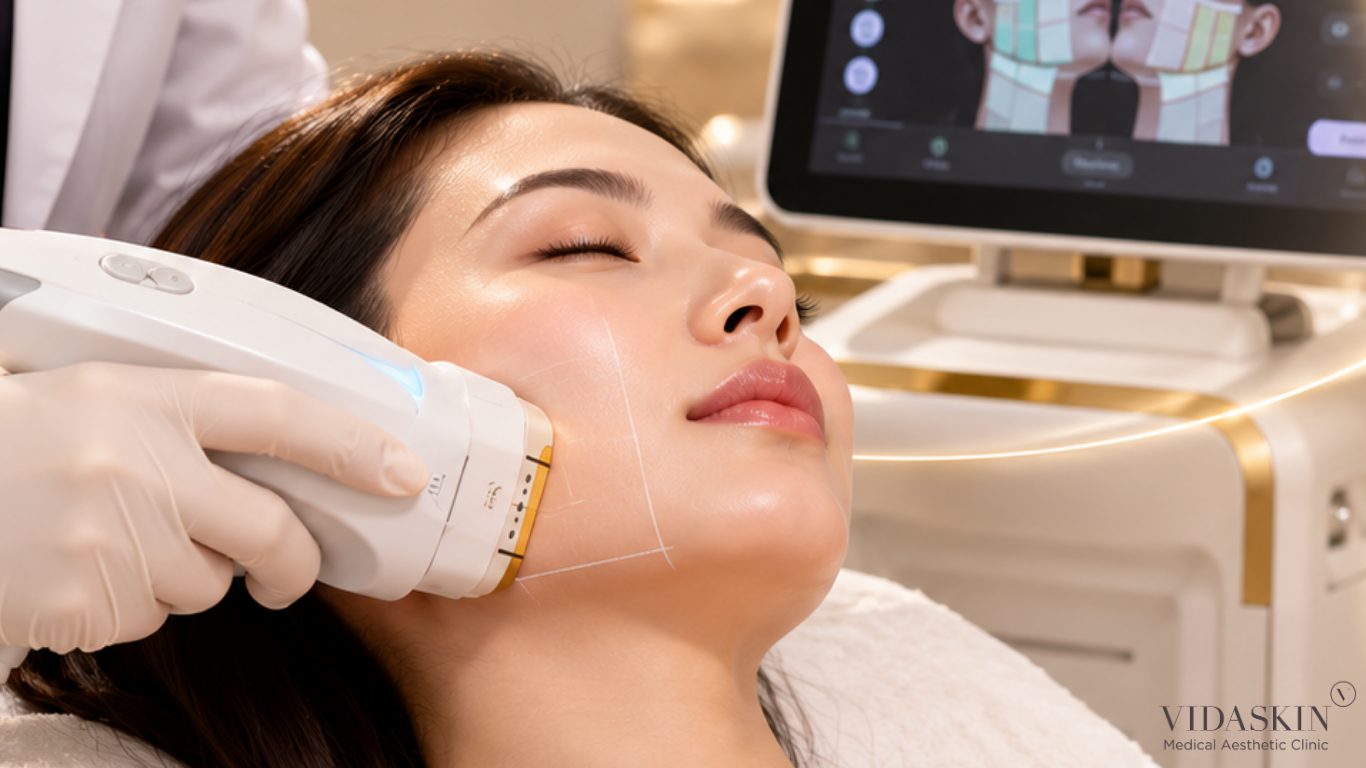
You have chosen Ultherapy PRIME, compared clinics, and set aside time for treatment. Before the session begins, one question still deserves a clear answer: is the device in the room the one you have booked?
Similar descriptions on price lists can make ultrasound treatments difficult to compare. You do not need to become an equipment expert, but you should be able to verify the platform, understand who will treat you, and receive an explanation of the proposed plan. The checks below help make that conversation more straightforward.
Ultherapy’s regional manufacturer guidance encourages patients to verify the provider, ask about real-time visualisation, and look for appropriate authenticity documentation.[1] Asking for this information is a normal part of understanding the procedure you are considering.
It helps to raise these questions before paying for a package. Ask the clinic to confirm the exact platform in writing and explain what you will be able to see on the day. This gives you time to clarify an unclear answer without feeling rushed in the treatment room.
Ultherapy and Ultherapy PRIME are brand names associated with the Ulthera system from Merz Aesthetics. They should not be used as interchangeable labels for every treatment that delivers focused ultrasound.[2]
The exact name matters when you compare quotations. If your booking specifies Ultherapy PRIME, the clinic should be able to identify that platform clearly. A description such as “ultrasound facial” does not provide the same information about the device you will receive.
Ultrasound lifting describes a type of treatment. Different manufacturers produce ultrasound devices with different features and supporting evidence. A separate brand may be a legitimate treatment in its own right; it should simply be identified accurately.[3]
Ask for the manufacturer and model, then compare the quotation with that information in mind. The issue is whether the service is being described transparently, rather than assuming that every lower-priced ultrasound treatment is either Ultherapy or an imitation of it.
Ask the clinic to identify the machine and explain its manufacturer or authorised-provider documentation. Merz’s regional guidance refers to trained, certified providers and an Ultherapy PRIME authenticity seal or certificate.[1] If anything is unclear, ask how it can be confirmed with Merz or its authorised distributor.
“Merz registration” should not be confused with Singapore regulatory registration. HSA’s Singapore Medical Device Register is a separate source for checking registered medical devices.[4] Ask which document is being shown and what it actually verifies; a provider certificate and a device registration serve different purposes.
The transducer is the component attached to the handpiece that delivers the treatment. Ask the doctor to show you the selected component and explain why it fits the plan. You should not need to handle the equipment or interpret technical markings yourself.
Genuine Ultherapy transducers may be used for multiple patients, with specified cleaning, disinfection, expiry and capacity limits.[5] Ask about these checks; a newly opened box alone is insufficient.
The PRIME display separates delivered lines from remaining transducer capacity, and the current line counter can be reset.[5] Ask which number you are viewing.
Agree on the treatment areas and planned coverage before the session, then request a summary of what was delivered. If the plan changes, the doctor should explain why. The screen supports that record, but a single number cannot tell you whether the exposures were placed appropriately for your face.
Ask for the treating practitioner’s name and role before booking. Singapore Medical Council guidance sets out requirements for doctors performing aesthetic procedures, including relevant ultrasound treatments.[6] You should be clear about who assesses you, who operates the device and who is responsible for follow-up.
At VIDASKIN, Ultherapy PRIME procedures are performed by medical doctors.[7] When arranging your appointment, confirm who will carry out your treatment. A consultation with a named doctor should not leave you uncertain about who you will see in the treatment room.
Ultherapy’s visualisation allows the practitioner to view tissue beneath the handpiece and use that information during planning and delivery.[8] Ask how imaging will be used for your treatment and whether the doctor can explain what is being assessed when it is appropriate to do so.
Seeing an ultrasound picture on a screen is only part of the conversation. You want to understand that imaging is being used for your anatomy at the relevant points in treatment. A saved demonstration image cannot answer that question for you.
Clear answers should be available about the platform, the treating practitioner and the proposed procedure. Occasionally a certificate needs to be retrieved or a manufacturer enquiry takes time. What matters is that the uncertainty is acknowledged and resolved before you commit to treatment.
At VIDASKIN, the consultation should connect the equipment discussion with the clinical plan. Knowing the brand is useful, but so is understanding why the treatment has been recommended for your face, what it may improve, and what it is unlikely to change.
Useful information to request includes:
A price only becomes meaningful when you know what it includes. A quotation for one limited area is not directly comparable with a broader treatment plan. VIDASKIN’s pricing guide explains that treatment areas and the prescribed line count are among the factors affecting cost.[9]
Ask for an itemised explanation of the platform, areas, planned coverage and follow-up. Clarify whether the quoted amount includes the consultation, taxes, and any proposed comfort measures. If two prices are very different, these details provide a useful starting point for comparison.
A low price does not prove that a device is inauthentic, just as a high price does not establish good treatment. If the explanation remains unclear, take time to verify the details before paying or proceeding.
Save or print this checklist and bring it to your consultation. It is a prompt for discussion, rather than a guarantee of safety or a substitute for medical assessment.
No. HIFU is a broad term for high-intensity focused ultrasound, while Ultherapy is a specific brand. Its name does not apply to every ultrasound device or every treatment described as a non-surgical lift.[2]
Ask the clinic for the manufacturer and model before comparing packages. If a different brand is being offered, it should be discussed on its own terms, including its evidence, indications and limitations. Accurate naming lets you decide whether the treatment meets your needs without relying on an assumption created by a familiar word.
No. The manufacturer specifies cleaning and disinfection between patient uses, alongside expiry and capacity limits.[5] Previous use alone does not establish that a genuine component is inappropriate.
Ask the practitioner to explain the component being used and how its condition is checked. You do not need to handle it, and the clinic should maintain appropriate hygiene while showing or explaining it. The useful distinction is whether the component is genuine, suitable and within its permitted use, rather than whether you watch a new package being opened.
No. Manufacturer or authorised-provider verification concerns the brand and its supply or provider arrangements. HSA’s Singapore Medical Device Register concerns medical device registration in Singapore.[4] One should not be presented as if it answers every question covered by the other.
If a clinic uses the word “registered”, ask what is registered and with whom. It is reasonable to request enough information to check the relevant entry or contact the manufacturer. Avoid relying on an unexplained badge, a cropped certificate or a statement that cannot be connected to the actual clinic and device.
No. A number does not explain the depth, location or clinical purpose of the exposures. Treatment planning needs to consider these together, with coverage adapted to the tissues and concern being addressed.[10]
Ask why the proposed count is appropriate for your treatment areas and how the completed procedure will be recorded. If the plan changes, ask for the reason. This makes the count useful as part of the treatment record while keeping the decision centred on the expected benefit, rather than treating the largest number as the best option.
No. Sensation is not an authenticity test. Published evidence shows variation in discomfort during microfocused ultrasound treatment, and pain does not establish the identity of the machine or the quality of the procedure.[11]
Ask about comfort measures before treatment and tell the practitioner if the sensation becomes difficult to tolerate. You should not feel obliged to endure severe pain as proof that a treatment is working. Verify the device through its identity and documentation, and treat comfort as a separate part of your medical care.
No. Original Ultherapy and Ultherapy PRIME are different generations of the branded platform. Original Ultherapy also uses real-time visualisation; PRIME is a newer system.[12] A treatment should be described according to the device that is actually being used.
If your quotation specifies PRIME, ask the clinic to confirm that this is what you will receive. If original Ultherapy is proposed, you can discuss that option on its merits. The key point is an accurate description and an informed choice, rather than assuming that an earlier genuine platform is counterfeit.
The regional Ultherapy website offers a provider locator with separate Ultherapy and Ultherapy PRIME filters.[13] You can use it as one starting point for checking a clinic, making sure that you have selected the relevant location and platform.
If you cannot find the clinic, ask it to help you confirm its status with Merz or the authorised distributor. An absent search result alone does not explain why the listing is missing. Resolve the uncertainty directly before booking, rather than treating either the clinic’s reassurance or the directory result as the entire investigation.
No. Authentic equipment establishes an important part of what you are receiving, but patient selection, anatomical knowledge and appropriate technique still matter. Expert safety guidance emphasises planning and visualisation as part of reducing treatment risks.[3]
A consultation should therefore cover both verification and suitability. Ask what improvement is realistic for you, what adverse effects are possible, and how concerns will be reviewed afterwards. If the treatment does not fit your anatomy or expectations, confirming the brand does not make it the right choice. You can take time before deciding.
You should feel comfortable asking how a treatment is verified and why it has been recommended. Clear answers help you make a decision that is based on both the equipment and the care surrounding it.
Arrange a consultation with Dr Nick Wang at VIDASKIN to discuss Ultherapy PRIME, review your concerns, and understand the proposed plan before treatment. Bring your questions about the device, the procedure, and the result you hope to achieve.
[1] Merz Aesthetics. Ultherapy Asia: Authenticity. Manufacturer guidance on provider verification, visualisation and authenticity documentation. Accessed 13 October 2026. View source
[2] Merz Aesthetics. Ultherapy and Ultherapy PRIME: official product website and trademark information. Accessed 13 October 2026. View source
[3] Pavicic T, Ballard JR, Bykovskaya T, et al. Microfocused ultrasound with visualization: Consensus on safety and review of energy-based devices. Journal of Cosmetic Dermatology. 2022;21(2):636–647. doi:10.1111/jocd.14666. View source
[4] Health Sciences Authority, Singapore. Infosearch: Singapore Medical Device Register (SMDR). Accessed 13 October 2026. View source
[5] Ulthera, Inc./Merz Aesthetics. Ulthera System Instructions for Use featuring DeepSEE Technology for Ultherapy PRIME. US edition, 2025. Device precautions, post-market events, transducer care and display functions. Accessed 13 October 2026. View source
[6] Singapore Medical Council. Guidelines on Aesthetic Practices for Doctors, 2016 edition. Current SMC guidance page accessed 13 October 2026. View source
[7] VIDASKIN. Why VIDASKIN Is the Go-To Clinic for Ultherapy PRIME in Singapore. Cited for the clinic’s statement that Ultherapy PRIME is performed by medical doctors. Accessed 13 October 2026. View source
[8] Merz Aesthetics. Ultherapy Asia: See Plan Treat. Manufacturer information on visualisation and individualised planning. Accessed 13 October 2026. View source
[9] VIDASKIN. Ultherapy Cost Singapore: Pricing Guide and Factors. Cited for the role of treatment areas and line count; no price quotation reproduced. Accessed 13 October 2026. View source
[10] Park JY, Hong W, Lee KC, et al. Customizing Microfocused Ultrasound With Visualization Treatment for Facial Lifting in Asian Men: Experience and Practical Insights From Korea. Journal of Cosmetic Dermatology. 2025;24:e70278. doi:10.1111/jocd.70278. Clinical experience and practical guidance; not a comparative trial. View source
[11] Amiri M, Ajasllari G, Llane A, et al. Microfocused Ultrasound With Visualization (MFU-V) Effectiveness and Safety: A Systematic Review and Meta-Analysis. Aesthetic Surgery Journal. 2025;45(3):NP86–NP94. doi:10.1093/asj/sjae228. View source
[12] VIDASKIN. Ultherapy PRIME Treatment in Singapore. Clinic information on the platform and assessment approach. Accessed 13 October 2026. View source
[13] Merz Aesthetics. Ultherapy Asia: Find a Provider. Provider locator with Ultherapy and Ultherapy PRIME filters. Accessed 13 October 2026. View source

Dr. Kay Low is a UK-trained medical doctor with over 7 years of clinical experience across the UK and Singapore, specialising in aesthetic medicine. A graduate of the University of Cambridge, she has worked across multiple medical and surgical disciplines in the UK and Singapore before completing postgraduate training in Family Medicine and advanced training in aesthetic medicine.
