- 501 Orchard Road, #04-08 Wheelock Place, Singapore 238880
- (65) 6235 4429
- hello@vidaskinclinic.com
- (65) 9830 0597
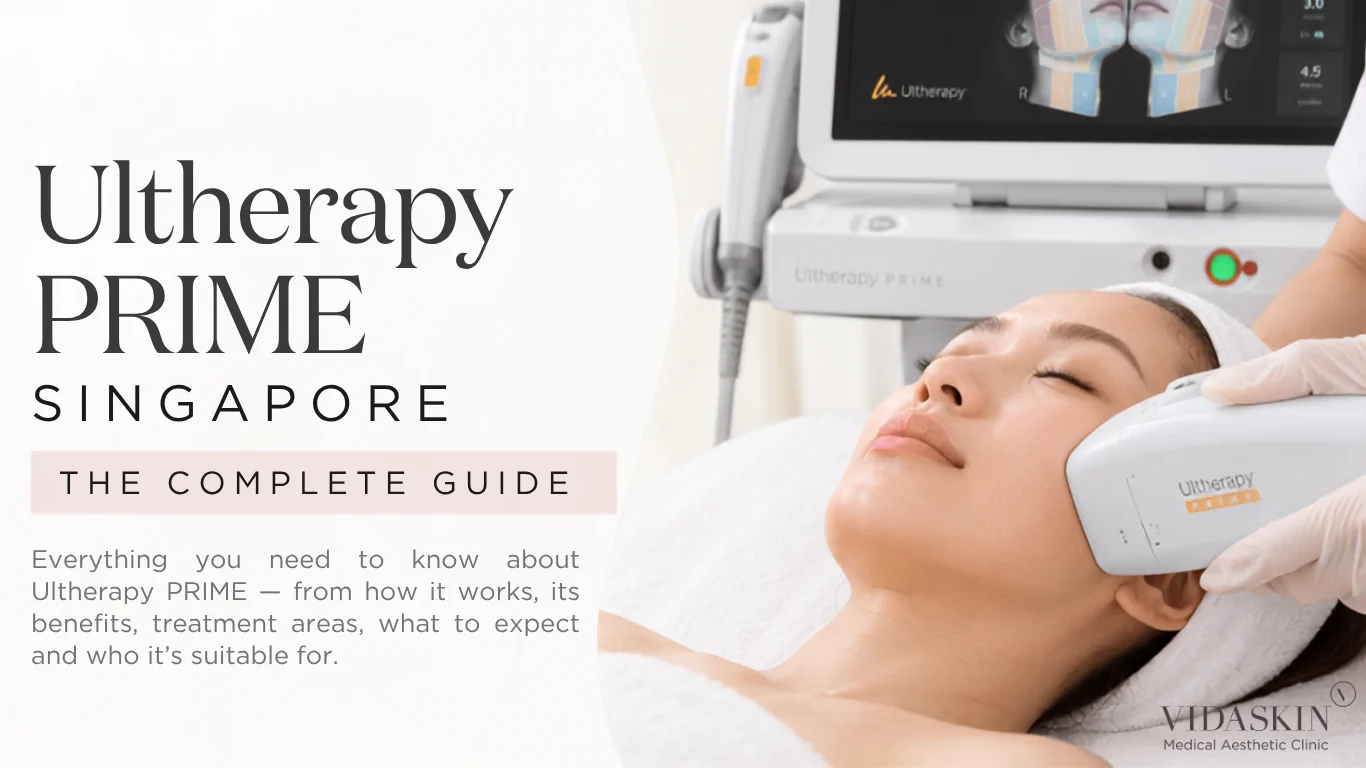
Ultherapy has been around for well over a decade, and most people who ask about it by name have already read that it’s “the non-surgical facelift.” What that shorthand tends to skip over is why it earned that comparison: unlike most energy-based skin treatments, it reaches the SMAS, the same structural layer a surgeon repositions during a facelift, which is what allows it to lift tissue rather than only improve the skin sitting on top of it. This guide walks through what Ultherapy PRIME, the current-generation platform, actually does, how a session is planned and dosed, and what results genuinely look like.
“A lot of patients come in already fairly set on Ultherapy because of the name recognition, without necessarily knowing whether it’s the right match for what’s actually happening on their face,” says Dr Kay Low, senior aesthetic physician at VIDASKIN. “Part of the first consultation is working that out properly, rather than treating everyone who asks for it the same way.”

Ultherapy PRIME uses microfocused ultrasound with visualization (MFU-V) to deliver focused ultrasound energy beneath the skin’s surface, while letting the treating physician view the tissue layers on-screen in real time as it happens. That’s a meaningful difference from most energy devices, which are applied based on average anatomy rather than what’s actually under a given patient’s skin. It’s FDA-cleared for lifting skin on the neck, under the chin, and the eyebrow, and newer clearances have extended the platform to body areas such as the arms, abdomen, and knees, though at VIDASKIN it’s requested almost entirely for the face, jawline, and neck.
The underlying science hasn’t changed; the platform has. Ultherapy PRIME is reported to deliver treatment around 20 percent faster than earlier systems, with a roughly 35 percent larger imaging screen and a faster image refresh rate, alongside general improvements to ergonomics and workflow. For patients, this mostly translates into a physician being able to see and plan around their anatomy more precisely, rather than a change in what the treatment is fundamentally doing.
Every Ultherapy PRIME session follows a structured three-step protocol. In the “see” step, the physician uses the device’s real-time ultrasound imaging to view the skin, fat, and structural layers underneath the treatment area, and to locate structures such as bone and major nerves that the treatment needs to avoid.
That imaging then informs the “plan” step: energy levels and depths are set for that specific patient and area rather than pulled from a generic protocol. Only in the “treat” step is ultrasound energy delivered, at the depths and locations mapped out in the two steps before it. “Being able to actually see the tissue I’m about to treat, rather than working from where I’d expect it to be, changes how I plan a session,” says Dr Kay Low. In practice, this tends to mean more consistent outcomes and less risk of energy being delivered too close to bone or nerve structures.

The deepest of Ultherapy PRIME’s three transducers reaches 4.5mm, which in most facial areas corresponds to the SMAS, the fibrous-muscular layer that also forms the foundation of a surgical facelift. This is the depth doing most of the actual lifting work, since stimulating collagen renewal here helps restore some of the support this layer loses with age.
Two shallower transducers, at 3.0mm and 1.5mm, work within the mid-dermis and more superficial dermal layers. Dr Kay Low generally uses these to support skin quality and finer contouring around a treated area, alongside the SMAS-level work rather than instead of it, since a deep and shallow pass address different parts of the same problem.
How much of each depth to use, and at what energy, is really the whole clinical judgment behind an Ultherapy session. It depends on the area being treated, how much support has actually been lost, and what the physician sees on imaging that day. This is also why the treatment is performed by doctors at VIDASKIN rather than delegated to a therapist: dosing is a case-by-case decision, not a fixed setting.

Each pulse of focused ultrasound creates a small, precise thermal coagulation point at the targeted depth, reaching temperatures of roughly 60 to 70°C. That heat denatures the collagen immediately at each point and sets off the body’s normal wound-healing sequence: macrophages clear the treated tissue and recruit fibroblasts, which lay down new type III collagen that gradually matures into stronger, cross-linked type I collagen over the following weeks. Studies have recorded increases of up to 42 percent in collagen type I and III production in treated skin.
Because this is a biological process rather than an instant mechanical one, don’t expect to see the result on the way out of the clinic. Most patients start noticing a firmer, better-supported jawline from around 8 to 12 weeks post-treatment, with improvement continuing to build for up to 6 months as newly formed collagen matures.
Reported results commonly hold through the first year, with some patients seeing benefit extend into a second year, depending on age, baseline skin condition, and how much correction was needed to begin with. Since the ageing process doesn’t pause after treatment, most patients plan for occasional maintenance rather than treating this as a one-time fix.

The patients who tend to get the most out of Ultherapy PRIME are the ones with an early softening along the jawline, the beginnings of jowling, or looseness under the chin, who’d rather address it with a non-surgical option and are willing to wait a couple of months for results to build rather than see something immediately.
This isn’t the right treatment for every concern, and Dr Kay Low is upfront about that in consultation. If skin simply feels loose or crepey without any real change in facial contour, radiofrequency treatment such as Thermage often suits that better, since it works by heating the dermis broadly rather than lifting one specific layer. If the concern is actually about lost volume, hollow cheeks, or flattened contours, dermal filler or a collagen-stimulating injectable is usually the more direct fix. And for skin that’s genuinely excess or very advanced sagging, no energy-based device, Ultherapy included, is going to do what surgery can. “My job during a consultation is really to work out which of these is actually going on,” says Dr Kay Low, “because Ultherapy gets recommended by name far more often than it’s actually the right answer.”

A session starts with an assessment of the treatment area, goals, and medical history, followed by the imaging step that confirms the area is a good candidate and sets the depths and energy levels to be used.
Ultrasound gel is applied, and the device delivers energy in a series of lines across the treatment area at the planned depths, with the number of lines varying by area. Dosing for the lower face and jawline typically runs to several hundred lines, with fewer needed for a smaller area such as the area under the chin, and the exact count is set individually rather than applied as a fixed package. Patients usually feel brief, momentary heat or a tingling sensation as each point is treated; comfort measures such as oral pain relief are commonly offered, and no incisions, needles or anaesthesia are involved.
There’s typically no downtime. Some patients notice mild redness or tenderness, and occasionally slight swelling or bruising, in the hours or days afterward, but most people go straight back to their day.
At VIDASKIN, Dr Kay Low is an experienced aesthetic physician trained in the See-Plan-Treat protocol, and performs treatment herself rather than delegating it. Her starting point with every patient is working out what’s actually causing the change they’re seeing before recommending Ultherapy at all.
If your main concern is a softening jawline or early jowling, the most useful first step is a consultation with Dr Kay Low to confirm whether Ultherapy PRIME is actually the right fit for what’s going on.
To learn more or book a consultation with Dr Kay Low, visit us or contact us here today.
It’s built for lifting. The SMAS-level treatment is what gives Ultherapy PRIME an actual lifting effect on jowls and a softened jawline, rather than the more general tightening effect you’d get from a treatment that only works on the skin’s surface. Loose or crepey skin without any real change in facial contour is often a better fit for a different modality, such as radiofrequency.
Not exactly. “That’s the most common misconception I see,” says Dr Kay Low at VIDASKIN. “I’ve had patients come in disappointed because a friend got a dramatic lift for their jowls and they were hoping for the same thing for skin that’s just generally lax. It’s a great treatment, but only for what it’s actually built to do.”
Yes, this is one of the concerns it’s most often used for. Jowling typically reflects tissue that has lost support, and treating at the SMAS depth addresses that structural support directly.
It can, where the softening is caused by sagging rather than by volume or width. If your jawline looks less defined because of bulk from the masseter muscle rather than loss of support, that’s a different treatment conversation entirely.
Both are non-surgical and energy-based, but the mechanism differs. Thermage uses radiofrequency to heat the dermis fairly evenly, which works well for overall skin tightening. Ultherapy PRIME’s advantage is depth: reaching the SMAS specifically is what lets it lift tissue rather than only improve how the skin sitting above it feels.
Most patients describe brief, momentary heat or tingling at each treatment point rather than ongoing pain. Comfort levels vary by treatment area and individual pain threshold, and oral pain relief is commonly offered.
The sensation is broadly similar, since the underlying ultrasound energy delivery hasn’t changed. What has improved is the precision of planning, which in Dr Kay Low’s experience can mean fewer unnecessary passes over areas that don’t need treatment.
Many patients see meaningful lifting from a single session, though some with more advanced tissue descent may benefit from a follow-up session. Dr Kay Low assesses this individually during consultation rather than prescribing a fixed number for everyone.
Most patients notice initial improvement in jawline definition and jowl support within 8 to 12 weeks, with results continuing to develop for up to 6 months as new collagen matures.
Clinical data suggests results can last up to a year or more, though this varies with age, how much tissue had descended before treatment, and each patient’s ongoing rate of collagen decline.
As one of the clinics trained in the See-Plan-Treat protocol in Singapore, VIDASKIN has treatments performed by doctors, including Dr Kay Low, rather than by therapists, given how much of the outcome depends on accurate real-time interpretation of the imaging and individualised depth and energy planning.
It’s generally considered safe when performed by a trained physician using the See-Plan-Treat protocol, which allows the treating doctor to visualise and avoid structures such as bone and major nerves before delivering energy. As with any treatment, individual suitability should be assessed during consultation.
Treatment is generally avoided during pregnancy, in areas with active skin infection or severe active acne, and in patients with certain implanted electronic devices in the treatment area. A full medical history is taken before treatment to check for these and other contraindications.
Yes. Dr Kay Low often combines Ultherapy PRIME, for lifting descended tissue, with treatments that address volume, such as dermal filler, or skin quality, such as hyaluronic skin boosters, depending on what a patient’s face actually needs.
Typically none. Some patients have mild redness, tenderness or, less commonly, slight swelling or bruising for a few days, but most return to normal activities the same day.
Yes, because it works through heat delivered at depth rather than targeting pigment in the skin, it’s generally considered suitable across skin types and tones, unlike some laser treatments.
There’s no fixed age; it comes down to how much support has actually been lost rather than a number. Some patients start in their late 30s or early 40s as soon as they notice early jowling; others wait until it’s more established. Dr Kay Low assesses this on the day rather than by a rule of thumb.
Yes, sagging and jowling isn’t unique to women. Dr Kay Low will adjust and personalise her treatment plan for differences in skin thickness, facial anatomy and desired outcomes, but the underlying treatment approach is the same.
Your consultation will cover anything specific to your case. Generally, avoiding excessive sun exposure beforehand and providing a full medical history are the main things that allow treatment to be planned safely.
Yes, meaningfully. Dosing and depth selection are real-time clinical judgment calls, not a fixed setting, so outcomes vary with who’s performing the treatment and how they’re trained. At VIDASKIN, Dr Kay Low is an experienced aesthetic physician trained in the See-Plan-Treat protocol, and performs treatment herself rather than delegating it. Her starting point with every patient is working out what’s actually causing the change they’re seeing before recommending Ultherapy at all.

Dr. Kay Low is a UK-trained medical doctor with over 7 years of clinical experience across the UK and Singapore, specialising in aesthetic medicine. A graduate of the University of Cambridge, she has worked across multiple medical and surgical disciplines in the UK and Singapore before completing postgraduate training in Family Medicine and advanced training in aesthetic medicine.
