- 501 Orchard Road, #04-08 Wheelock Place, Singapore 238880
- (65) 6235 4429
- hello@vidaskinclinic.com
- (65) 9830 0597
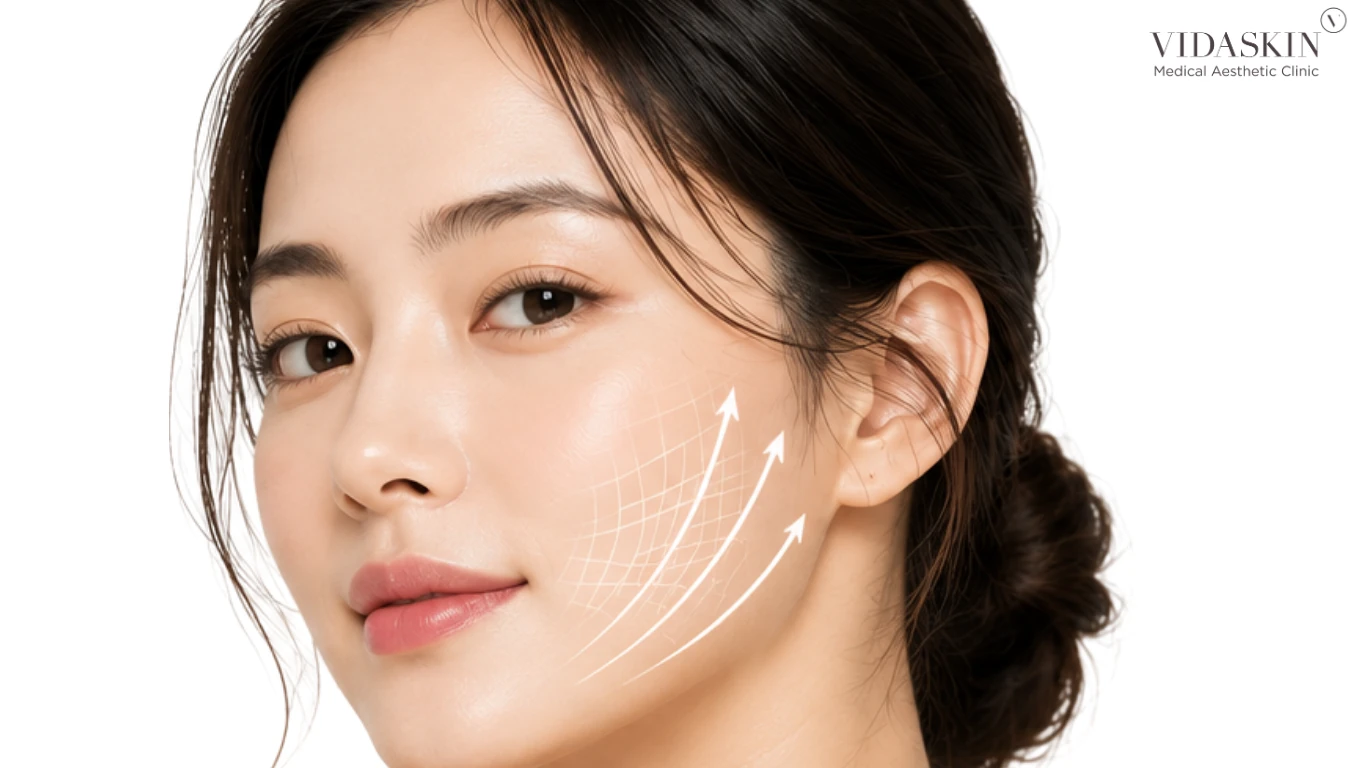
Non-surgical facial rejuvenation rarely relies on a single treatment. Because facial ageing affects several tissue layers at once, from bone and deep fat to the skin itself, an effective non-surgical plan usually sequences more than one modality, each addressing a different depth. Titanium lifting, a multi-wavelength laser treatment that delivers controlled heat energy into the superficial-to-mid dermis, is typically positioned as the layer that refines and firms the skin itself, working alongside deeper-acting and hydrating treatments rather than replacing them.
Facial ageing is now understood as a multi-layered process rather than something that happens only at the skin’s surface. Changes occur within the underlying bone, which gradually loses volume and support; the deep and superficial fat compartments, which shift and, in places, deplete; the retaining ligaments and SMAS layer, which loosen over time; and the dermis and epidermis, where declining collagen and elastin content reduce firmness and elasticity. Dermatological literature places the decline in collagen synthesis at approximately 1 to 1.5 percent per year from around age thirty, with progressive disorganisation of collagen fibres contributing directly to loss of firmness and the deepening of wrinkles.

Because each of these layers changes independently, a treatment that addresses only one of them tends to produce a partial result. Radiofrequency or laser-based skin tightening can improve the dermis and superficial tissue but has limited effect on deeper structures. Ultrasound-based lifting can address deeper support but does not restore lost volume. Dermal filler can restore volume but does not, on its own, improve the quality or elasticity of the skin. Recognising these limits is what leads most non-surgical rejuvenation plans to combine, rather than rely on, a single modality.
Titanium lifting uses a combined multi-wavelength laser, typically layering wavelengths around 755 nm, 810 nm, and 1064 nm, to deliver controlled thermal energy into the superficial-to-mid dermis. This heat causes an immediate, mechanical contraction of existing collagen fibres, followed by a slower phase of fibroblast activation and neocollagenesis. Published research on infrared devices in this wavelength range has documented measurable increases in fibroblast activity and dermal collagen turnover, alongside skin elasticity improvements that continue to build for months after treatment. Because this effect is confined to the skin and immediately underlying tissue, titanium lifting is generally used after, or alongside, treatments that address deeper structural layers, rather than as a way to reposition sagging tissue itself.
The SMAS, a fibromuscular layer beneath the skin, provides much of the face’s structural support and is the common target of Ultherapy, a microfocused ultrasound treatment. A systematic review of microfocused ultrasound describes energy delivered to depths of approximately 1.5 to 4.5 millimetres, reaching focal temperatures of 60 to 70°C that create controlled thermal injury within the dermis and SMAS, producing immediate collagen contraction and ongoing new collagen formation, with reported improvements in skin laxity of roughly 18 to 30 percent in the lower face, neck and periorbital region. Because this depth of penetration is beyond what a dermal-focused laser can reach, clinicians typically address the SMAS layer first with Ultherapy, where structural support is the primary concern, then use titanium lifting to refine the skin itself once deeper support has been addressed, allowing each treatment to contribute the effect it is best suited to.

Heat-based skin tightening depends on a functioning population of fibroblasts to convert thermal stimulation into new collagen. Skin that is significantly dehydrated or has reduced extracellular-matrix support may respond less predictably to this kind of stimulation. Bio-remodelling hyaluronic skin boosters, built on hybrid complexes of high- and low-molecular-weight hyaluronic acid, work through a complementary mechanism: laboratory studies of these hybrid complexes have shown substantial upregulation of fibroblast collagen gene expression, with type I collagen increasing roughly sevenfold and type III collagen roughly twelvefold, alongside a comparable rise in elastin expression, within twenty-four hours of exposure. Pairing this kind of hydration-and-bio-remodelling treatment with titanium lifting is intended to support a healthier dermal environment for the skin to respond to thermal energy.
Elasticity is what allows skin to contract and reorganise in response to thermally induced collagen changes. Skin with better baseline hydration and elastin content is generally more responsive to this process. This is one reason clinicians may recommend a course of skin boosters or bio-remodelling treatment either before or alongside a titanium lifting programme, particularly for patients whose primary concern includes dehydration or reduced skin quality in addition to laxity.

Titanium lifting can support firmer, smoother, more evenly toned skin through a gradual collagen-remodelling process. It cannot reposition sagging tissue, restore lost facial volume, or replace the structural effect of a surgical facelift or SMAS-level procedure. Presented honestly, it is one component of a broader non-surgical rejuvenation plan rather than a solution for advanced structural ageing on its own.
Because the collagen-remodelling response develops over weeks to months, and because collagen continues to decline with age even after treatment, most non-surgical rejuvenation plans include periodic maintenance sessions rather than a single course of treatment. The exact interval depends on the modalities used, the patient’s baseline skin condition and the rate of ongoing ageing change, and is best determined individually by the treating doctor.

Titanium lifting, as part of a broader non-surgical plan, may be appropriate for:

Non-surgical facial rejuvenation works best as a coordinated plan rather than a single treatment chosen in isolation. Understanding which tissue layer is contributing most to a patient’s concerns- structural support, volume, or skin quality- is the starting point for deciding how titanium lifting should be sequenced with other treatments.
At VIDASKIN, titanium lifting is planned alongside a full assessment of facial anatomy, skin quality, and treatment history, so that each layer of ageing is addressed by the modality best suited to it.
To learn more or book a consultation, visit us here today.
Titanium lifting is a non-surgical, multi-wavelength laser treatment that delivers controlled heat into the superficial-to-mid dermis to stimulate collagen contraction and gradual collagen remodelling, supporting firmer, smoother-looking skin.
No. Titanium lifting acts on the skin itself and does not reach the SMAS layer or reposition sagging tissue the way Ultherapy or a surgical facelift can. It is generally used alongside, rather than instead of, these deeper-acting procedures where structural laxity is present.
Many patients benefit from pairing titanium lifting with hydration or bio-remodelling treatment, since a well-hydrated, elastic dermis tends to respond more predictably to heat-based collagen stimulation. Whether this is appropriate depends on individual skin assessment.
Facial ageing typically involves change across bone, deep and superficial fat compartments, the SMAS layer, and the skin itself. A comprehensive plan considers which of these layers is contributing most to a patient’s concerns before selecting and sequencing treatments.
A subtle early firming effect may be noticeable soon after treatment, but the more visible improvement in tone, texture and firmness develops gradually over the following weeks to months as collagen remodelling progresses. Individual timelines vary.

Dr. Kay Low is a UK-trained medical doctor with over 7 years of clinical experience across the UK and Singapore, specialising in aesthetic medicine. A graduate of the University of Cambridge, she has worked across multiple medical and surgical disciplines in the UK and Singapore before completing postgraduate training in Family Medicine and advanced training in aesthetic medicine.
