- 501 Orchard Road, #04-08 Wheelock Place, Singapore 238880
- (65) 6235 4429
- hello@vidaskinclinic.com
- (65) 9830 0597
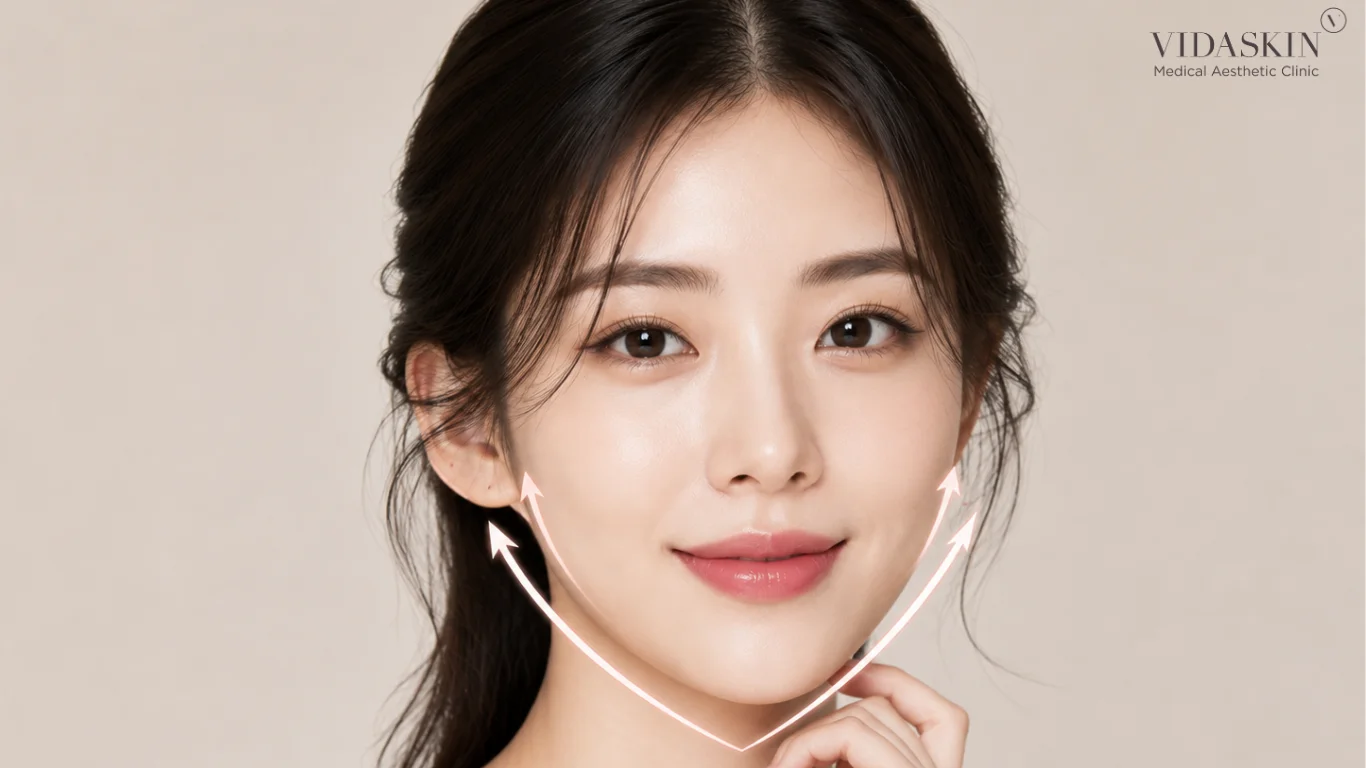
Titanium Lift is a non-invasive, laser-based treatment designed to firm and refine the skin using controlled heat energy delivered from a multi-wavelength laser system. Rather than surgically repositioning tissue or restoring lost volume, it works by heating the dermis to a level that triggers the skin’s own collagen-remodelling response, supporting a gradual, natural-looking improvement in tone, texture and firmness. For patients who are noticing the earliest signs of skin laxity, such as softening along the jawline, cheeks or neck, Titanium Lift offers a way to support skin quality without downtime.
Titanium Lift delivers energy using a combined multi-wavelength laser system, layering wavelengths in the 755 nm, 810 nm, and 1064 nm range within a single pass. Each wavelength interacts with tissue slightly differently: shorter, visible-to-near-infrared wavelengths are absorbed more superficially and are typically associated with improvements in tone and surface clarity, while longer near-infrared wavelengths such as 1064 nm penetrate further into the dermis, where they contribute to a firming effect.
By combining these wavelengths within a single treatment, Titanium Lift is designed to deliver controlled thermal energy across more than one depth of skin at a time, rather than relying on a single fixed penetration point.

The dermis is the layer of skin that contains collagen and elastin fibres, along with the fibroblast cells responsible for producing them. Near-infrared wavelengths in this range are able to penetrate into the dermis while the epidermis is protected with contact cooling. Research on broad-spectrum infrared skin-tightening devices has documented two distinct effects: an immediate, mechanical contraction of existing collagen fibres, followed by a slower biological phase of neocollagenesis, in which fibroblasts are activated to lay down new collagen. In one recent published study of an infrared device in this wavelength range, treated skin showed an approximate 40 percent increase in fibroblast count alongside a significant rise in collagen turnover markers, together with measurable improvements in skin elasticity that continued to build for several months after treatment.
This dual mechanism, immediate fibre contraction plus a slower, cumulative collagen-building response, is why Titanium Lift can produce both a subtle early firming effect and a more visible improvement in skin quality that continues to develop over subsequent weeks.

Titanium Lift works within the skin and the tissue immediately beneath it. It is not designed to reposition deeper structures such as the SMAS, the fibromuscular layer that provides much of the face’s underlying structural support, and it does not restore volume lost from deep fat compartments. Patients with more advanced skin laxity, pronounced jowling, or significant volume loss are more likely to need deeper-acting procedures, such as microfocused ultrasound or dermal filler, either instead of or in combination with a laser-based skin-tightening treatment.
Understanding this distinction matters for setting realistic expectations. Titanium Lift is best suited to refining and firming the skin itself, not to lifting tissue that has already lost significant structural support.
Titanium Lift may be appropriate for patients who want to support skin firmness and quality rather than address structural sagging or volume loss. Common candidate profiles include:
Suitability should always be assessed individually, particularly for patients who are pregnant or breastfeeding, have active skin infection or inflammation in the treatment area, have a history of keloid scarring or abnormal wound healing, or are using photosensitising medication.

Collagen production naturally declines with age. Dermatological literature places this decline at approximately 1 to 1.5 percent per year from around age thirty onwards, alongside progressive disorganisation of collagen fibres and a shift in the ratio of type I to type III collagen, changes that are closely linked to loss of firmness and the deepening of wrinkles.
Because Titanium Lift works by stimulating the skin’s existing fibroblast population to produce new collagen, it tends to be most effective when there is still a reasonably intact dermal architecture to build on. Treating early, before collagen loss and fibre disorganisation become extensive, gives the skin a stronger foundation from which to respond to thermal stimulation.

Many patients begin Titanium Lift in their late twenties to forties, when early laxity is present but the deeper facial structures are still well supported. This does not mean the treatment has no place later in life; it remains useful at later stages, but is typically combined with deeper-acting procedures rather than used as a stand-alone treatment once structural laxity is more advanced. A consultation with your treating doctor can help determine the appropriate stage to begin, based on your skin’s current condition rather than age alone.
Facial ageing does not occur in a single layer. It involves change across several tissue depths at once: resorption of the underlying bone, volume shifts within the deep fat compartments, loosening of the SMAS layer that provides structural definition, descent of the superficial fat pads, and, closest to the surface, thinning and reduced elasticity within the dermis and epidermis. Each of these changes contributes to the overall appearance of ageing in a slightly different way.
Because Titanium Lift acts on the skin’s surface and superficial-to-mid dermis, it is generally positioned as one part of a broader treatment plan rather than a stand-alone solution for advanced ageing. Where deeper support is needed, treatments such as microfocused ultrasound are used to address the SMAS layer, while dermal filler can restore lost volume in deep fat compartments or over bony landmarks. Titanium Lift is then used to refine the skin itself, improving surface tone, texture, and firmness once the deeper structural layers have been addressed. Sequencing treatments this way allows each modality to work within the tissue depth it is best suited to.

Because the results of Titanium Lift build gradually, standardised before-and-after photography, taken under consistent lighting, angles and positioning, is an important tool for objectively assessing change across a treatment course. This allows the clinician and patient to track genuine improvement rather than relying on memory or day-to-day variation in the skin’s appearance.
Skin does not age at a constant rate, and it does not respond to treatment at a constant rate either. Clinicians typically review progress at intervals throughout a treatment course and may adjust the number of sessions, the energy settings or the treatment areas based on how the skin has responded, rather than following a fixed protocol regardless of outcome.
Results from Titanium Lift are generally subtle, cumulative and cosmetic rather than structural. Most patients notice a gradual improvement in skin firmness, tone and texture over the weeks following treatment, with visible change often continuing to develop for one to several months as collagen remodelling progresses.
Patients may notice:
The degree and duration of improvement vary with age, baseline skin laxity, sun exposure, smoking, skincare routine, and whether maintenance sessions are performed. Titanium Lift is not a substitute for surgical facelifting or for deeper structural procedures where these are clinically indicated, and a consultation is important to determine whether it is suitable as a stand-alone treatment or should be sequenced with other modalities.
The right approach to skin tightening is not just about choosing a device. It depends on understanding whether a patient’s primary concern is surface skin quality, deeper structural laxity, volume loss, or a combination of these factors.
At VIDASKIN, Titanium Lift is planned around each patient’s skin condition, facial anatomy, and treatment history, to use controlled thermal energy strategically to support firmer, healthier-looking skin over time.
To learn more or book a consultation, visit us here today.
Titanium Lift is a non-invasive treatment that uses a multi-wavelength laser (commonly combining 755 nm, 810 nm, and 1064 nm) to deliver controlled heat into the superficial-to-mid dermis, supporting collagen contraction and gradual collagen remodelling for firmer, smoother-looking skin.
Titanium Lift primarily targets the dermis. Ultherapy, which uses microfocused ultrasound, reaches deeper, to the SMAS layer, to address structural support, while radiofrequency also acts mainly at the dermal level. Because they act at different depths, these treatments are often used together rather than interchangeably.
A course of several sessions is typically recommended, as collagen remodelling is a cumulative process. The exact number depends on baseline skin condition, treatment area, and individual response, and is best determined during a consultation.
Downtime is minimal for most patients. Mild, transient redness or a warm sensation may occur immediately after treatment and typically settles within a few hours.
Some patients notice an early, subtle firming effect, but the more visible improvement in tone and texture develops gradually over the following weeks to months as collagen remodelling progresses. Individual timelines vary.

Dr. Kay Low is a UK-trained medical doctor with over 7 years of clinical experience across the UK and Singapore, specialising in aesthetic medicine. A graduate of the University of Cambridge, she has worked across multiple medical and surgical disciplines in the UK and Singapore before completing postgraduate training in Family Medicine and advanced training in aesthetic medicine.
