- 501 Orchard Road, #04-08 Wheelock Place, Singapore 238880
- (65) 6235 4429
- hello@vidaskinclinic.com
- (65) 9830 0597

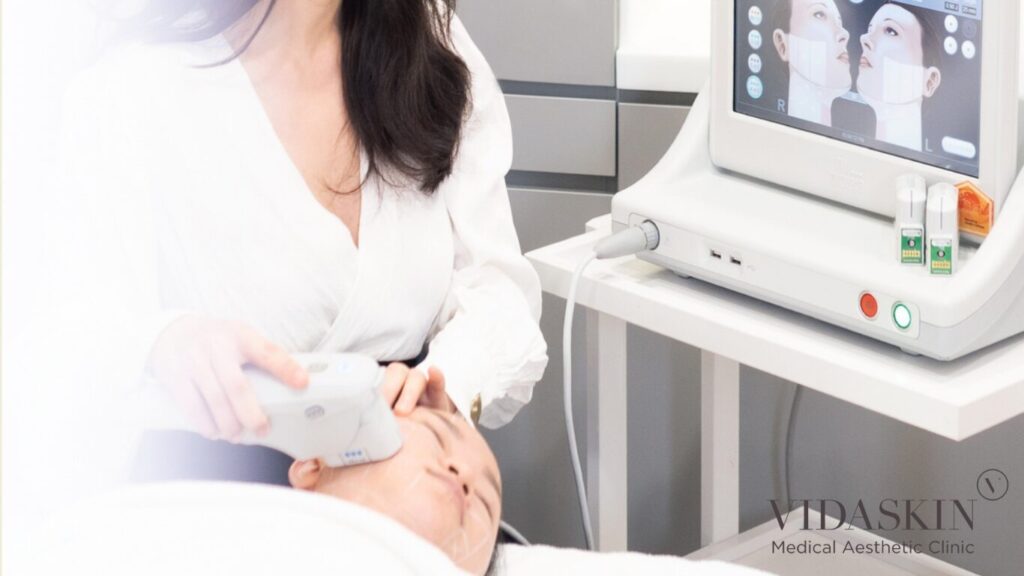
Choosing where to have Ultherapy in Singapore is a decision that carries genuine clinical weight. As a medical-grade procedure that delivers focused ultrasound energy to deep tissue layers, Ultherapy requires a licensed doctor, authentic technology, and a rigorous pre-treatment assessment. With a growing number of clinics offering the treatment — at widely varying price points and standards — knowing how to evaluate your options is essential before committing to a provider.
This guide outlines the five most important criteria to apply when selecting an Ultherapy clinic in Singapore: MOH licensing, authentic certification, mandatory medical consultation, real-time ultrasound visualisation capability, and whether the clinic is doctor-owned and led.
Before evaluating clinics, it helps to understand what Ultherapy actually is — and what it requires in terms of clinical infrastructure and expertise.
Ultherapy is a non-invasive, FDA-cleared procedure that uses micro-focused ultrasound with visualisation (MFU-V) to lift and tighten skin without surgery or injections. It is the only non-surgical treatment FDA-cleared for lifting the brow, chin, and neck, and for reducing lines on the décolletage. Unlike surface-level skin treatments, Ultherapy targets the deeper structural layers of the skin — the same layers addressed during a surgical facelift.
Its appeal lies in its ability to produce a meaningful lifting effect with no incisions, no anaesthesia, and no required recovery time. Results develop gradually over two to three months as the body regenerates collagen in response to the ultrasound energy.
Ultherapy works by delivering precise thermal energy — in the form of focused ultrasound — to specific depths beneath the skin surface. This controlled heat creates micro-coagulation points within the tissue, triggering the body’s natural wound-healing response. The result is the production of new collagen and elastin, which progressively tightens and lifts the treated tissue over the months that follow.
This mechanism — known as neocollagenesis — is what distinguishes Ultherapy from topical treatments or superficial skin procedures. The effect is structural, not cosmetic, targeting the tissue foundation rather than the skin surface.
Ultherapy has long been established for facial and neck rejuvenation, but its indications have expanded significantly. It is now used to address skin laxity and crepey skin texture across the body — making it one of the most versatile non-surgical tightening treatments available today.
Face and neck:
Body:
This expanded body indication represents a significant development in what Ultherapy can achieve. As with facial treatments, the appropriate treatment areas and protocol for body Ultherapy are determined through individual clinical assessment — the same principles of personalised planning, authentic technology, and doctor-led precision apply equally to body treatments.
The quality of your Ultherapy outcome is directly shaped by the clinic you choose. This is not a treatment where provider differences are marginal — in a procedure that delivers focused energy to deep tissue, the stakes of getting it wrong are real.

Ultherapy is classified as an aesthetic medical procedure in Singapore and is subject to oversight by the Ministry of Health (MOH). Clinics offering this treatment must meet specific licensing requirements, and the procedures must be performed by registered medical practitioners. Choosing a non-compliant provider — one without proper licensing or that permits non-doctors to administer the treatment — exposes you to avoidable clinical risk.
The Ultherapy system — manufactured by Merz Aesthetics — is a precise medical device with FDA clearance based on specific clinical evidence. Counterfeit or non-original devices that mimic the Ultherapy system exist in the market and are sometimes marketed using similar terminology. Without access to the genuine device and its authenticated transducers, the treatment parameters are unvalidated, and the safety and efficacy profile of the authentic system does not apply.
Ultherapy outcomes are strongly influenced by the treating doctor’s ability to interpret real-time ultrasound imaging, select appropriate treatment depths, and adapt the protocol to individual anatomy. This requires both formal training and accumulated clinical experience. Clinics where procedures are delegated to non-medical staff, or where doctors have limited Ultherapy experience, are unlikely to achieve consistently accurate results.
A well-selected provider — one that is MOH-licensed, uses authentic technology, requires proper medical consultation, applies real-time visualisation, and is led by a doctor — provides the foundation for predictable, reproducible outcomes. The variability in Ultherapy results that patients sometimes report is most often attributable to suboptimal clinic selection rather than limitations of the technology itself.
In Singapore, the regulatory framework governing aesthetic medicine is designed to protect patients from unqualified providers and substandard clinical environments. Understanding this framework helps you verify that a clinic meets the minimum standards required to offer Ultherapy safely.
The Ministry of Health (MOH) in Singapore regulates aesthetic procedures through a combination of clinic licensing requirements and practitioner registration under the Singapore Medical Council (SMC). Aesthetic clinics offering medical-grade treatments — including Ultherapy — must hold the appropriate MOH licence, and the doctors performing procedures must be registered practitioners in good standing.
MOH also publishes guidelines governing how aesthetic procedures should be offered, including requirements around advertising, consultation, and informed consent. Clinics that operate outside these guidelines — for example, by offering Ultherapy without a prior medical consultation — are not compliant with MOH standards, regardless of their other credentials.
An MOH-licensed clinic has demonstrated that it meets the structural, staffing, and procedural requirements set by the regulatory authority. This includes maintaining appropriate clinical standards, employing qualified medical professionals, and adhering to protocols for patient assessment and consent.
When evaluating a clinic, you can verify its registration through the MOH’s online healthcare institution listing. If a clinic is unable or unwilling to confirm its licensing status, that is a significant warning sign. At VIDASKIN, we operate in full compliance with MOH licensing requirements and Singapore Medical Council guidelines.d give you a programme that actually addresses the condition — not just its surface appearance.
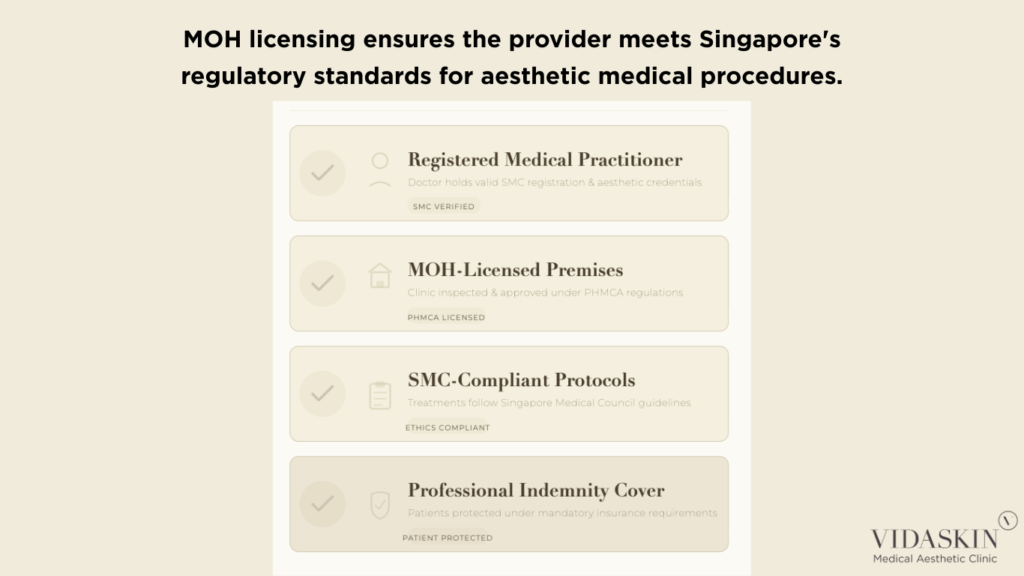
Beyond regulatory licensing, the use of genuine Ultherapy technology is a distinct and equally important criterion. MOH licensing confirms that a provider is legally permitted to offer aesthetic procedures — it does not, by itself, confirm that the Ultherapy system being used is authentic.
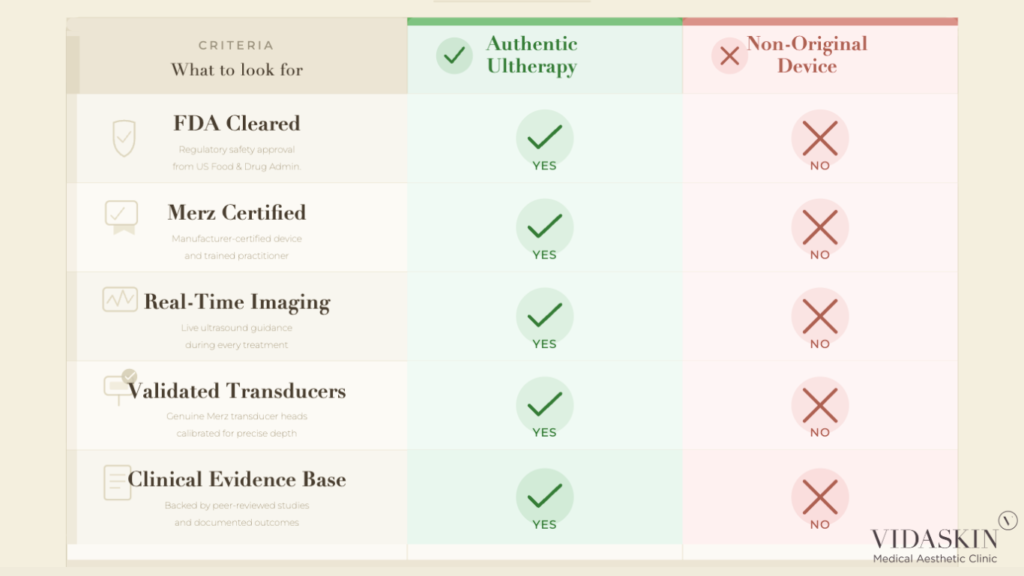
Authentic Ultherapy providers in Singapore are certified partners of Merz Aesthetics, the manufacturer of the Ultherapy system. Certified clinics display official “Authentic Ultherapy” certification, confirming that the device and transducers used are genuine, manufacturer-approved components.
When visiting or researching a clinic, look for this certification — it should be clearly displayed and verifiable. You can also confirm a clinic’s status as an authorised Ultherapy provider directly through Merz Aesthetics. Clinics that use non-original or third-party devices but market the treatment as “Ultherapy” are misrepresenting the procedure. The Ultherapy treatments at VIDASKIN use only authentic, manufacturer-certified technology.
The FDA clearance held by the Ultherapy system is specifically tied to the Ulthera device and its associated transducers. This clearance was granted on the basis of clinical data generated using those specific components — not generic ultrasound technology. Using non-cleared devices under the Ultherapy brand name means the treatment is not supported by the clinical evidence base that makes Ultherapy a trusted procedure.
FDA clearance also implies ongoing post-market surveillance, manufacturer accountability, and quality control standards that do not apply to uncleared devices. These are meaningful safety assurances — not marketing language.
Authentic transducers are calibrated to deliver a precise and consistent energy output at specific tissue depths. They are subject to manufacturer usage limits — each transducer has a finite pulse count after which it must be replaced. These controls exist to ensure that every treatment session delivers energy within the validated therapeutic range.
Non-original transducers do not carry these assurances. Energy delivery may be inconsistent, depth accuracy may be compromised, and there is no manufacturer accountability if something goes wrong. Authentic certification is therefore not simply a quality indicator — it is a patient safety standard.
A compliant and reputable Ultherapy provider will never proceed to treatment without a prior physical consultation with a doctor. This requirement exists for clinical reasons, not administrative ones.
An in-person consultation allows the treating doctor to assess your skin condition, tissue structure, and the degree of laxity in the areas you wish to treat. This assessment cannot be adequately conducted through photographs or online forms. The doctor needs to physically examine the tissue, understand your aesthetic history, and evaluate your suitability for Ultherapy as an individual patient — whether the treatment is for the face, neck, or body.
A provider that offers to book your Ultherapy treatment without requiring a prior consultation is not following appropriate clinical protocols — and is likely not MOH-compliant. Book your personal consultation at VIDASKIN to begin with a proper clinical assessment.
Not every patient is an ideal candidate for Ultherapy. The treatment is most effective for patients with mild to moderate skin laxity — those with significant tissue descent may require a surgical approach to achieve meaningful results. Other factors that influence suitability include skin thickness, the presence of implants or fillers in the treatment area, certain medical conditions, and prior energy-based treatments.
These suitability factors can only be assessed through a proper consultation. Proceeding with Ultherapy in the absence of this assessment increases the risk of an unsatisfactory outcome — and potentially of adverse effects in patients who were not appropriate candidates.
Informed consent is a clinical and ethical requirement for any medical procedure. As part of the consultation, the doctor should discuss the known risks and potential side effects of Ultherapy — including temporary tenderness, swelling, redness, and in rare cases, transient nerve sensitivity in the treated area.
Patients should also be given a realistic expectation of outcomes, including the gradual nature of results and the factors that influence how pronounced the lifting effect will be. A provider that downplays risks or guarantees specific outcomes without proper assessment is not operating within responsible clinical standards. Our team of doctors at VIDASKIN ensures every patient is fully informed before proceeding.
One of the defining clinical features of the Ultherapy system is its integrated real-time ultrasound imaging capability. This is not a standard feature of all ultrasound devices — it is specific to the authentic Ultherapy system and is central to how the treatment achieves its safety and precision profile.
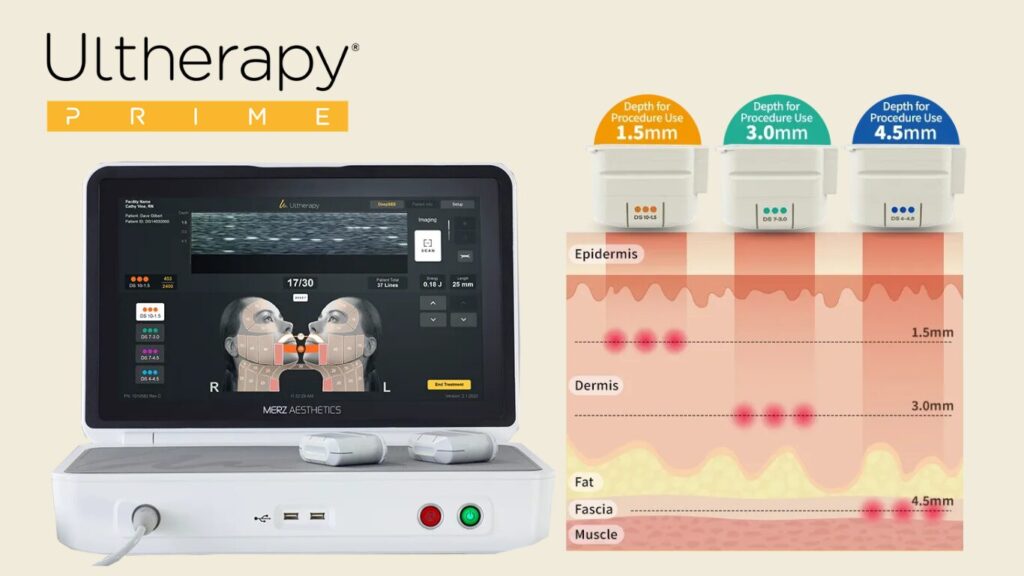
Before and during treatment, the Ultherapy system allows the doctor to visualise the layers of tissue beneath the skin surface on a real-time imaging display. This includes the epidermis, dermis, subcutaneous fat layer, and the SMAS — the deep fibromuscular layer that is the primary target of a lifting treatment.
The imaging allows the doctor to confirm the precise depth of each tissue layer at different anatomical locations across the face, neck, and body, and to position the transducer accordingly. This means treatment parameters are not applied according to a generic protocol — they are adjusted in real time to the patient’s individual anatomy.
The accuracy of energy delivery is what separates a clinically effective Ultherapy session from one that produces minimal results. If the energy is delivered too superficially, it misses the SMAS and produces only superficial collagen stimulation. If delivered too deep, it bypasses the target tissue and risks unnecessary discomfort or adverse effects.
Real-time visualisation eliminates the guesswork from depth targeting. The doctor can confirm — on screen, before each pulse — that the transducer is correctly positioned at the intended tissue depth. This level of precision is only possible with the authentic Ultherapy system; non-original devices that lack this imaging capability require the operator to estimate depth, which introduces a significant margin for error.
The face, neck, and body contain anatomical structures that should not be targeted during an Ultherapy session — including superficial nerves and blood vessels. Real-time imaging allows the treating doctor to identify and avoid these structures, reducing the risk of adverse events.
This capability also allows the doctor to adapt the treatment in areas where tissue anatomy is atypical — for example, in patients with very thin skin, or in body areas where prior treatments have altered the tissue landscape. Explore our non-surgical treatment options at VIDASKIN to learn more about how we approach treatment precision.
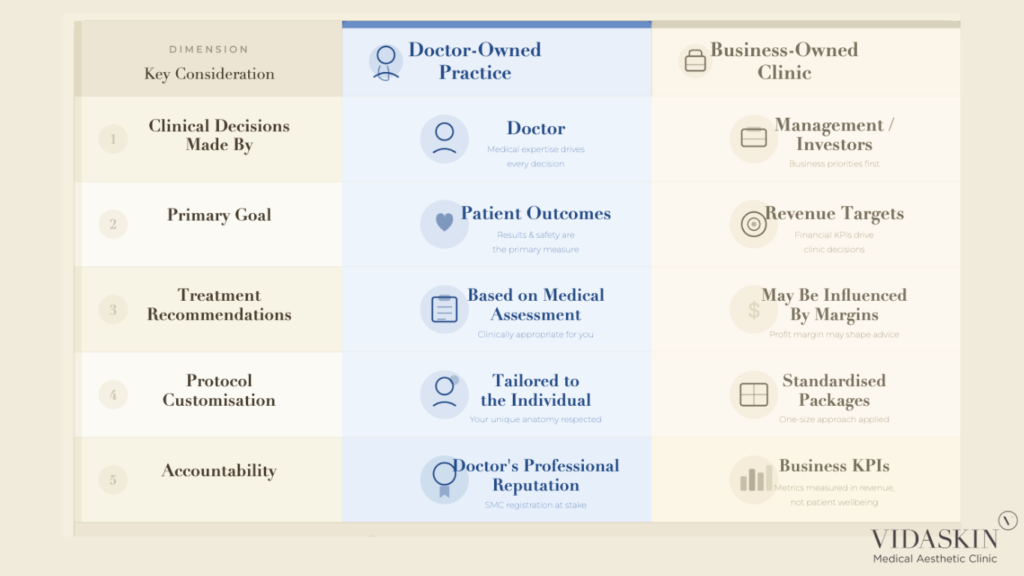
This criterion is rarely discussed openly, but it is one of the most consequential factors in the quality of care you will receive. In Singapore’s aesthetic industry, a significant number of clinics are owned and operated by businesspeople rather than doctors. This distinction — between a doctor-led practice and a commercially driven one — has a direct bearing on the decisions made about your treatment.
In a business-owned aesthetic clinic, the primary stakeholder is the investor or management company, not the doctor. Clinical decisions — including which treatments are recommended, how many lines are prescribed, which devices are purchased, and how aggressively treatments are discounted — are made through a commercial lens. The goal is revenue optimisation, not clinical optimisation.
This model can create structural conflicts of interest that compromise patient outcomes. Doctors in commercially owned clinics may be incentivised to recommend higher-margin treatments over more appropriate ones, to operate within cost constraints that limit line counts or transducer quality, or to see patient volumes that reduce the time available for each assessment. In a procedure as precision-dependent as Ultherapy, these compromises are not trivial.
When a practice is owned and led by a doctor, the basis for every decision changes. The doctor-owner is accountable for outcomes in a way that a business manager is not. Clinical recommendations are made according to medical judgement — not sales targets. The doctor sets the protocols, selects the technology, determines the line counts, and is personally invested in the results because their professional reputation depends on them.
In a doctor-led practice, there is no management layer between the patient and the clinician. The person assessing your skin is the same person who chose the device, trained on it, and will be performing your treatment. This continuity of clinical accountability is difficult to replicate in a corporate or investor-owned model.
When evaluating a provider, it is entirely reasonable to ask whether the practice is doctor-owned and whether the treating doctor has a direct stake in the outcomes. You can also observe indirect signals: Does the doctor conduct the consultation personally, or is this handled by a coordinator or consultant? Is the treatment recommendation tailored to your clinical presentation, or does it feel like a standard package? Is there transparency about what is included in the protocol and why?
At VIDASKIN, the practice is doctor-owned and doctor-led. Every clinical decision — from device selection to treatment protocol — is made by our doctors, based on medical merit. There is no investor agenda, no sales-driven recommendation, and no compromise on the standards we believe every patient deserves.
How do I know if an Ultherapy clinic in Singapore is legitimate?
Look for MOH licensing, which can be verified through the Ministry of Health’s online registry. Confirm the provider holds official Authentic Ultherapy certification from Merz Aesthetics, and verify that a licensed doctor — not a therapist or aesthetician — will be performing the procedure following a physical consultation.
Can non-doctors perform Ultherapy in Singapore?
No. Ultherapy is a medical-grade aesthetic procedure and must be performed by a registered medical practitioner under MOH regulations. Providers where the treatment is administered by non-medical staff are not operating within regulatory compliance, regardless of what the device being used is called.
What is the difference between authentic Ultherapy and other ultrasound treatments?
Authentic Ultherapy uses micro-focused ultrasound with real-time visualisation (MFU-V), delivered via the FDA-cleared Ulthera system with manufacturer-certified transducers. Other ultrasound treatments — including HIFU (High-Intensity Focused Ultrasound) devices from other manufacturers — use different technology and different energy parameters, and do not carry the same clinical evidence base or FDA clearance for skin lifting.
Is a consultation required before Ultherapy?
Yes — and any reputable, MOH-compliant provider will require one. A physical consultation with a doctor is necessary to assess your suitability for the treatment, evaluate your skin condition, determine the appropriate protocol, and obtain your informed consent. Providers that allow you to book a session without a prior consultation are not following proper clinical standards.
Can Ultherapy treat the body as well as the face?
Yes. Ultherapy’s indications now extend beyond the face and neck to include body areas such as the abdomen, thighs, buttocks, above the knees, and other areas affected by skin laxity and crepiness. Body Ultherapy follows the same clinical principles as facial treatment — personalised protocol, authentic technology, and doctor-led precision are equally important for body applications.
What questions should I ask before booking Ultherapy?
Key questions include: Is the provider MOH-licensed? Does it hold Authentic Ultherapy certification from Merz Aesthetics? Will a doctor personally perform the treatment? Is the practice doctor-owned? How many lines are included, and at what depths? Is a pre-treatment consultation required? What is the doctor’s specific experience with Ultherapy for the area I want treated?
How do I know if a clinic is doctor-owned versus business-owned?
Ask directly — a doctor-led practice will have no hesitation confirming this. You can also observe the consultation experience: in a doctor-owned practice, the doctor typically conducts the consultation personally, provides a clinically tailored recommendation, and is transparent about the treatment protocol and rationale. A business-driven environment often relies on coordinators or consultants to manage patient interactions and close bookings.
Book An Ultherapy Consultation With A Trusted Provider
Selecting an Ultherapy provider in Singapore requires more than comparing price lists. The five criteria covered in this guide — MOH licensing, authentic Merz certification, mandatory medical consultation, real-time ultrasound visualisation, and doctor ownership — form the standard for a clinically sound and ethically operated Ultherapy provider.
At VIDASKIN, we meet each of these criteria as a matter of clinical principle. Our doctors are MOH-licensed and registered with the Singapore Medical Council. We use only the authentic, FDA-cleared Ultherapy system with Merz-certified transducers. Every patient undergoes a physical consultation before any treatment is scheduled. Every session is performed with real-time ultrasound imaging. And as a doctor-owned and doctor-led practice, every decision we make is grounded in clinical judgement — not commercial interest.If you are currently comparing providers and would like to experience the difference that doctor-led care makes, book a consultation at VIDASKIN. Our doctors will assess your skin, answer your questions thoroughly, and provide an honest recommendation — whether or not Ultherapy turns out to be the right treatment for you.
