- 501 Orchard Road, #04-08 Wheelock Place, Singapore 238880
- (65) 6235 4429
- hello@vidaskinclinic.com
- (65) 9830 0597


Acne scars are one of the most emotionally significant skin concerns a patient can bring to a consultation. Unlike active acne, which resolves, scars are structural changes to the skin — depressions, fibrous bands, and textural irregularities that persist long after the original breakouts have cleared. For many patients, acne scars have been present for years, have resisted topical treatments, and carry a daily psychological weight that is disproportionate to what others may notice.
The good news is that modern laser technology — particularly fractional laser systems — has fundamentally changed what is achievable in acne scar treatment. Combined with complementary procedures such as subcision and skin boosters, today’s treatment protocols can produce meaningful, lasting improvements in even significant scarring. The important caveat is that not all scars respond to the same treatment, and not all laser protocols are appropriate for every patient.
This article explains how fractional laser technology works, how different scar types determine treatment selection, what recovery looks like, and why combination therapy is often the most effective approach to deep or complex scarring.
To understand why fractional laser is effective for acne scars, it helps to understand both the mechanism of the technology and the biology of how scars form in the first place.
Acne scars develop when inflammatory acne lesions damage the dermis — the deeper layer of skin responsible for structural integrity. The healing process following dermal injury does not always restore the original architecture perfectly. In some cases, collagen is lost in the damaged area, creating a depression or pit. In others, fibrous scar tissue forms beneath the surface, tethering the skin downward and creating a distorted texture. The type of scar that results depends on the depth and nature of the original injury, the patient’s inflammatory response, and genetic factors governing their wound healing.
Laser treatment for acne scars works not by removing the scar, but by triggering the skin to remodel it from within.
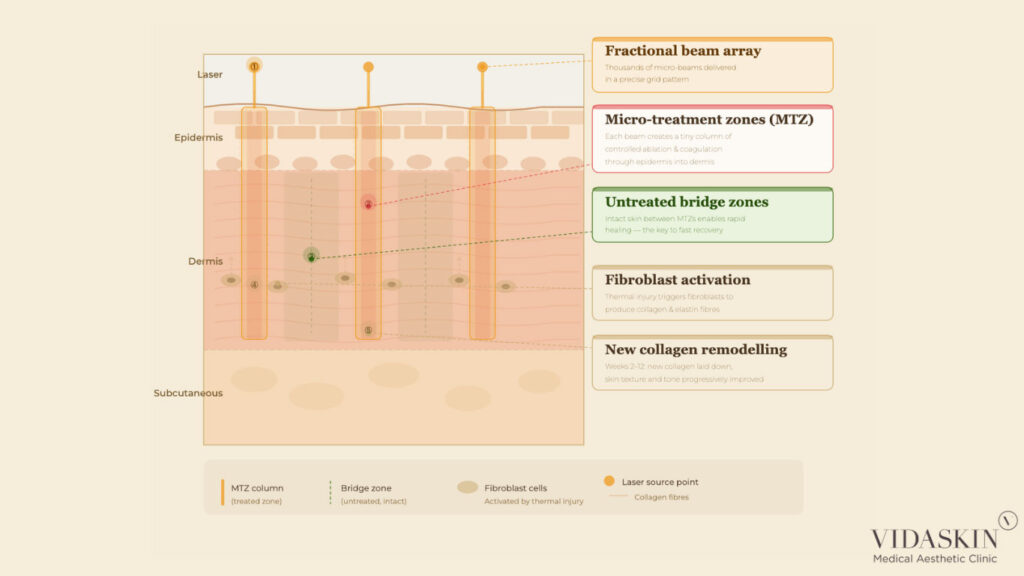
Fractional laser technology works on the principle of fractional photothermolysis — delivering laser energy in a pattern of thousands of microscopic columns, known as microthermal treatment zones (MTZs), separated by untreated skin. Each column of energy creates a controlled micro-injury within the dermis, stimulating a wound-healing response in that localised area.
The word “fractional” describes the fact that only a fraction of the skin surface is treated at any given session — typically between 15% and 40%, depending on the laser and the settings used. The untreated tissue between the MTZs acts as a reservoir of healthy cells that rapidly repopulate the treated zones, accelerating healing and reducing downtime compared to fully ablative laser resurfacing, which treats the entire surface uniformly.
This fractional approach allows the treating doctor to titrate the aggressiveness of treatment — more aggressive settings produce more pronounced remodelling but require longer recovery; more conservative settings allow faster healing and can be applied to a wider range of skin phototypes with a lower risk profile. Our doctors at VIDASKIN tailor fractional laser parameters specifically to each patient’s scar type, skin phototype, and tolerance for downtime — there is no single protocol applied uniformly across all patients.
The micro-injuries created by fractional laser trigger the body’s natural wound-healing cascade. Fibroblasts — the cells responsible for collagen and elastin production — are activated in the treated zones, producing new structural proteins that gradually fill the collagen-deficient areas within depressed scars.
This process is cumulative and progressive. The new collagen produced in response to each treatment session adds to and reinforces the remodelling initiated by previous sessions. Patients typically notice continued improvement for three to six months following each laser session as the collagen maturation process progresses — meaning the full benefit of a treatment session is not visible at the two-week post-treatment review, but rather at the three to six month mark.
Managing this expectation is an important part of the clinical consultation. Patients who understand that collagen remodelling is a gradual biological process — not an immediate cosmetic correction — are better positioned to assess their results accurately and to commit to the multi-session programme that most acne scarring requires.
Within the fractional laser category, there is a clinically significant distinction between ablative and non-ablative platforms — and the choice between them has direct implications for both the aggressiveness of the result and the recovery the patient should expect.
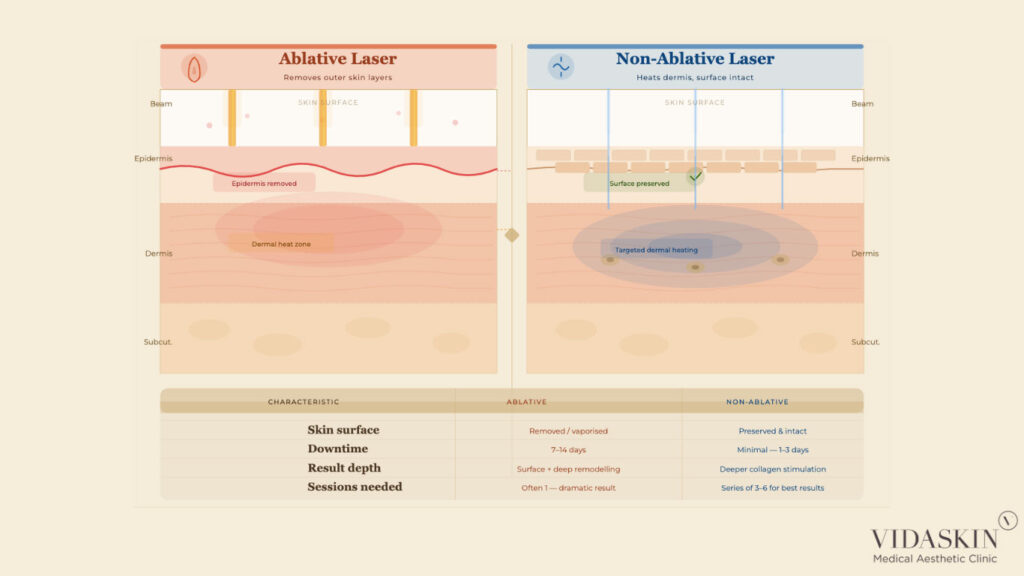
Ablative fractional lasers — most commonly CO2 (carbon dioxide) and Er: YAG (erbium) lasers — vaporise the tissue within each MTZ, removing the surface skin within the treated column entirely. This more aggressive approach produces more pronounced collagen remodelling and is generally more effective for deeper, more established scarring. The trade-off is a more significant recovery period — typically five to ten days of redness, crusting, and social downtime following treatment.
Non-ablative fractional lasers — such as the 1550nm or 1927nm thulium systems — deliver thermal energy into the dermis without vaporising the surface skin. The epidermis remains intact, which means the healing process is faster and the social downtime is considerably reduced — typically two to five days of mild redness and swelling. The limitation is that non-ablative fractional lasers produce less aggressive remodelling per session, and patients with deeper or more severe scarring may require more sessions to achieve comparable results.
Neither ablative nor non-ablative is universally superior — the appropriate choice depends on the scar types being treated, the patient’s skin phototype, their tolerance for downtime, and the doctor’s clinical assessment. In many patients with mixed scarring, a combination of ablative and non-ablative treatments across a multi-session programme produces optimal outcomes. Explore the laser and scar treatments available at VIDASKIN and how they are selected for individual presentations.
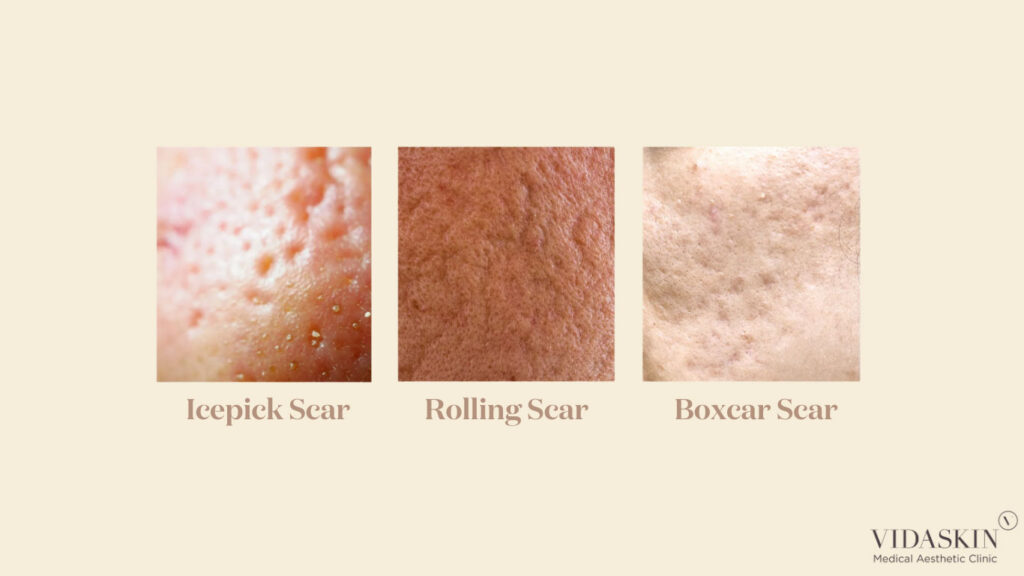
Acne scars are not a single entity — they are a family of distinct structural changes to the skin, each with its own morphology, depth, and response to different treatments. Accurate scar classification is a prerequisite for effective treatment planning.
Boxcar scars are depressed lesions with well-defined, sharp, vertical edges — resembling the shape of a box or crater when viewed from above. They result from the destruction of collagen in a localised area during inflammatory acne, creating a broad, flat base with defined borders. They are most commonly found on the cheeks and temples.
Boxcar scars are among the most responsive to fractional laser treatment because their relatively broad base provides a good surface area for collagen stimulation. Shallow to moderate boxcar scars often respond well to non-ablative fractional laser over a course of sessions; deeper boxcar scars may benefit from ablative fractional resurfacing or a combination approach. In some cases, the sharp edges of deeper boxcar scars benefit from subcision or punch excision techniques to release the fibrous borders before laser treatment is applied.
Rolling scars produce a wave-like, undulating surface texture — the skin appears to roll or ripple rather than presenting as distinct individual depressions. They result from fibrous adhesions that form between the dermis and the subcutaneous tissue beneath it, tethering the surface skin downward unevenly across a broader area.
Rolling scars present a specific clinical challenge: because the primary cause of the depression is a fibrous tether pulling the skin downward from below, laser treatment alone — which works by stimulating collagen above the tether — has limited ability to correct the structural deformity. Rolling scars are the scar type that most consistently benefits from subcision — a procedure in which a needle is used to release the fibrous bands beneath the scar, freeing the skin from its downward tethering. Subcision is typically performed before or in conjunction with laser treatment to address the structural component that laser cannot reach. Book a scar assessment at VIDASKIN to have your scar types accurately classified and a treatment plan designed accordingly.
Icepick scars are narrow, deep, sharply defined puncture-like channels extending from the surface into the deeper dermis or subcutaneous tissue. They are typically the most challenging acne scar type to treat, because their narrow diameter and significant depth make it difficult for surface-applied laser energy to stimulate meaningful remodelling at the base of the scar.
Fractional laser has limited effectiveness as a standalone treatment for true icepick scars. The narrow width of the scar means that relatively little laser energy reaches the deep base where remodelling is needed. More targeted approaches — including punch excision (surgically removing the scar channel and suturing the defect), punch elevation (freeing the scar base and elevating it to the surface level), or TCA (trichloroacetic acid) cross — are often more appropriate for icepick scars and may be combined with laser resurfacing of the surrounding skin. A doctor experienced in scar management will identify icepick scars during the initial assessment and recommend the most appropriate intervention — rather than applying laser treatment to a scar type where it is unlikely to produce meaningful improvement.
One of the most practically important aspects of acne scar laser treatment — and one of the most significant factors in treatment selection — is recovery. Patients considering laser treatment for their scars need accurate, honest information about what the post-treatment period looks like, so they can plan appropriately.
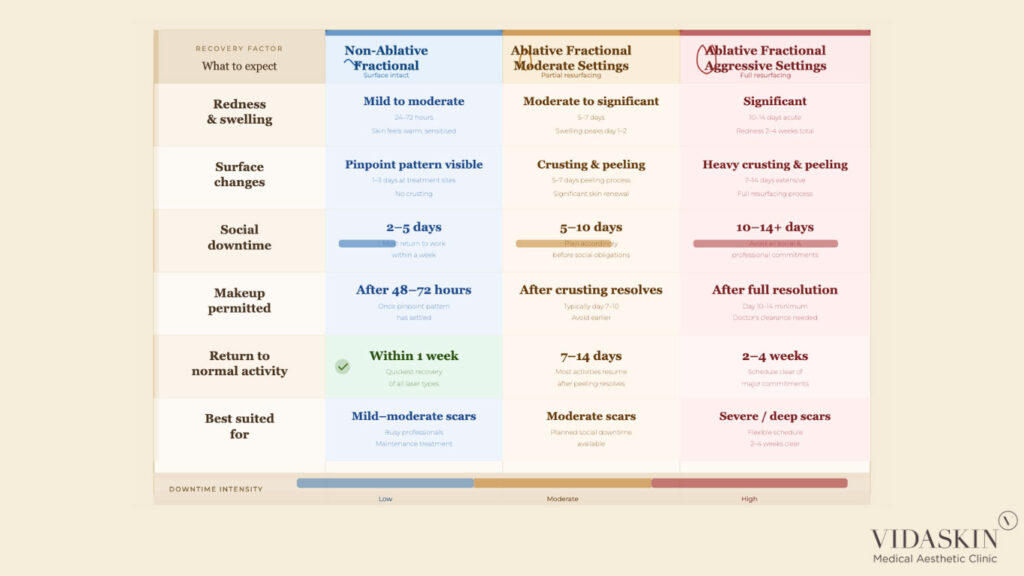
Recovery following fractional laser treatment exists on a spectrum, determined primarily by whether an ablative or non-ablative platform is used and the aggressiveness of the settings applied.
Non-ablative fractional laser: Most patients experience mild to moderate redness and swelling for 24 to 72 hours, with a pinpoint pattern visible at the treatment sites for one to three days. Social downtime is typically two to five days, and most patients return to normal activities within a week. Makeup can generally be applied after 48 to 72 hours. The skin may feel warm and slightly sensitised for several days post-treatment.
Ablative fractional laser (moderate settings): Redness, swelling, and surface crusting are expected over five to seven days. The skin undergoes a more significant peeling and renewal process, and social downtime of five to ten days is realistic for most patients. Makeup should be avoided until the crusting has fully resolved.
Ablative fractional laser (aggressive settings): For deeper, more severe scarring requiring higher-energy treatment, recovery can extend to ten to fourteen days, with significant redness persisting for two to four weeks post-treatment. Patients undergoing aggressive ablative resurfacing should plan their schedules accordingly and should not commit to social or professional obligations in the immediate post-treatment window.
Redness following ablative fractional laser is a predictable and expected part of the healing process — it reflects the inflammatory response and neo-vascularisation associated with active collagen remodelling. In most patients, this resolves progressively over one to two weeks for moderate treatments, though a degree of pinkness may persist for several weeks in patients with lighter skin phototypes or following higher-energy sessions.
Crusting — a superficial scabbing over the treated MTZ columns — is specific to ablative fractional treatments and represents the healing of the tissue within each micro-column. Patients must not pick, scratch, or prematurely remove this crusting, as doing so interrupts the healing process and significantly increases the risk of post-inflammatory hyperpigmentation and scarring. The crusting resolves naturally within five to ten days as the skin heals from below.
Social downtime — the period during which most patients prefer not to appear in professional or social settings due to the visible recovery process — typically aligns with the crusting phase for ablative treatments and the redness phase for non-ablative ones. Patients should plan their treatment timing to accommodate this period, ideally scheduling sessions to allow full resolution before any important commitments.
The following measures promote optimal healing following fractional laser treatment and reduce the risk of complications:
Our doctors at VIDASKIN provide each patient with a personalised post-treatment protocol before every laser session — post-treatment care is discussed in detail at the consultation, not handed over as a generic aftercare sheet at the door.
For patients with moderate to severe acne scarring — particularly those with rolling scars, deep boxcar scars, or a combination of scar types — laser treatment alone is rarely the most effective approach. The most significant outcomes in acne scar treatment are typically achieved through combination protocols that address the multiple structural components of scarring simultaneously.
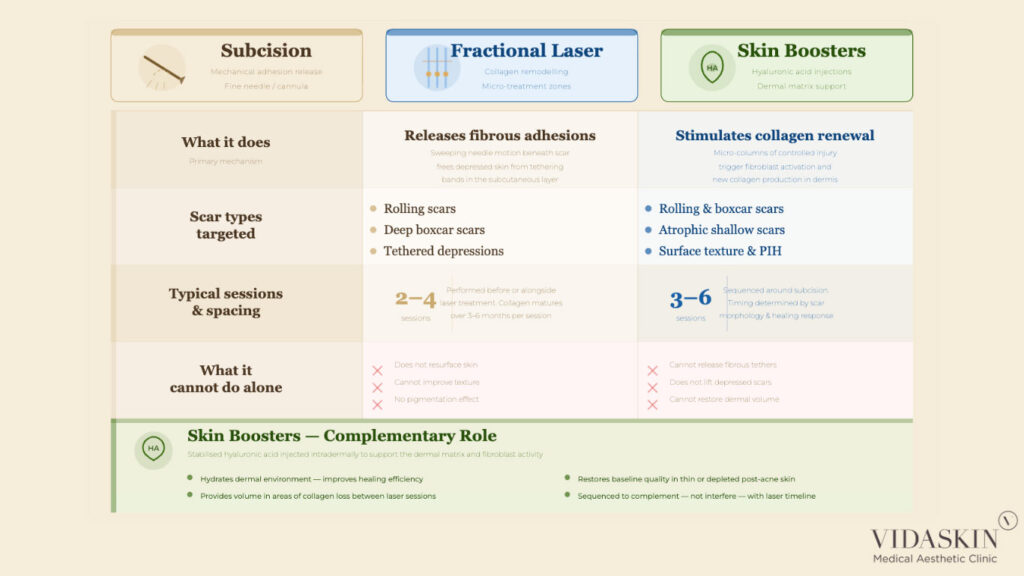
Subcision is a minimally invasive procedure in which a fine needle or cannula is inserted beneath a depressed scar and moved in a sweeping motion to mechanically release the fibrous adhesions tethering the scar to the underlying tissue. As these adhesions are released, the depressed skin is freed to rise toward the surface, and the space created beneath the scar fills with new collagen as part of the wound-healing response.
The combination of subcision and fractional laser is one of the most clinically effective protocols for rolling and deep boxcar scars. Subcision addresses the structural tether — the underlying cause of the depression — while fractional laser stimulates collagen remodelling in the dermis above. Each treatment addresses what the other cannot: subcision does not resurface the skin, and laser does not release fibrous adhesions. Together, they target the problem from both directions.
In many patients, subcision is performed in a series of sessions — typically two to four — before or alongside laser treatment, with the timing and sequencing determined by the treating doctor based on the individual’s scar morphology and healing response. The collagen stimulated by subcision also takes time to mature, and patients typically notice progressive improvement for three to six months following each subcision session.
Skin boosters — intradermal injections of stabilised hyaluronic acid — have an increasingly well-recognised role as a complementary treatment in acne scar management. While their primary application is skin hydration and quality improvement, the effect of intradermal HA on the dermal matrix — supporting the extracellular scaffold and stimulating fibroblast activity — makes them a clinically useful adjunct in patients undergoing laser and subcision treatment for scarring.
In the context of acne scar treatment, skin boosters serve several functions. They improve the overall quality and hydration of the skin in which the scars are embedded — creating a healthier dermal environment for collagen remodelling. They also provide a degree of volume replacement in areas of dermal collagen loss, which can improve the appearance of shallow to moderate depressed scars between laser sessions. And in patients whose skin is thin, dehydrated, or depleted from years of acne-related inflammation, skin boosters help restore the baseline skin quality that makes laser treatment more effective and healing more efficient.
The sequencing of skin boosters within an acne scar programme is determined clinically, typically spaced to allow adequate healing between sessions and optimised to complement rather than interfere with the laser treatment timeline. Explore how VIDASKIN integrates skin boosters, subcision, and laser treatment within a cohesive scar management programme.
For patients whose acne scarring exists alongside broader skin quality concerns — enlarged pores, uneven texture, post-inflammatory hyperpigmentation, or residual redness — the treatment programme can be extended to address these concurrent issues as part of the same overall plan.
Pico laser, delivered in fractional toning mode, is particularly useful for addressing post-inflammatory hyperpigmentation and uneven skin tone that coexist with structural scarring — without the downtime of ablative resurfacing. Combining a Pico toning session with a fractional resurfacing programme allows both the structural scars and the surface pigmentation to be addressed within the same treatment timeline.The principle of comprehensive treatment planning — addressing all relevant components of a patient’s skin concerns within a cohesive, sequenced programme — is central to how VIDASKIN approaches acne scar management. A patient whose scarring has improved structurally but whose skin tone remains uneven has not received a complete result, and a patient whose tone is improved but whose structural scars are unchanged is in the same position. The most satisfying outcomes come from programmes that address all layers of the problem in a coordinated way. Book a comprehensive scar consultation at VIDASKIN to have all aspects of your scarring assessed and a programme designed to address them systematically.
Does laser treatment remove acne scars completely?
Laser treatment can produce significant improvement in acne scars — often reducing their visibility by 50% to 80% or more in well-responding patients — but complete elimination is not a realistic expectation for most types of scarring, particularly deep icepick or established boxcar scars. The goal of treatment is a meaningful, clinically significant improvement that reduces the scars’ visual and textural impact on the skin. Realistic expectations, set during the consultation, are essential to patient satisfaction.
How many laser sessions are needed for acne scars?
Most patients require a minimum of three to six sessions for meaningful improvement, with deeper or more severe scarring often requiring more. Sessions are typically spaced four to six weeks apart to allow adequate healing and collagen maturation between treatments. The total number of sessions is determined by the scar types, severity, and the patient’s individual response to treatment, which is assessed at each follow-up visit.
Which is better for acne scars — ablative or non-ablative laser?
Neither is universally better — the appropriate choice depends on the scar types, their depth and severity, the patient’s skin phototype, and their tolerance for downtime. Ablative fractional laser produces more aggressive remodelling and is generally more effective for deeper scarring, but requires a longer recovery period. Non-ablative fractional laser offers less downtime with a more gradual improvement profile. Many patients with mixed scarring benefit from a combination of both across a treatment programme. A doctor’s assessment is required to determine the most appropriate approach.
Is laser treatment for acne scars safe for Asian skin?
Yes, when performed by an experienced doctor who selects appropriate parameters for the patient’s skin phototype. Asian skin (Fitzpatrick types III to V) is more susceptible to post-inflammatory hyperpigmentation (PIH) following laser treatment than lighter phototypes, which means parameter selection, conservative initial settings, and diligent post-treatment sun protection are especially important. Properly managed, fractional laser is safe and effective for Asian skin.
What is the difference between laser treatment and subcision for acne scars?
Laser treatment works by stimulating collagen remodelling in the dermis through controlled micro-injury — improving scar depth and texture from above. Subcision works by releasing the fibrous adhesions beneath depressed scars — addressing the structural tether that pulls the skin downward. The two treatments are complementary rather than interchangeable, and many patients with rolling or deep boxcar scars benefit most from a combination of both.
Can acne scars be treated while active acne is still present?
Active, inflamed acne should be brought under control before aggressive laser treatment is initiated — applying high-energy fractional laser to actively inflamed skin increases the risk of PIH and worsens the inflammatory environment. Mild residual acne may not preclude treatment in all cases, but a doctor’s assessment of the current state of the skin is required before any laser scar treatment is planned.
How long before I see results from acne scar laser treatment?
Initial improvement may be visible within four to six weeks of the first session as early collagen production begins. However, the most significant results develop progressively over three to six months following each session as collagen matures and remodels. Patients should not assess their final result at the two-week post-treatment review — the full benefit of each session continues to develop for months afterward.
What is the cost of laser treatment for acne scars in Singapore?
The cost of acne scar laser treatment in Singapore varies depending on the laser platform used, the aggressiveness of the treatment, the number of treatment areas, and whether combination procedures such as subcision or skin boosters are included. A meaningful cost estimate can only be provided following a clinical assessment of the scarring — the protocol, and therefore the cost, is specific to each patient’s presentation. At VIDASKIN, full treatment costs are discussed transparently at the consultation, with no hidden fees.
Acne scar treatment is one of the most clinically nuanced areas of aesthetic medicine. The range of scar types, laser platforms, complementary procedures, and sequencing options means that there is no single protocol that works for every patient — and no shortcut to the careful clinical assessment that good scar treatment requires.
At VIDASKIN, our doctors approach every acne scar consultation with a systematic assessment of the scar types present, their depth and severity, the patient’s skin phototype and healing history, and their practical tolerance for downtime and treatment commitment. From this assessment, we design a treatment programme — which may include fractional laser, subcision, skin boosters, Pico toning, or a combination — that addresses the full complexity of the patient’s scarring rather than applying a generic protocol.
As a doctor-owned and doctor-led practice, every recommendation we make is grounded in clinical judgement. We will tell you honestly how much improvement is realistic for your scar types, how many sessions are likely to be required, and what the recovery process will involve — so you can make a genuinely informed decision about your treatment.
If you are ready to address your acne scars with a properly structured, doctor-led programme, book a consultation at VIDASKIN. Our doctors will assess your skin in person, classify your scar types, and design a treatment plan that gives you the best achievable outcome for your specific presentation.