- 501 Orchard Road, #04-08 Wheelock Place, Singapore 238880
- (65) 6235 4429
- hello@vidaskinclinic.com
- (65) 9830 0597

When patients hear about dermal fillers, they usually think about volume, contour, and smoother lines. However, one of the most important factors behind a natural-looking result is filler rheology, which refers to how a filler behaves under pressure, movement, and within facial tissue.
In simple terms, rheology helps explain why one filler may work better in the cheeks, while another may be more suitable for the lips or under-eye area. Choosing the right filler properties for the specific area can enhance support, movement, integration, and safety, which is why rheology plays a crucial role in modern facial aesthetics.

Filler rheology describes the physical behavior of a filler gel, including how firm, flexible, spreadable, or resistant to deformation it is when placed in the face. These properties influence how the filler lifts tissue, integrates into the surrounding structures, and responds to everyday facial movement such as smiling, speaking, and chewing.
Understanding rheology helps doctors select products more precisely rather than treating all fillers as if they are the same. Even when fillers are all made from hyaluronic acid, their manufacturing process, degree of crosslinking, and gel structure can give them very different clinical behavior.
Two commonly discussed rheological terms are G-prime and viscosity. G-prime, or elastic modulus, refers to how well a filler resists deformation and returns to shape, while viscosity refers to how much the gel resists flow.
A filler with a higher G-prime generally offers more structural support and projection, which can be useful in areas such as the cheeks, chin, or jawline. A filler with a lower G-prime or lower viscosity is usually softer and more spreadable, which may be beneficial for delicate or dynamic areas, such as the lips or superficial fine lines.
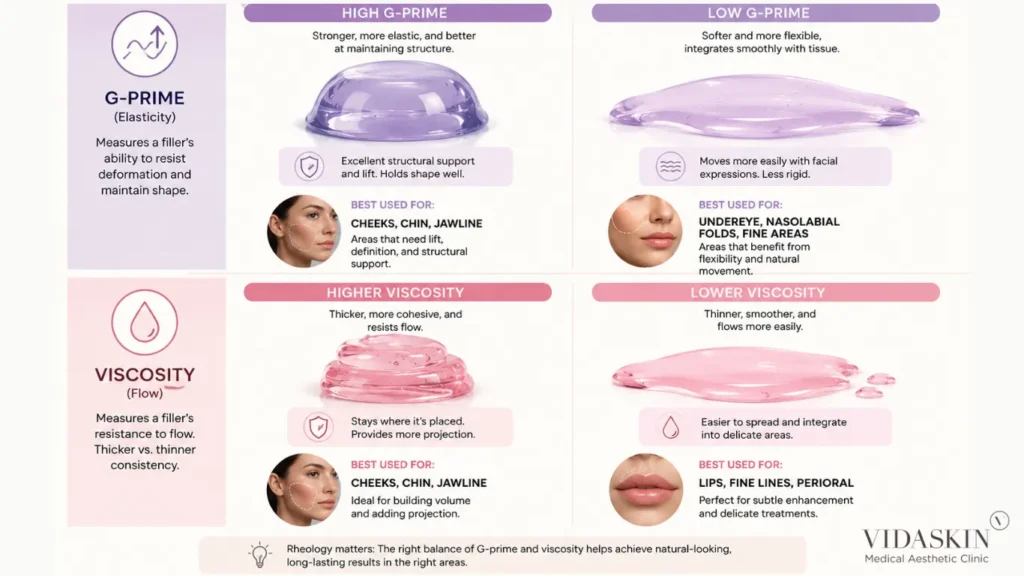
Filler support is not only about how much product is injected. It also depends on the gel’s internal structure, including elasticity, viscosity, and cohesivity, which is the tendency of the gel to hold together rather than disperse too easily.
A firmer, more cohesive filler may maintain projection better in areas exposed to compression and shear forces. In contrast, a softer filler may integrate more smoothly in areas where flexibility and subtle blending are more important than lift.
The face is not static. Every day, it is exposed to repeated motion, pressure, and changes in expression, which means the filler must perform well not only at rest but also during animation.
That is why filler selection matters. Matching rheology to facial anatomy and function helps support more natural-looking results, reduce visibility or lumpiness, and improve the balance between structure and softness.
Once injected, fillers interact with skin, fat, fascia, and retaining structures. Their behavior inside the tissue affects how natural the result looks and how well the filler tolerates movement over time.
Some fillers are designed to hold shape and resist compression, while others are designed to spread more gently and integrate into softer tissues. This is important because not every area of the face benefits from the same level of structure.
For example, highly structural fillers can be useful in deeper planes where support is needed, while softer fillers may suit superficial or delicate zones where visibility must be minimised. Good tissue integration helps the result feel and look more natural rather than stiff or obvious.
The face moves constantly, especially around the mouth, cheeks, and perioral region. Fillers in these areas need to accommodate dynamic facial movement rather than simply hold a rigid shape.
A filler that is too stiff for a highly mobile area may look less natural when the face animates. Selecting a filler with suitable flexibility and spread can help preserve natural expressions while still improving contour or softening folds.
One of the core challenges in filler treatment is balancing support with softness. A product that gives excellent lift may not always be ideal for a delicate area, while a very soft filler may not provide enough support in a structural zone.
This is why filler selection is less about choosing the “best” filler overall and more about choosing the most appropriate filler for a specific indication. In experienced hands, this tailored approach can create results that look refreshed rather than overdone.
Different treatment areas have different anatomical demands. The cheeks, jawline, lips, tear troughs, and nasolabial folds all experience different degrees of pressure, movement, and tissue thickness, so they often need different filler properties.
Product-to-indication matching means selecting a filler based on where it is being placed and what it is expected to do. A doctor may choose one filler for structural lifting, another for contour refinement, and another for soft tissue blending.
This is one reason aesthetic treatment should not be approached as a one-size-fits-all injection. Using the right product in the right layer and area can improve longevity, integration, and overall facial harmony.
Dynamic areas are regions that move often, such as the lips and around the mouth. Static or structural areas include places like the cheekbone, chin, or jawline, where projection and support are often more important.
Dynamic areas usually benefit from softer, more flexible fillers that move naturally with expression. Static areas more often require fillers with stronger resistance to deformation so they can maintain shape under pressure.
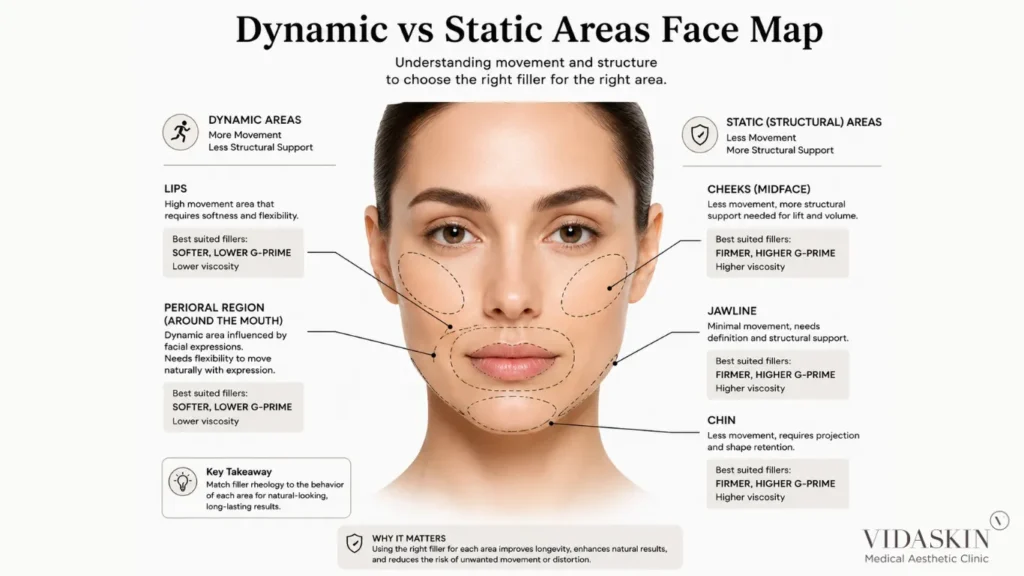
A filler that performs beautifully in the cheek may not be the best choice for the lips, and vice versa. The tissues are different, the movement is different, and the treatment goals are different.
That is why rheology matters clinically. It helps guide decisions so the result suits the anatomy of each region rather than forcing one filler type to perform every role.
Natural-looking filler is not only about adding volume. It is also about preserving expression, maintaining proportion, and respecting the way the face moves in real life.
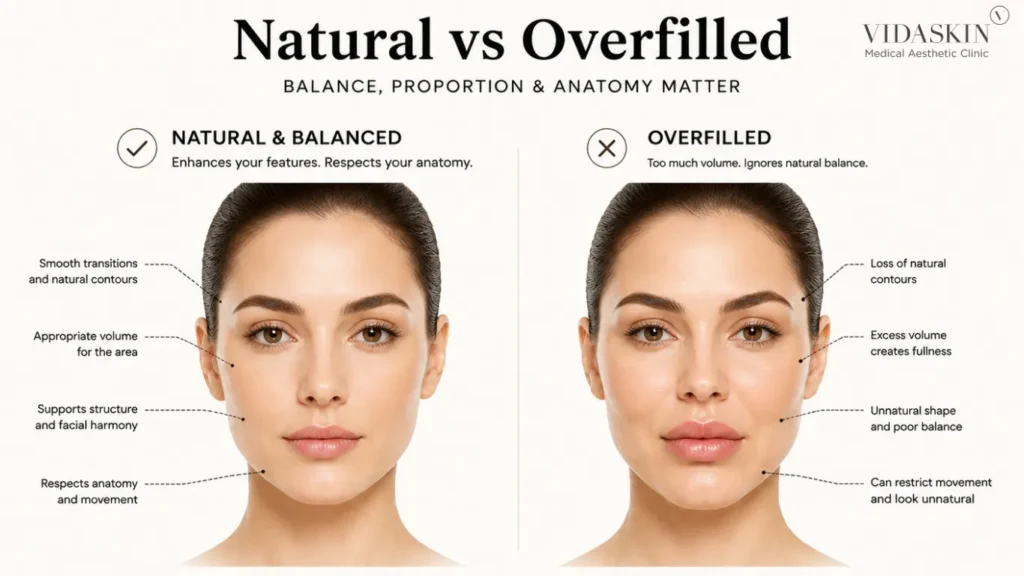
A successful filler result should look balanced when the face is both resting and moving. This means the product must work with the patient’s expressions rather than fight against them.
When filler choice is matched properly to tissue behavior, the face can remain expressive and soft. This is especially important in areas such as the lips, smile lines, and perioral region, where excessive stiffness may be more noticeable.
An overfilled look can happen when too much filler is used, when the wrong filler is chosen for the area, or when facial proportions are not assessed carefully. Good rheologic matching helps reduce the risk of heaviness, visible product or an unnatural contour.
A natural result usually comes from respecting anatomy, selecting the correct product, and avoiding the assumption that more volume always means a better outcome.
Facial anatomy includes not only skin and fat, but also ligaments, muscles, support structures, and patterns of movement. Filler selection should account for all of these factors rather than focusing on a wrinkle or hollow in isolation.
This is why experienced injectors assess the whole face dynamically. The goal is to support facial balance while maintaining harmony during speech, smiling, and normal expression.
One reason hyaluronic acid fillers remain popular is that they are reversible with hyaluronidase, an enzyme that breaks down hyaluronic acid. This reversibility can be helpful in selected situations, including unsatisfactory results, misplaced filler, or urgent vascular complications.

Hyaluronidase is an enzyme that breaks down hyaluronic acid, which is the main substance used in many modern dermal fillers. When injected appropriately, it can dissolve hyaluronic acid filler and help reverse or reduce the treated area.
This is one of the safety advantages of hyaluronic acid fillers compared with some non-HA products. However, dissolving filler still requires medical judgment, anatomical knowledge, and careful assessment.
Filler dissolving may be considered when there is overcorrection, visible lumpiness, poor placement, migration, asymmetry, or when a patient wants a previous result adjusted. It is also used in emergency protocols when vascular compromise is suspected after hyaluronic acid filler treatment.
Not every concern automatically requires dissolving, and in some cases, observation, massage, or a staged correction may be more appropriate. The decision depends on the product used, the area treated, the severity of the issue, and the clinical assessment.
Hyaluronic acid fillers are widely used because they can provide lasting improvement, generally do not require routine allergy testing before treatment, and can be dissolved with hyaluronidase if needed. Even so, safety depends heavily on proper product choice, sterile technique, anatomical knowledge, and prompt recognition of complications.
Patients should understand that reversibility is not a substitute for careful injection technique. The safest approach remains thoughtful planning, precise product selection, and treatment by an experienced medical professional.
At VIDASKIN, filler treatment should be tailored not only to the area being treated but also to how the face moves, how the tissues behave, and what kind of result the patient wants to achieve. Rheology is part of that decision-making process because it helps match the right filler to the right indication for more natural-looking outcomes.
A personalised consultation can help determine whether the priority is structure, contour, softness, flexibility, or reversibility, and whether dermal fillers should be combined with other treatments as part of a broader facial rejuvenation plan.
Learn more about Dermal Fillers
Filler rheology influences how firm, flexible, and supportive a filler is once injected. This affects how naturally it moves with your facial expressions and how well it maintains contour over time.
G-prime reflects a filler’s elastic strength or resistance to deformation. Higher G-prime fillers are often better for support and projection, while lower G-prime fillers may suit softer or more mobile areas.
No. Even hyaluronic acid fillers can differ significantly in elasticity, viscosity, cohesivity, and tissue behavior, which is why different fillers are used for different parts of the face.
Yes. Hyaluronic acid fillers can be dissolved with hyaluronidase, which is one reason they are widely used in aesthetic medicine.
A natural-looking result depends on proper product choice, injection technique, anatomy, and how well the filler’s rheology matches the treatment area and facial movement.