- 501 Orchard Road, #04-08 Wheelock Place, Singapore 238880
- (65) 6235 4429
- hello@vidaskinclinic.com
- (65) 9830 0597

Singapore patients today have more aesthetic options than ever: skin boosters, Baby Glow, fillers, lasers, collagen stimulators, bio-remodelling treatments, and energy-based lifting. The challenge is that many of these treatments are marketed with similar words: glow, collagen, hydration, lifting, rejuvenation, and anti-ageing.
The honest answer is that there is no single “best” treatment for everyone. There is only one treatment that matches your skin concern, facial anatomy, stage of ageing, downtime tolerance, and long-term goals.
This guide explains where Baby Glow by Teoxane fits among skin boosters, fillers, lasers, and collagen-supporting treatments, so you can have a more informed consultation at VIDASKIN Clinic.

Before choosing a treatment, identify what you are trying to improve. Is the skin dry and dull? Is there pigmentation? Are the cheeks hollow? Is the jawline softening? Are the pores and texture the main concern?
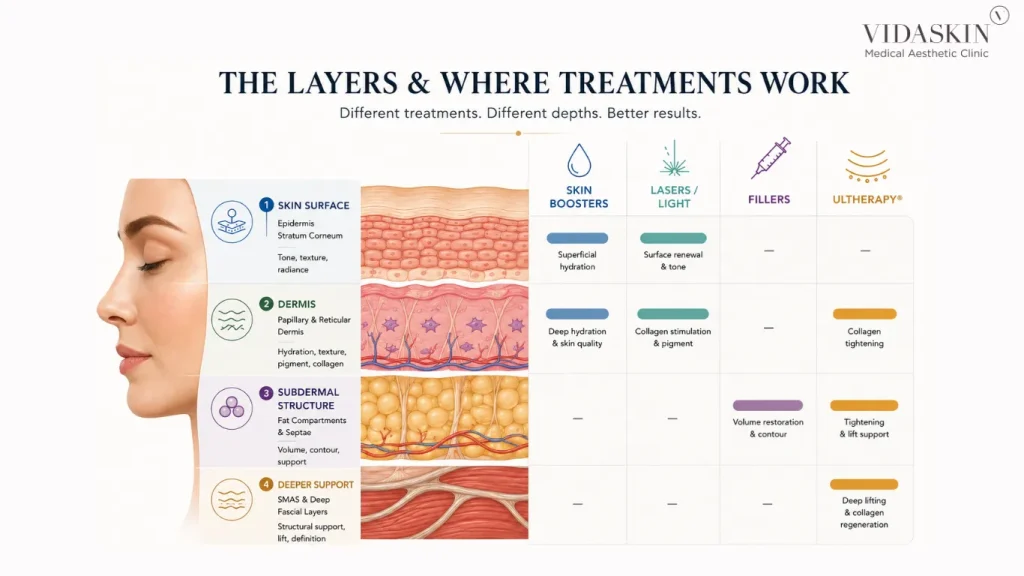
Different concerns come from different layers. Surface pigmentation may require lasers or pigment control. Dehydration may respond to skin boosters. Volume loss may require fillers or biostimulators. Laxity may require collagen-supporting energy treatments.
This is why VIDASKIN uses a layered approach. Treating the wrong layer can lead to disappointment, even if the treatment itself is good.
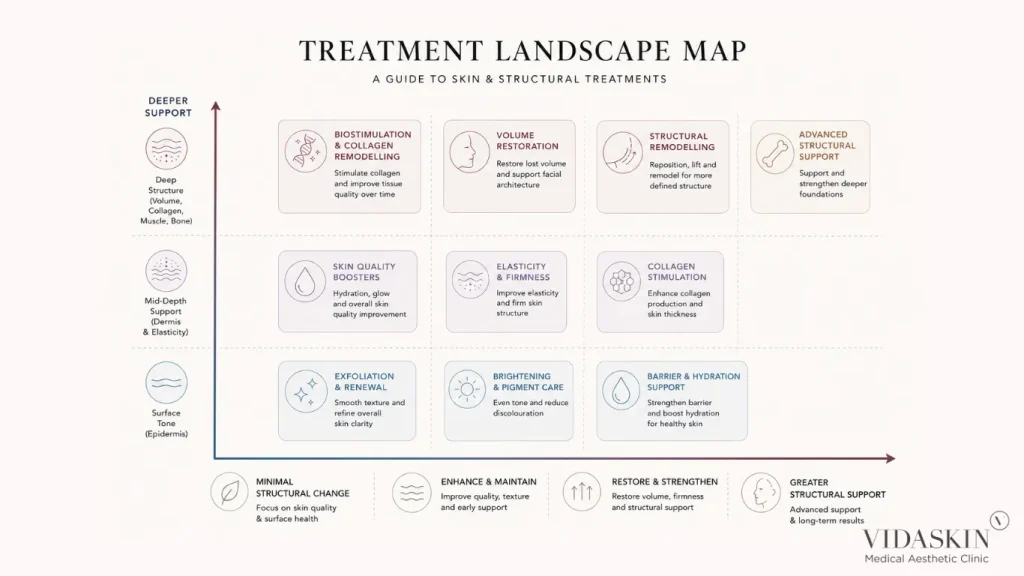
Baby Glow belongs in the skin booster family. Teoxane describes babyGLOW™ as a technique using TEOSYAL Redensity 1, placed through a standardised 8-point injection approach in the immediate subdermal layer to improve skin quality and create a glowing effect (Teoxane babyGLOW introduction).
The product used, TEOSYAL Redensity 1, is a non-crosslinked hyaluronic acid skin quality injectable. Clinical literature describes Redensity 1 as a bioactive HA hydrogel containing non-stabilised hyaluronic acid and 14 bioactive ingredients, including amino acids, antioxidants, minerals, and vitamin components (Pharmaceutics skin density study).
Skin boosters are best suited for concerns such as:
They are less suitable when the main concern is hollowing, sagging, deep folds, or significant pigmentation.
Dermal fillers work differently from skin boosters. They are used to create a smoother or fuller appearance in selected facial areas, such as folds, cheeks, chin, lips, and hands, depending on the approved use and product type (FDA dermal filler safety information).
At VIDASKIN, fillers may be considered when the concern is structural:
Fillers are not automatically “stronger” or “better” than skin boosters. They simply solve a different problem. If your skin is dull but your facial structure is balanced, a filler may not be the first choice. If your skin is hydrated but your mid-face has lost support, a skin booster alone may not be enough.
Lasers are often more appropriate when the primary concern is tone or surface texture rather than hydration. Depending on the laser type, they can target pigmentation, redness, pores, scars, superficial texture, or collagen remodelling.
In Singapore, this matters because many patients struggle with sun exposure, pigmentation tendency, and uneven tone. Sunscreen and photoprotection remain foundational because ultraviolet exposure contributes to photoaging, dyspigmentation, and collagen-related changes (Sunscreens and Photoaging review).
Lasers may be more suitable than Baby Glow when the main concern is:
However, lasers do not replace hydration injectables. A combined plan may sometimes use a laser for tone and texture, then a skin booster for hydration and glow, with appropriate spacing.
Some patients do not need volume, but they are starting to notice laxity or reduced firmness. This is where collagen-supporting treatments may enter the plan.
Energy-based treatments such as microfocused ultrasound are used for non-invasive lifting and collagen remodelling. A systematic review of microfocused ultrasound reported that the technology can create controlled thermal zones in deeper tissue to support collagen remodelling and skin tightening, while avoiding injury to the epidermal surface (Microfocused ultrasound systematic review).
For VIDASKIN, this is where Ultherapy PRIME may be relevant. Ultherapy-type treatments are not skin boosters. They address deeper support and firmness, while Baby Glow focuses more on hydration and visible skin quality.
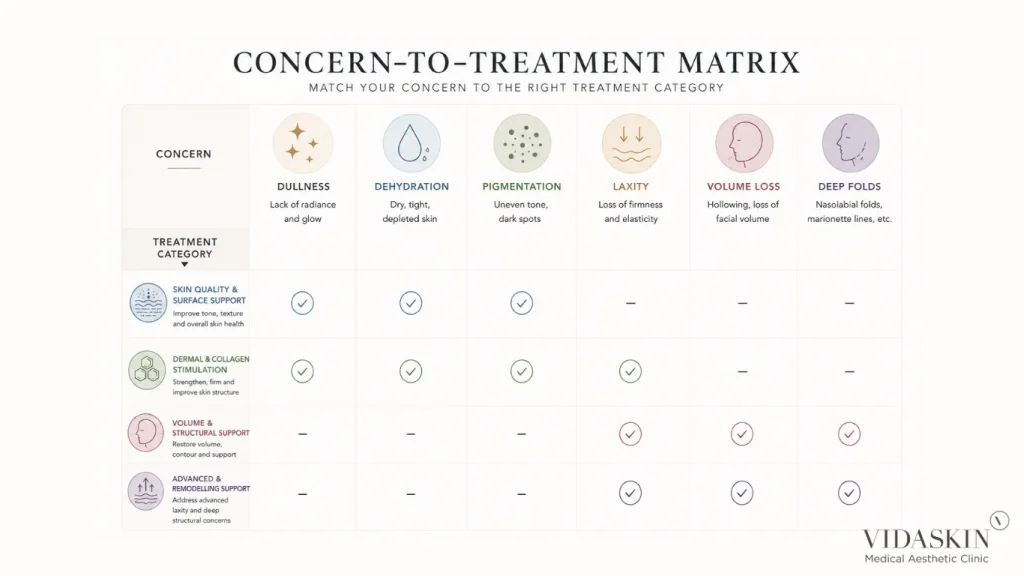
Use this table as a starting point, not a diagnosis.
| Primary concern | Treatment category to discuss | Why it may fit |
| Dull, dehydrated, tired-looking skin | Baby Glow or skin booster | Supports hydration, radiance, and skin quality |
| Fine lines from dryness | Skin booster plus skincare | Improves hydration and smoothness without volume |
| Hollow cheeks or contour loss | Dermal filler or biostimulator | Supports structure and facial proportion |
| Pigmentation or uneven tone | Laser and pigment plan | Targets pigment more directly |
| Mild laxity or jawline softness | Ultherapy PRIME or collagen-supporting treatment | Supports deeper firmness and collagen remodelling |
| Early maintenance in the late 20s to 30s | Skincare, sunscreen, skin booster, selected energy treatment | Preserves skin quality before heavier correction |
| Mixed concerns | Layered doctor-led plan | Treats different layers in the correct sequence |
The key is sequence. For example, if a patient has dullness and pigmentation, a laser-first approach may be better. If a patient has dullness and dehydration but no significant pigmentation or laxity, Baby Glow may be a more direct first step.
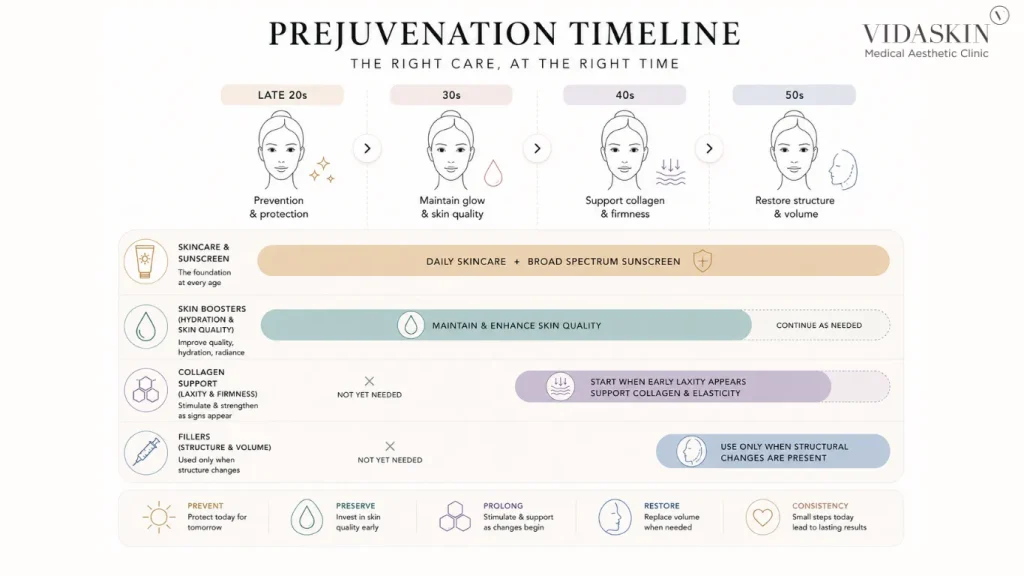
Prejuvenation means early, evidence-based intervention before more obvious signs of ageing require heavier correction. It does not mean doing every treatment early. It means choosing the lightest appropriate treatment for the actual concern.
Baby Glow may fit this philosophy because it is focused on skin quality rather than structural change. Teoxane positions Baby Glow for immediate glow, hydration, and minimal downtime in a soft skin-quality treatment (Teoxane babyGLOW patient page).
For a patient in the late 20s or 30s, Baby Glow may be considered when the main concerns are dehydration, tired-looking skin, rough texture, or early glow loss. For the same patient, filler may be unnecessary if there is no volume deficit, and Ultherapy may be unnecessary if there is no laxity.
This is the VIDASKIN difference: not more treatment, but more precise treatment.
Patients often ask whether one skin booster is “better” than another. A more useful question is: which mechanism best matches your skin?
Different skin-quality injectables may focus on hydration, bio-remodelling, polynucleotide repair, collagen stimulation, or a combination of effects. A broad review of injectable skin boosters notes that the category includes many substances and mechanisms, and that product choice should be guided by indication, delivery method, and evidence quality (Archives of Plastic Surgery review).
Baby Glow with Redensity 1 is best framed as a hydration and radiance-focused option. Other products may be chosen for laxity, repair, collagen stimulation, or more mature skin concerns. This is why a consultation is more useful than choosing based on online trends.
Every injectable treatment carries risk, even when the goal is subtle skin quality improvement. The FDA advises patients to seek licensed healthcare providers who are trained and experienced in dermal filler injection procedures, and it highlights rare but serious risks such as vascular injection, tissue injury, vision abnormalities, or stroke (FDA dermal filler safety information).
In practical terms, safety depends on:
At VIDASKIN, treatment choice starts with an assessment. If your concern does not require Baby Glow, we will say so. If another treatment is more appropriate, we will explain why.
Baby Glow, fillers, lasers, and collagen-supporting treatments are not interchangeable. They solve different problems in different layers of the face and skin.
Baby Glow may be a good discussion point if your main concern is dull, dehydrated, tired-looking skin, and you want a subtle glow without facial volume change. Fillers may be more appropriate for volume loss. Lasers may be better for pigmentation and texture. Ultherapy PRIME or other collagen-supporting treatments may be better for laxity.
The best first step is not choosing a treatment from a menu. It is understanding what your skin actually needs.
Book a Consultation with us today.
This article is for general educational purposes only. It does not replace a consultation with a qualified medical practitioner. Suitability for injectable treatments, lasers, energy-based treatments, or combined aesthetic plans varies by individual. Risks, downtime, treatment intervals, and results vary.
Baby Glow and filler are designed for different concerns. Baby Glow focuses on hydration and skin radiance, while fillers are used for structural volume, contour, and selected folds. The better option depends on your concern.
Baby Glow and lasers work differently. Baby Glow supports hydration and skin quality, while lasers may be more suitable for pigmentation, pores, acne marks, and texture. Some patients may benefit from both in a planned sequence.
It may be suitable for younger patients with dehydrated, dull, or tired-looking skin who want early skin quality maintenance. It is not necessary for everyone, so a doctor-led assessment is important.
Baby Glow should not be positioned as a lifting treatment. It may make skin look fresher and more light-reflective, but laxity or sagging may require collagen-supporting energy treatments or other structural approaches.
These treatments use different formulations and mechanisms. Baby Glow with Redensity 1 is focused on hydration and radiance, while other injectables may focus more on bio-remodelling, repair, or collagen support. Your doctor can recommend based on your skin.
Yes, in suitable patients, but not always in the same session. Skin boosters and fillers address different layers and concerns, so the sequence should be planned by your doctor.
It may be possible in a layered treatment plan. Ultherapy PRIME focuses on collagen support and lifting, while Baby Glow focuses on skin quality and hydration. Your doctor will advise timing.
Natural results come from correct diagnosis, conservative planning, and the right treatment for the right layer. Baby Glow may suit hydration and glow, while other treatments may be needed if the issue is volume, laxity, or pigmentation.