- 501 Orchard Road, #04-08 Wheelock Place, Singapore 238880
- (65) 6235 4429
- hello@vidaskinclinic.com
- (65) 9830 0597

If you have heard the term “Baby Glow” on social media or from aesthetic clinics, you may be wondering whether it is a new filler, a skin booster, or another name for 水光针. The short answer is that Baby Glow by Teoxane is a skin quality approach that uses TEOSYAL® Redensity 1, a hyaluronic-acid-based injectable designed to support skin hydration, radiance, and smoothness.
Unlike treatments that reshape facial contours, Baby Glow is not about making your face look different. It is about helping your skin look fresher, more hydrated, and naturally luminous while keeping your features unchanged.
At VIDASKIN Clinic, we approach treatments like Baby Glow through a doctor-led lens. That means we first assess whether your concern is truly skin quality, hydration, early fine lines, dullness, or whether another treatment would suit you better.

Baby Glow, also written by Teoxane as babyGLOW™, is a treatment technique designed to improve the look of skin quality using TEOSYAL® Redensity 1. Teoxane describes it as a precise 8-point injection approach placed in the immediate subdermal layer to support light reflection, smoothness, and an immediate glowing effect (Teoxane babyGLOW introduction).
The technique is designed to deliver the product in anatomically selected points rather than through many superficial micro-injections. This matters because traditional skin booster injections can sometimes leave temporary small bumps, especially when placed very superficially. Teoxane states that the Baby Glow approach uses the product’s fluidity and subdermal placement to encourage more even diffusion and reduce the risk of visible papules (Teoxane babyGLOW introduction).
For patients, the idea is simple: a faster, more standardised way to improve skin glow and hydration without adding facial volume.
Baby Glow is best understood as a technique using TEOSYAL® Redensity 1, not a completely separate injectable product. TEOSYAL Redensity 1 is a non-crosslinked hyaluronic acid injectable from Teoxane that is used for skin quality improvement rather than structural volumising.
Teoxane’s patient-facing Baby Glow page describes the treatment as using its non-crosslinked high-molecular-weight HA skin booster to brighten the mid-face, soften shadowed areas, and create a naturally light-reflecting glow (Teoxane babyGLOW patient page).
This distinction is important. A product can be established, while a technique can be newer. Redensity 1 has been used internationally for years as a skin quality injectable, while Baby Glow is Teoxane’s newer protocol for how that product is delivered.
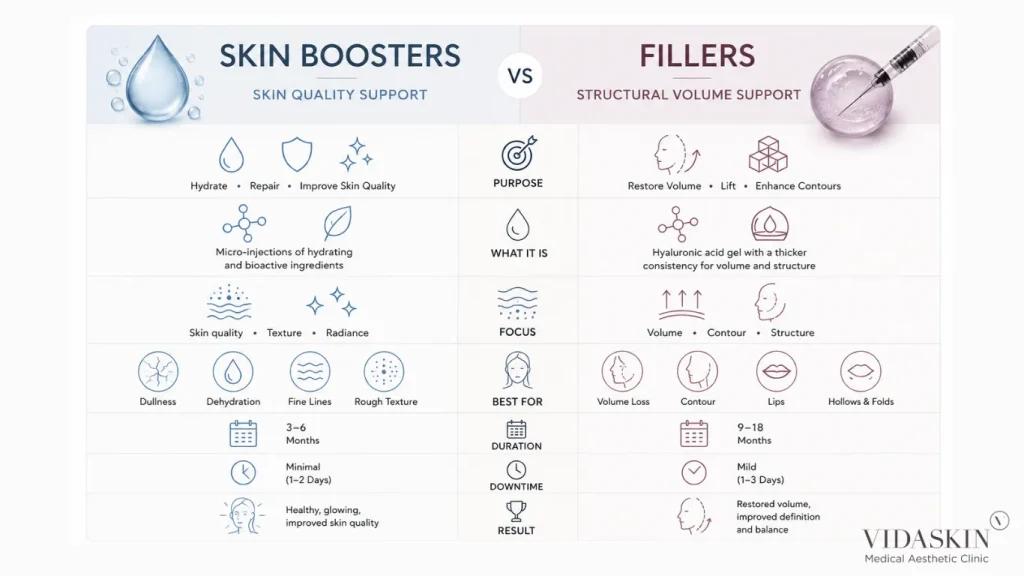
Many patients hear “injectable” and immediately think of fillers. Baby Glow is different from a volumising dermal filler because its goal is not to build cheeks, sharpen the chin, or lift deep folds.
Dermal fillers are medical device implants used to create a smoother or fuller appearance in areas such as folds, cheeks, chin, lips, and hands, and their effect depends on the filler type, injection area, tissue structure, and amount used (FDA dermal filler safety information). Baby Glow is positioned as a skin quality treatment for hydration, luminosity, and texture rather than as a contouring filler.
Think of the difference this way:
| Concern | More likely treatment category | Why |
| Dull, dehydrated, tired-looking skin | Skin booster such as Redensity 1 or Baby Glow | Supports hydration and skin radiance |
| Hollow cheeks or facial volume loss | Dermal filler or collagen stimulator | Restores or supports structure |
| Pigmentation and uneven tone | Laser or pigment-focused plan | Targets pigment and tone more directly |
| Mild laxity or sagging | Energy-based lifting or collagen-supporting treatment | Works on firmness and support layers |
| Early skin maintenance | Skin booster, skincare, sunscreen, and selected treatments | Preserves skin quality over time |
If your concern is “I look tired, but I do not want to change my face,” Baby Glow may be worth discussing. If your concern is “my cheeks have hollowed” or “my jawline has softened,” another approach may be more appropriate.
Baby Glow uses TEOSYAL Redensity 1, which is based on non-crosslinked hyaluronic acid. Hyaluronic acid is naturally present in the skin and is known for its ability to attract and hold water.
Skin boosters are generally used to improve dermal hydration, texture, elasticity, and overall skin quality rather than to replace lost volume. A 2024 review of injectable skin boosters describes hyaluronic acid as one of the most commonly used skin-boosting agents, while also noting that the category includes many different ingredients and that evidence quality varies between products and techniques (Archives of Plastic Surgery review).
Redensity 1 is also described in clinical literature as a bioactive hyaluronic acid hydrogel containing non-stabilised HA and 14 bioactive ingredients, including amino acids, antioxidants, minerals, and vitamin components (Pharmaceutics skin density study). These ingredients are intended to support hydration and skin quality, but the exact outcome still depends on your skin baseline, treatment protocol, technique, and maintenance.
Baby Glow uses TEOSYAL Redensity 1, which is based on non-crosslinked hyaluronic acid. Hyaluronic acid is naturally present in the skin and is known for its ability to attract and hold water.
Skin boosters are generally used to improve dermal hydration, texture, elasticity, and overall skin quality rather than to replace lost volume. A 2024 review of injectable skin boosters describes hyaluronic acid as one of the most commonly used skin-boosting agents, while also noting that the category includes many different ingredients and that evidence quality varies between products and techniques (Archives of Plastic Surgery review).
Redensity 1 is also described in clinical literature as a bioactive hyaluronic acid hydrogel containing non-stabilised HA and 14 bioactive ingredients, including amino acids, antioxidants, minerals, and vitamin components (Pharmaceutics skin density study). These ingredients are intended to support hydration and skin quality, but the exact outcome still depends on your skin baseline, treatment protocol, technique, and maintenance.
Baby Glow may be considered for patients who are noticing skin quality concerns, such as:
Teoxane’s patient page positions Baby Glow for people who want skin to look fresher and more rested, feel less dry or tight, and appear more luminous without looking “done” (Teoxane babyGLOW patient page).
At VIDASKIN, the most important step is still assessment. Some patients need skin boosters. Others may need pigmentation treatment, barrier repair, collagen support, or simply a better skincare and sunscreen plan before injectables are considered.
Baby Glow should be framed as a subtle skin quality treatment, not a dramatic transformation. Teoxane describes the approach as supporting an immediate glowing effect and minimal downtime, while its patient page lists a treatment time of 5 to 10 minutes and longevity of 3 to 6 months, depending on protocol (Teoxane babyGLOW patient page).
Clinical evidence on Redensity 1 supports improvements in skin quality parameters, but results should be discussed in context. A 2025 retrospective controlled study of 20 women treated with cannula-delivered Redensity 1 reported a statistically significant increase in ultrasound-measured skin density at 3 to 4 weeks, high patient satisfaction, minor bruising in 10 percent, transient swelling in 15 percent, and no serious adverse events in that small study (Pharmaceutics skin density study).
This does not mean every patient will see the same degree of improvement. It means that Redensity 1 has encouraging clinical support for skin quality improvement, while the final result depends on suitability, technique, skin condition, and maintenance.
Your consultation should come first. A doctor will assess your skin hydration, texture, facial structure, medical history, lifestyle, previous treatments, and goals before deciding whether Baby Glow is appropriate.
If suitable, treatment usually involves a series of injection points across selected facial areas. Teoxane describes the Baby Glow method as an 8-point approach in the immediate subdermal layer, using TEOSYAL Redensity 1 for even diffusion and a light-reflecting effect (Teoxane babyGLOW introduction).
You may experience mild redness, swelling, tenderness, small injection marks, or bruising after treatment. These are recognised possible effects after injectable procedures, and most mild filler-related side effects, such as swelling and bruising, occur shortly after injection and often resolve within days to weeks (FDA dermal filler safety information).

Traditional skin boosters often use many superficial micro-injections across the treatment area. This can be effective, but it may also create temporary visible bumps or papules depending on the product, layer, technique, and skin.
Baby Glow’s key difference is the standardised injection map and subdermal placement. Teoxane states that the approach is designed for homogeneous product diffusion and reduced papule risk compared with superficial skin-quality treatments (Teoxane babyGLOW introduction).
This does not make it automatically better for everyone. It makes it a specific approach that may suit patients who want a quick, subtle skin-quality treatment with minimal disruption, provided they are medically suitable.
Baby Glow is an injectable treatment, so it must be approached as a medical procedure. The FDA notes that dermal fillers and injectable soft-tissue fillers can cause common side effects such as bruising, redness, swelling, pain, tenderness, itching, and rash, while rare but serious risks include unintentional injection into a blood vessel, tissue injury, vision abnormalities, or stroke (FDA dermal filler safety information).
That is why the product choice is only one part of safety. The injector’s anatomical knowledge, technique, assessment, hygiene, and follow-up processes matter just as much.
VIDASKIN’s approach is doctor-led and suitability-led. We would rather advise that you are not ready for an injectable treatment yet than recommend something that does not match your skin.
Baby Glow by Teoxane is not about changing your face. It is a skin quality treatment concept using TEOSYAL Redensity 1 to support hydration, radiance, smoothness, and a fresher look.
For the right patient, it may be a useful option for dull, dehydrated, tired-looking skin or early skin-quality maintenance. For other concerns such as pigmentation, laxity, deep folds, or volume loss, a different treatment or layered plan may be more suitable.
The best next step is a doctor-led consultation. At VIDASKIN Clinic, we assess your skin first, then recommend only what is appropriate for your concerns, anatomy, and long-term goals.
Book a Baby Glow Consultation today.
This article is for general education and does not replace medical advice. Suitability for Baby Glow, TEOSYAL Redensity 1, skin boosters, fillers, lasers, or other aesthetic treatments must be assessed by a qualified medical practitioner. Results, side effects, downtime, treatment intervals, and maintenance needs vary between individuals.
Baby Glow uses an injectable hyaluronic-acid-based skin booster, but its goal is different from a volumising dermal filler. It is designed to support skin hydration and radiance rather than add structural volume or reshape facial contours.
Baby Glow is a technique that uses TEOSYAL Redensity 1. Redensity 1 is the product, while babyGLOW™ refers to Teoxane’s standardised injection approach for skin quality enhancement.
Some patients may notice a fresher or more luminous look soon after treatment, while skin quality improvement is usually more meaningful over a course of treatments. Your doctor will advise the expected timeline based on your skin and protocol.
Teoxane’s patient-facing material describes longevity as 3 to 6 months depending on the protocol. Actual duration varies depending on your skin condition, age, lifestyle, metabolism, and maintenance plan.
Downtime is usually minimal, but it is not always zero. Redness, swelling, tenderness, injection marks, or bruising can occur after injectable treatments, and your doctor will advise aftercare.
It may suit patients with dull, dehydrated, rough, or tired-looking skin who want subtle radiance without changing facial structure. A consultation is needed to confirm suitability.
No. Skin boosters work best when supported by daily skincare, sunscreen, and healthy skin habits. Injectables should complement a good skin plan, not replace it.
It may be combined with other treatments in a planned sequence, depending on your skin concerns. Your VIDASKIN doctor will advise whether to space treatments apart and which should come first.