- 501 Orchard Road, #04-08 Wheelock Place, Singapore 238880
- (65) 6235 4429
- hello@vidaskinclinic.com
- (65) 9830 0597
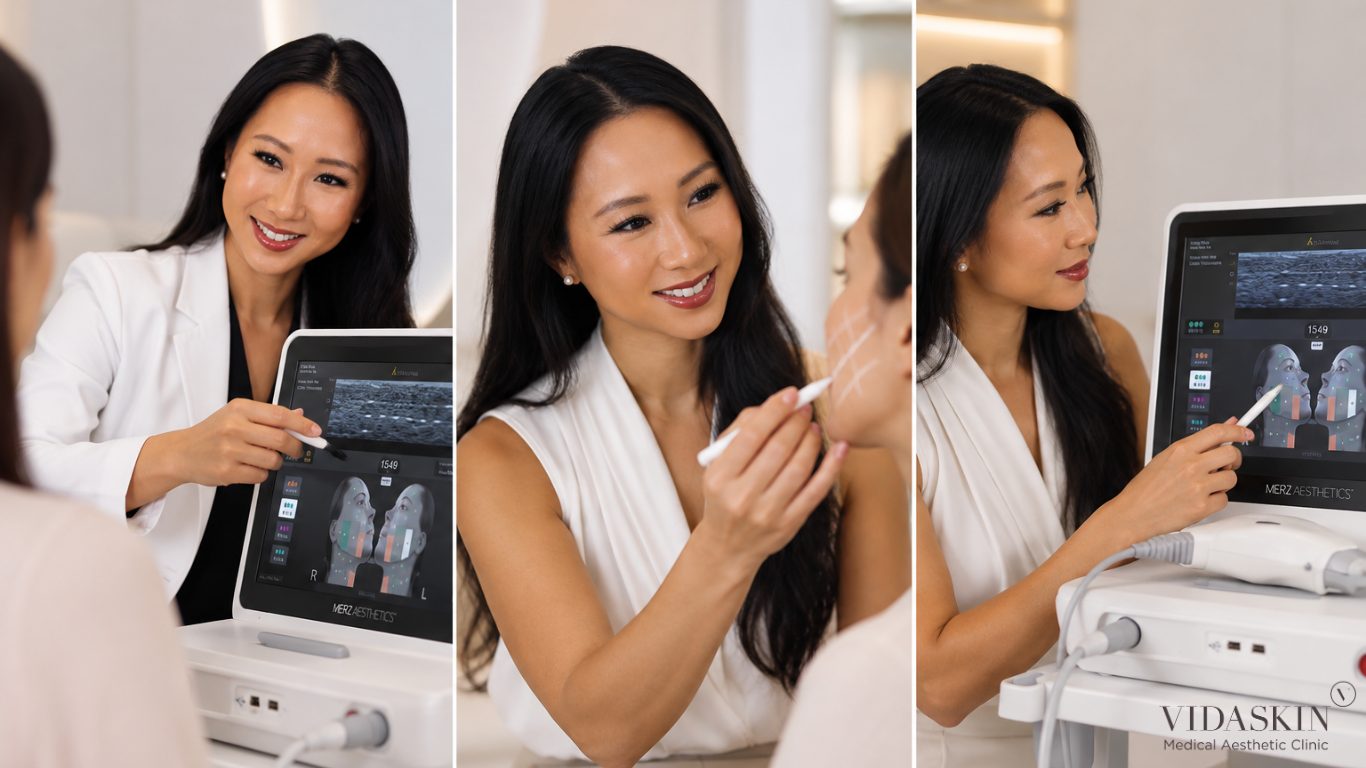
By Dr Kay Low, Senior Aesthetic Physician, VIDASKIN
When patients research Ultherapy, one of the first questions they ask is how many lines they need. It is a good question. “Full face Ultherapy” can describe very different treatments, and the number of lines delivered, and where they are placed, is a large part of what determines the result.
In this guide, I explain what a line actually is, the typical line ranges we use for each treatment zone, why more is not always better, and how your own line count should be decided.
A “line” is a single pass of the Ultherapy transducer across the skin. Each line delivers a short row of tiny thermal coagulation points at a set depth beneath the surface. These are small, precise zones of heat that trigger the body’s natural collagen remodelling over the following months.
Depending on the transducer, lines are delivered at depths of around 1.5 mm, 3.0 mm or 4.5 mm. The deepest lines target the SMAS (superficial musculoaponeurotic system), the fibrous layer that surgeons tighten during a facelift. The shallower lines target the dermis to improve skin firmness and quality.
A genuine Ultherapy system records every line delivered, so the number of lines in your treatment can always be confirmed.
Patients naturally think in areas: “my jawline”, “my eyes”, “full face”. But the same area can be treated with very different numbers of lines, at different depths and in different directions.
Collagen remodelling depends on delivering enough energy to the right tissue. Too few lines spread across a large area may produce little visible change. Lines placed thoughtfully, at the correct depth and along the right lifting vectors, are what make the difference.
The table below shows the typical line counts we use at VIDASKIN. Your own plan depends on your anatomy, skin thickness, degree of laxity and goals, so it may sit above or below these figures.
| Treatment zone | Typical line count | Common depths |
|---|---|---|
| Full face | 800–1,100 | Combination |
| Full face and neck | 1,100–1,400 | Combination |
| Periorbital (around the eyes) | 100-400 | 1.5 mm, 3.0 mm |
| Neck | Around 400 | 3.0 mm, 1.5 mm |
| Décolletage | Around 400 | 3.0 mm, 1.5 mm |
Typical ranges only. Final line counts are set after an in-person assessment and pre-treatment scan.
Imagine two patients who both have “full face Ultherapy”. One receives around 300 lines spread evenly across the face at a single depth. The other receives over 800 lines, planned zone by zone, with depth chosen after scanning each area.
Both treatments carry the same name. They are not the same treatment, and they are unlikely to give the same result.
This is why I encourage patients to think in lines per zone and depth, rather than area names alone. A lower number is not automatically wrong, as some faces need less. However, it should be a clinical decision based on your anatomy.
If a proposed plan seems to include far fewer lines than the ranges above, it is reasonable to ask:
A smaller plan may simply reflect a smaller treatment area or a face that needs less. Asking helps you understand the reasoning.
Before treatment, your doctor uses Ultherapy’s real-time imaging to look at the layers beneath your skin. This can change the plan. A zone may need fewer deep lines because the SMAS sits closer to bone than expected, or more superficial lines. After all, the skin itself is thin and lax.
As an aesthetic doctor with a special interest in early facial ageing, I often find the scan reveals asymmetry patients were unaware of. One side of the jawline may carry more soft tissue than the other, so line counts are adjusted side by side rather than simply mirrored.
Lines are most valuable where there is tissue to remodel and a clear lifting vector. That typically means along the jawline, under the chin, at the lateral brow, and in the lower cheek.
Lines are less valuable over bony prominences, in very thin tissue, or in areas where the concern is volume loss rather than laxity. A careful plan concentrates lines where they will make a visible difference.
More lines do not automatically mean better results. Beyond what a zone needs, additional lines add discomfort without a proportional benefit.
In very slim faces with thin soft tissue, an overly aggressive plan may not be in the patient’s interest. Published evidence on facial fat loss after microfocused ultrasound is limited, and appropriately delivered treatment has not been shown to routinely cause it. Still, conservative planning is sensible where tissue is thin.
Our approach at VIDASKIN is to optimise, not maximise. The right line count is the one that achieves your goal well, delivered where it counts.
Illustrative composites to show how planning differs. These are not real patients.
Face 1: Early 30s, early brow heaviness, good skin quality
The main concern is a slightly heavy lateral brow and tired-looking eyes. Lower-face laxity is minimal. The plan focuses on the brow, forehead, and periorbital area. A full face treatment would not address any additional real concern.
Face 2: Mid-40s, softening jawline, early jowls, fuller lower face
The scan shows a thicker layer of lower-face fat and a deeper SMAS along the jawline. The plan is a full face and neck treatment, with deep lines concentrated along the jawline and under the chin and superficial lines on the neck for skin quality. This is the profile where Ultherapy often performs well.
Face 3: Mid-50s, slim face, more advanced laxity and volume loss
The scan shows thin soft tissue over bone in several zones. Ultherapy alone is unlikely to meet the patient’s expectations. The conversation covers a conservative Ultherapy plan alongside volume restoration, and, honestly, whether a surgical opinion would better match the goals.
In my practice, Face 1 and Face 2 are the most common. Many of my patients are in their thirties and forties and want to address early change gently, before it becomes more established.
At VIDASKIN, a full face treatment typically involves 800 to 1,100 lines, depending on face size, skin thickness, and degree of laxity. Your doctor will confirm the number after scanning.
A full face and neck treatment typically falls within 1,100 to 1,400 lines. Lines are distributed between the face and neck according to where laxity is most significant.
The brow and forehead typically receive around 400 lines. The exact number depends on brow position, skin thickness and whether the upper eyelid area is included.
The periorbital area typically receives around 400 lines, mostly using shallower transducers because the skin is thin and bone lies close beneath.
The submental (under-chin) area typically receives around 200 lines, combining deep and mid-depth lines depending on fat thickness and laxity.
The neck and décolletage each typically receive around 400 lines, with an emphasis on shallower depths to improve skin firmness and crepiness.
It depends on the area. Around 300 lines may suit a targeted zone, but it is generally light for a full face, which typically needs 800 to 1,100 lines. Ask how the lines are distributed by zone.
Not necessarily. Enough lines in the right zones matter. Beyond that, additional lines add discomfort without a proportional benefit, particularly in thin or slim faces.
Yes. A genuine Ultherapy system records the lines delivered. It is reasonable to ask your doctor to show you the line count.
Yes. Targeted treatment of a single area, such as the brow or under the chin, is common and can be very effective when that is where the main concern lies.
Often, yes. Slim faces with thin soft tissue may need fewer deep lines and more careful planning. The pre-treatment scan helps your doctor decide where lines are best placed.
Many patients see meaningful improvement from a single session. Results develop over two to three months, and maintenance sessions are typically considered every 12 to 18 months.
A full face and neck session commonly takes around 60 to 90 minutes. Smaller areas such as the brow or under the chin take less time.
Comfort depends more on the area and depth than on total line count. Lines over bony areas and at deeper depths tend to be more noticeable. Your doctor can discuss pain-relief options with you.
In some cases, this is possible. However, treating all planned zones in one session is usually preferred, as it allows a more balanced result. Discuss this with your doctor.
Both use focused ultrasound, but Ultherapy adds real-time imaging so the doctor can see the tissue layers and adjust depth before each line. Many HIFU devices treat without imaging.
Some patients notice early firmness within weeks. More visible lifting typically develops from two to three months, with continued improvement for some time after.
Downtime is usually minimal. Mild redness, swelling, tenderness or temporary numbness can occur and generally settle within days to a few weeks.
The most useful number in your Ultherapy plan is the line count per zone, and the reasoning behind it.
At VIDASKIN, your Ultherapy PRIME plan is set after an in-person consultation and scan. You’ll leave knowing which zones will be treated, how many lines each receives and why.
Book a line count assessment with Dr Kay Low.
Dr Kay Low is a Senior Aesthetic Physician at VIDASKIN. She graduated in medicine from the University of Cambridge (MA, MB BChir) and is registered to practise in both Singapore and the United Kingdom. Her special interests include early facial ageing in the 30s and 40s, skin quality and women’s skin across life stages.
This article is for general education and does not replace an individual medical consultation. Line counts, suitability and results vary between patients.

Dr. Kay Low is a UK-trained medical doctor with over 7 years of clinical experience across the UK and Singapore, specialising in aesthetic medicine. A graduate of the University of Cambridge, she has worked across multiple medical and surgical disciplines in the UK and Singapore before completing postgraduate training in Family Medicine and advanced training in aesthetic medicine.
