- 501 Orchard Road, #04-08 Wheelock Place, Singapore 238880
- (65) 6235 4429
- hello@vidaskinclinic.com
- (65) 9830 0597
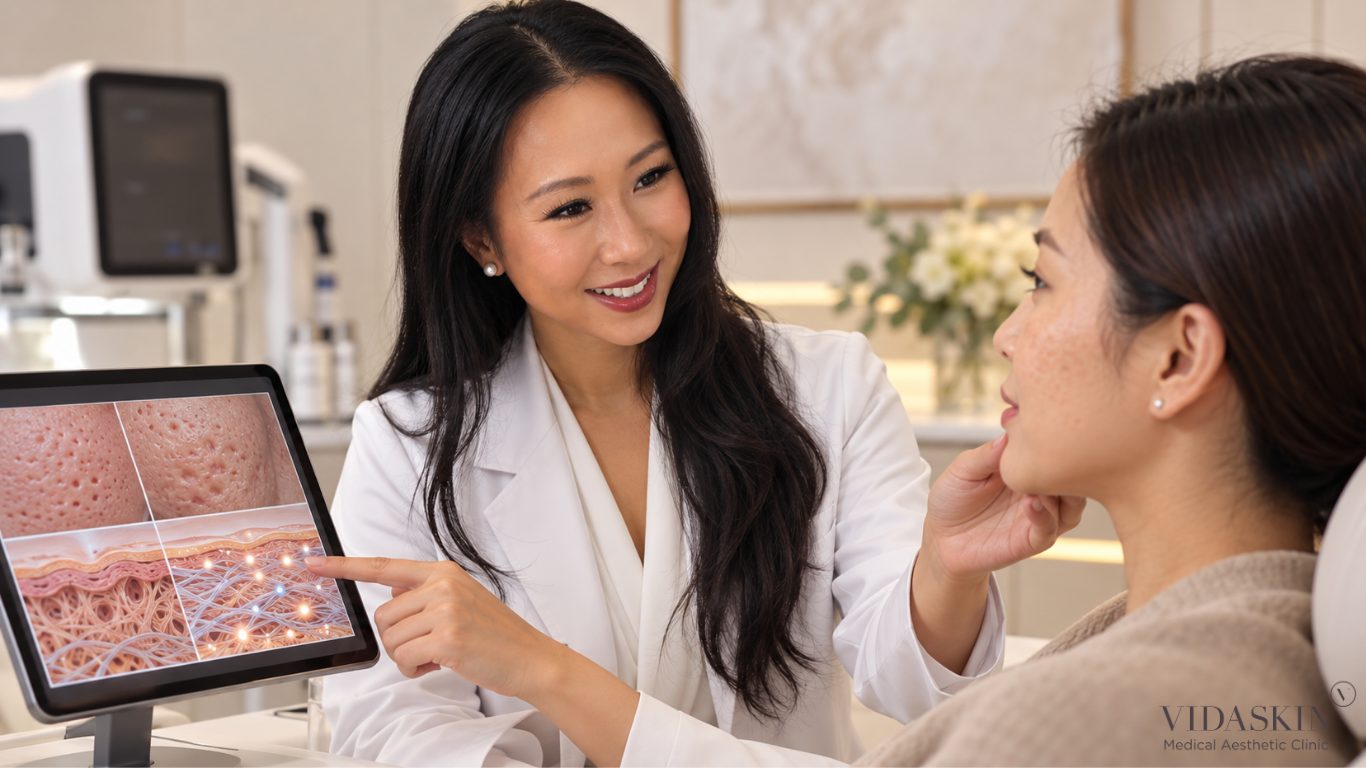
By Dr Kay Low, Senior Aesthetic Physician, VIDASKIN
Enlarged pores, acne scars and uneven texture are among the most common skin concerns in Singapore. They are also among the most frustrating. Skincare can help, but often only so far. Makeup can settle into texture rather than hide it. And many patients have already tried several treatments with limited success.
Collagen-stimulating skin boosters have become a popular option for these concerns. But can they really improve pores and scars, and what can you realistically expect?
As an aesthetic doctor with a special interest in skin boosters, I see many patients with pores, scarring and texture concerns. This article explains why these problems develop, how collagen stimulators may help, what the evidence shows, and why the best results usually come from a combined plan.
At first glance, pores, acne scars and rough texture seem like different problems. Underneath, they share a common factor: the strength and quality of the dermis, the supportive collagen layer beneath the skin surface.
When the dermis is strong and well supported, pores look tighter, the skin surface is smoother and shallow scars are less visible. When collagen is reduced, through age, sun damage or past inflammation, pores look larger, texture becomes uneven and scars become more noticeable.
This is why treatments that rebuild collagen can improve all three.
Pore size is influenced by several factors:
Collagen-stimulating boosters address the third factor. They cannot change genetics or oil production directly, which is why they work best alongside skincare and, in some cases, oil-control treatments.
Acne scars form when inflammation damages the dermis and the healing process does not fully restore it. The main types of depressed acne scars are:
Each type responds differently to treatment. Collagen-stimulating boosters tend to help rolling scars and shallow boxcar scars most. Ice pick scars and deep boxcar scars usually need more targeted procedures.
It is also important to distinguish true scars from post-inflammatory pigmentation or redness, which are common in Asian skin and need different treatments.
Collagen stimulators, or biostimulators, contain microparticles that trigger a controlled tissue response. Fibroblasts are activated and produce new collagen over several months, gradually thickening and strengthening the dermis.
For pores and scars, this means:
The PDLLA Skin Booster uses poly-D,L-lactic acid microparticles. Of the collagen stimulators, PDLLA is the type most commonly used for pores, texture and acne scars. It is placed into the dermis across the treatment area, often over two to three sessions.
CaHA biostimulators and HA–CaHA hybrid injectables are used more for firmness and laxity than for scars, but they can improve overall skin quality and thickness.
Polynucleotide skin boosters are not collagen stimulators in the same way, but they are thought to support tissue repair and reduce inflammation. Scar-specific formulations are available, and they are often combined with collagen stimulators or energy-based treatments for scarring and texture.
The ability of PDLLA and other biostimulators to stimulate collagen is well supported. Evidence specifically for pores and acne scars is more limited. It comes mainly from small clinical studies and case series, many from Asia, which report improvements in scar appearance, pore size and texture.
These results are encouraging and match what many clinicians see in practice. However, studies are generally small and lack long-term follow-up, so results should be considered promising rather than definitive.
In my experience, collagen-stimulating boosters work best as part of a combined plan rather than on their own, particularly for acne scars.
Combining treatments that work at different depths, and spacing them appropriately, gives the most consistent improvement.
Realistic results include:
What collagen stimulators will not do:
Results build gradually, typically becoming noticeable from around six to eight weeks and continuing to improve over three to six months.
A typical plan involves two to three sessions of a collagen-stimulating booster, spaced four to six weeks apart, often alternating or combined with energy-based treatments. Maintenance is usually considered once a year, depending on the response.
Collagen-stimulating boosters may suit you if you have:
They are less suitable if you have active, inflamed acne, which should be treated first, or if your main concern is pigmentation or redness rather than texture.
Collagen-stimulating boosters can make pores look smaller by strengthening the collagen around them. They cannot close pores permanently.
PDLLA Skin Boosters are commonly used for pores and texture. Polynucleotide boosters may also help. The best choice depends on your skin.
They can improve rolling and shallow boxcar scars, particularly as part of a combined plan. Deep ice pick scars usually need targeted procedures.
It is a collagen-stimulating injectable using poly-D,L-lactic acid microparticles, which encourage the skin to produce new collagen over time.
Most patients need two to three sessions of a collagen-stimulating booster, often combined with energy-based treatments over several months.
Results usually become noticeable from around six to eight weeks and continue to improve over three to six months.
Results often last a year or more after a full course. Maintenance treatments help sustain them.
They work differently. Lasers and RF microneedling remodel the upper dermis, while boosters strengthen deeper support. Combining them often gives the best results.
Ice pick scars are narrow and deep, and usually respond better to targeted procedures. Boosters can improve the surrounding skin quality.
Active acne should be treated first, as new inflammation causes new scars. Your doctor will advise when it is appropriate to start.
They do not directly reduce oil production, but they can improve pore appearance and texture. Oil control usually needs skincare or other treatments.
Red or brown acne marks are not true scars and usually respond better to lasers, peels or topical treatments.
Most patients have mild swelling, redness or small bumps for a few days. Downtime increases if combined with lasers or RF microneedling.
Most patients experience mild discomfort. Numbing cream is applied beforehand, and the treatment is usually well tolerated.
Scar-specific polynucleotide formulations are used to support tissue repair and are often combined with other scar treatments.
Yes. Because they are injected beneath the surface, they carry a low risk of pigmentation. Combined treatments should be planned carefully for darker skin types.
Daily sunscreen, a retinoid, gentle exfoliation and non-comedogenic moisturisers are a good foundation. Your doctor can tailor this.
Pores, scars and texture improve gradually, and the best results come from understanding exactly what is driving each concern and treating it at the right depth.
To discuss a plan for pores, acne scars or texture, book a consultation with Dr Kay Low.
Dr Kay Low is a Senior Aesthetic Physician at VIDASKIN with a special interest in skin boosters and skin quality. She graduated in medicine from the University of Cambridge (MA, MB BChir) and is registered to practise in both Singapore and the United Kingdom. Her clinical interests include adult acne, early facial ageing in the 30s and 40s, and women’s skin across life stages.
This article is for general education and does not replace an individual medical consultation. Suitability and results vary between patients.

Dr. Kay Low is a UK-trained medical doctor with over 7 years of clinical experience across the UK and Singapore, specialising in aesthetic medicine. A graduate of the University of Cambridge, she has worked across multiple medical and surgical disciplines in the UK and Singapore before completing postgraduate training in Family Medicine and advanced training in aesthetic medicine.
