- 501 Orchard Road, #04-08 Wheelock Place, Singapore 238880
- (65) 6235 4429
- hello@vidaskinclinic.com
- (65) 9830 0597

In Singapore’s fast-moving aesthetic market, more patients are asking a different question: not “How do I reverse ageing?” but “How do I care for my skin before visible ageing becomes harder to manage?” This is where aesthetic prejuvenation in Singapore is gaining relevance.
Prejuvenation is the philosophy of early, measured, evidence-based intervention. Instead of waiting until skin laxity, deep lines, volume loss, or pigmentation become more established, prejuvenation focuses on protecting skin quality, supporting collagen, maintaining hydration, and preserving natural facial balance over time.
At VIDASKIN Clinic, prejuvenation is not about doing more treatments earlier. It is about doing the right things at the right time, in the right layers, so that the skin can age more gracefully and naturally.

Prejuvenation combines the ideas of prevention and rejuvenation. It refers to aesthetic care that starts before more advanced signs of ageing appear, intending to maintain skin health, collagen support, and facial harmony.
This can include a combination of daily photoprotection, medical-grade skincare, energy-based collagen treatments, skin boosters, subtle injectable support, and maintenance procedures. The plan is usually personalised, because early ageing does not look the same for everyone.
For one person, the first concern may be dullness, dehydration, and early fine lines. For another, it may be jawline softness, under-eye hollowing, or uneven skin tone. A prejuvenation plan looks at these changes early and addresses the underlying layers, not just the surface appearance.
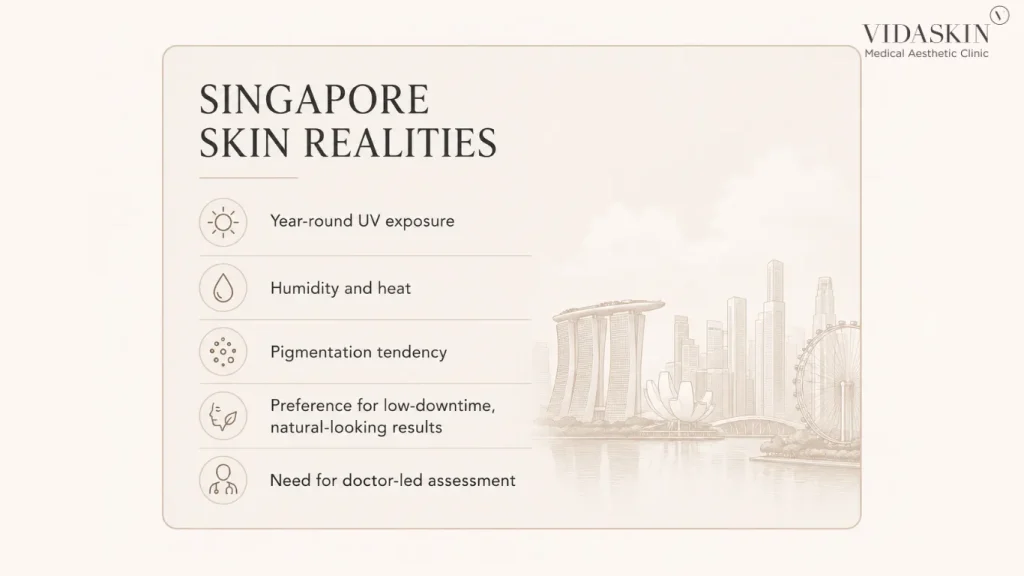
Singapore’s climate makes preventative skin care especially relevant. Year-round ultraviolet exposure, heat, humidity, urban stress, and lifestyle factors can contribute to pigmentation, dehydration, collagen breakdown, and uneven texture. A review in the American Journal of Clinical Dermatology notes that daily photoprotection plays an important role in preventing photoaging, dyspigmentation, and collagen-related skin changes: Sunscreens and Photoaging: A Review of Current Literature.
At the same time, aesthetic preferences in Singapore have evolved. Many patients now prefer results that are subtle, progressive, and natural-looking. Rather than dramatic changes, they want to look fresher, less tired, and well-maintained, while still looking like themselves.
This is why prejuvenation suits many Singapore patients. It supports a long-term approach to beauty: protect what is healthy, strengthen what is starting to change, and intervene before more correction is needed.
Corrective treatment usually begins when visible ageing has already become more established. Examples may include deeper folds, significant skin laxity, pronounced volume loss, etched lines, pigmentation, or texture damage.
Preventive aesthetic care is different. It focuses on earlier signals, such as:
The difference is not simply age. It is timing, intention, and treatment intensity.
Corrective treatments often need to restore what has already changed. Preventative care aims to maintain skin quality and structural support before changes become more obvious. This can sometimes mean smaller, more conservative interventions over time instead of larger corrective treatments later.
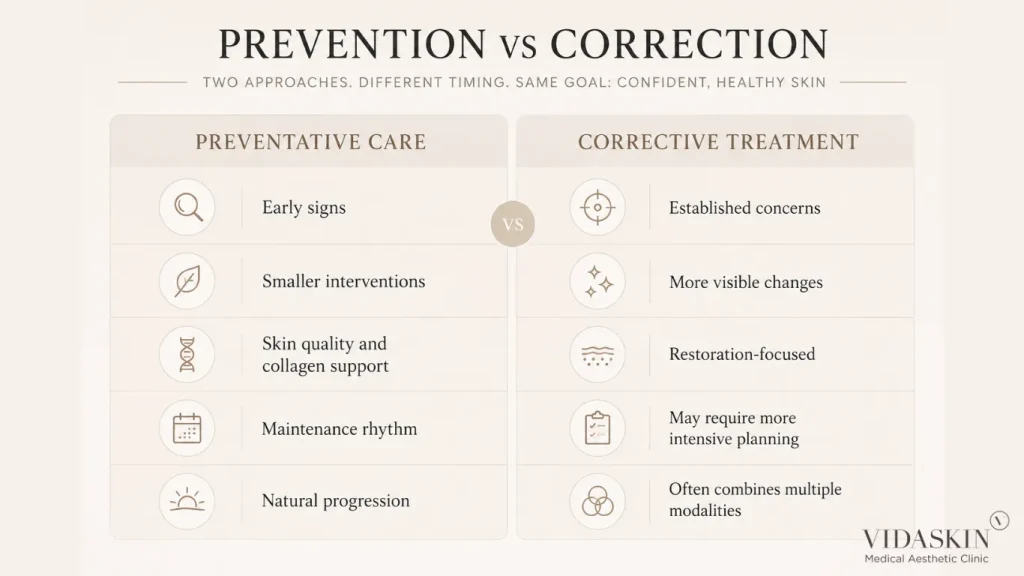
Ageing is not one-dimensional. The face changes across multiple layers: skin surface, dermis, fat compartments, ligaments, muscle activity, and deeper support structures. A strong prejuvenation plan should consider these layers together.
VIDASKIN’s layered approach focuses on four main dimensions: skin quality, collagen support, facial structure, and maintenance rhythm.
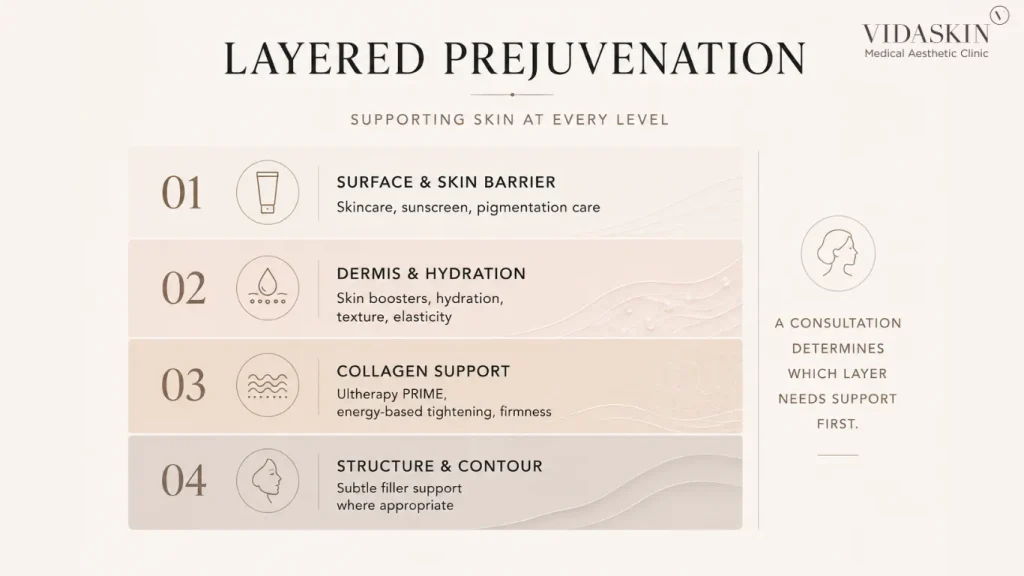
The first layer is skin quality. This includes hydration, smoothness, elasticity, pore appearance, pigmentation, and radiance.
Skin quality often changes before the face looks visibly aged. Patients may notice makeup sitting differently, skin looking duller, or fine lines appearing when the skin is dry. These concerns may not need volumising treatments. They often need better hydration, barrier support, and dermal-level skin conditioning.
Skin boosters are commonly used in aesthetic medicine to improve hydration and overall skin quality. A 2024 review describes skin boosters as treatments that may involve hyaluronic acid and other biologically active components intended to improve skin hydration, elasticity, and texture: Skin boosters: Definitions and varied classifications.
For VIDASKIN readers, this section can link to the clinic’s skin booster education pages:
Collagen is one of the key structural proteins that helps skin look firm, smooth, and resilient. With time, sun exposure, and natural ageing, collagen quality and quantity decline.
Prejuvenation often includes collagen-supporting treatments before laxity becomes more pronounced. The idea is not to “lift” the face dramatically in a younger patient. It is to maintain firmness, support facial contours, and encourage the skin’s regenerative response while changes are still mild.
Microfocused ultrasound is one example of an energy-based treatment used for skin tightening and collagen remodelling. A systematic review of microfocused ultrasound reported that the technology can create controlled thermal zones in deeper tissue to support collagen remodelling and skin tightening, while avoiding injury to the epidermal surface: A Systematic Review of the Clinical Efficacy of Micro-Focused Ultrasound Treatment for Skin Rejuvenation and Tightening.
At VIDASKIN, this topic can naturally link to Ultherapy PRIME, which uses microfocused ultrasound technology for non-invasive lifting and tightening.
Prejuvenation is sometimes misunderstood as “starting fillers early.” In a careful medical aesthetic plan, this is not the goal.
Dermal fillers can be used to support facial structure, restore subtle volume changes, or refine contour when appropriate. However, preventative care should be conservative. The aim is to preserve balance, not to alter identity or chase trends.
The United States Food and Drug Administration describes dermal fillers as injectable implants approved for specific uses such as creating a smoother or fuller facial appearance in areas including folds, cheeks, chin, lips, and hands: FDA Dermal Fillers.
In prejuvenation, fillers may be considered only after a doctor-led assessment. Some patients need skin quality support first. Others may benefit from subtle structural support in areas such as the cheeks, temples, chin, or under-eye region. The key is proportion, restraint, and anatomical understanding.
Prejuvenation is not a one-time makeover. It is a maintenance philosophy.
The most effective plan often includes a rhythm of daily skincare, sun protection, periodic skin quality treatments, and occasional collagen or structural support when indicated. This creates a more sustainable approach than waiting for larger visible changes and then trying to correct them all at once.
This is similar to fitness, dental care, or nutrition. Small, consistent actions often make a bigger difference than urgent intervention after neglect.
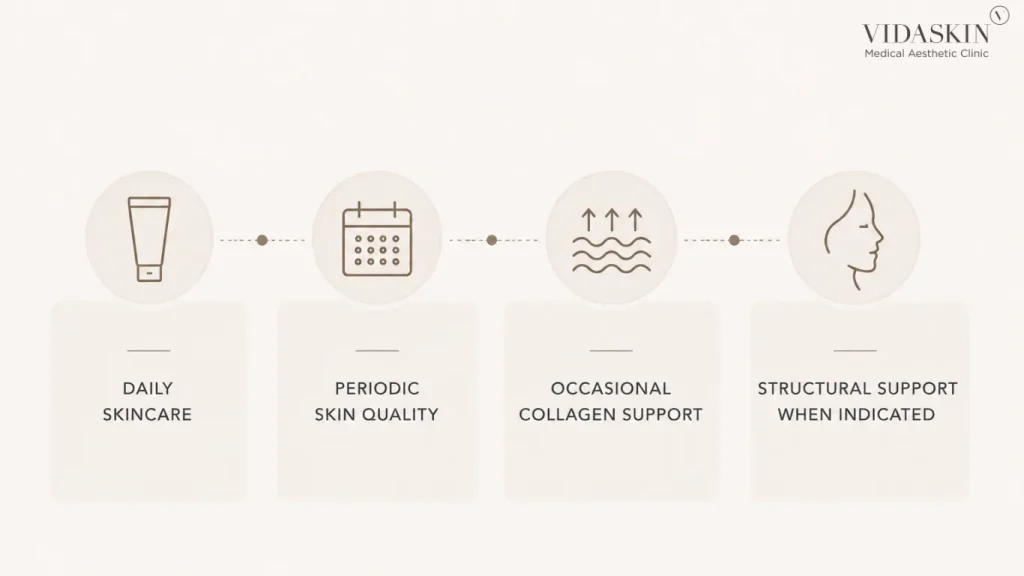
A prejuvenation plan should always be personalised after consultation. Depending on age, skin type, lifestyle, facial anatomy, and goals, it may include:
Daily skincare forms the foundation of prejuvenation. This may include sunscreen, antioxidants, retinoids, pigment-control ingredients, moisturisers, and barrier-supporting products. Daily broad-spectrum sunscreen is especially important because ultraviolet exposure contributes to photoaging and collagen degradation: Sunscreens and Photoaging: A Review of Current Literature.
Skin boosters may help improve hydration, smoothness, elasticity, and overall skin quality. They are particularly relevant for patients who feel their skin looks tired, dry, dull, or less supple, but do not necessarily need volumising filler.
For early laxity, jawline softness, or preventive collagen support, energy-based treatments such as Ultherapy PRIME may be discussed. Ultherapy states that its technology uses microfocused ultrasound energy with real-time imaging to target selected skin layers and support collagen and elastin production: Ultherapy.
Where early volume change affects facial balance, dermal fillers may be considered in conservative amounts. In prejuvenation, filler should be used strategically and sparingly, to maintain natural proportions.
Skin and facial structure change over time. A good prejuvenation plan should be reviewed periodically, adjusted to the patient’s evolving needs, and guided by a doctor who understands both prevention and correction.
Prejuvenation may be suitable for patients who:
It may not be suitable for patients expecting instant transformation, dramatic reshaping, or a single treatment to solve multiple concerns. Patients who are pregnant, breastfeeding, medically unsuitable, or experiencing active skin conditions should seek medical advice before aesthetic procedures.
VIDASKIN’s approach to prejuvenation is based on assessment, layering, and restraint.
First, the clinic evaluates the patient’s skin quality, ageing pattern, facial anatomy, lifestyle, and treatment history. This helps identify whether the main issue is hydration, collagen support, pigmentation, volume change, muscle movement, or a combination of factors.
Second, the treatment plan is layered. Surface-level skin quality may be addressed with skincare, lasers, or skin boosters. Deeper laxity may require collagen-supporting energy treatments such as Ultherapy PRIME. Structural changes may need subtle filler support only when appropriate.
Third, the plan is conservative and progressive. Prejuvenation should not make a patient look “done.” It should help the patient look rested, fresh, and naturally well-maintained.
Singapore’s aesthetic sector is also a regulated medical environment. The Singapore Medical Council provides guidelines on aesthetic practices for doctors, reinforcing the importance of appropriate training, patient assessment, informed consent, and patient safety: Singapore Medical Council Guidelines on Aesthetic Practices for Doctors.

The best prejuvenation plans are not driven by anxiety. They are driven by respect for the skin.
Ageing is natural. The goal is not to erase every line or prevent the face from changing. The goal is to support the skin and facial structure in a way that feels healthy, balanced, and authentic.
In this sense, prejuvenation is not anti-ageing. It is age-aware care.
If you are beginning to notice early changes in skin texture, hydration, facial firmness, or definition, a personalised consultation can help you understand what your skin needs now and what can wait.
Book a consultation with VIDASKIN Clinic to explore an evidence-based prejuvenation plan tailored to your skin, facial structure, and long-term goals.
Book a Prejuvenation Consultation today
Explore Skin Quality Treatments
This article is for educational purposes only and does not replace a medical consultation. Suitability for aesthetic treatments varies by individual and should be assessed by a qualified medical practitioner. Results, downtime, risks, and treatment intervals vary depending on skin condition, anatomy, medical history, and treatment plan.
What age should I start prejuvenation?
There is no fixed age to start. Many patients begin exploring prejuvenation in their late 20s to 30s, when early skin quality changes, fine lines or mild laxity first appear. The right timing depends on your skin, lifestyle, sun exposure, anatomy and goals.
Is prejuvenation the same as anti-ageing treatment?
Not exactly. Anti-ageing treatment often focuses on correcting visible signs of ageing, while prejuvenation focuses on early prevention, maintenance and support. It is usually more conservative, gradual and personalised.
Will prejuvenation make me look overdone?
It should not. A good prejuvenation plan is built around restraint and natural-looking results. At VIDASKIN, the aim is to support skin quality, collagen and facial balance, not to dramatically change how you look.
Are skin boosters the same as fillers?
Skin boosters and fillers can both involve injectable technologies, but they are used differently. Skin boosters generally focus on hydration and skin quality, while dermal fillers are more commonly used for volume support, contouring or softening selected folds. A doctor can advise which is appropriate for your concern.
Can Ultherapy PRIME be part of a prejuvenation plan?
Yes, for suitable patients. Ultherapy PRIME may be considered when there is early laxity or a desire to support collagen and skin firmness without surgery. It is not needed for everyone, so assessment is important.