- 501 Orchard Road, #04-08 Wheelock Place, Singapore 238880
- (65) 6235 4429
- hello@vidaskinclinic.com
- (65) 9830 0597

For anyone researching non-surgical skin lifting in Singapore, cost is almost always the first question. But Ultherapy pricing is not a fixed figure, but a clinically driven number shaped by the scope of your treatment, the technology used, and the expertise of your doctor. This guide breaks down every component of Ultherapy costs so you can compare clinics with confidence and know exactly what you are paying for.
Ultherapy is one of the most established non-surgical face-lifting treatments available in Singapore, FDA-cleared for lifting the brow, chin, and neck, and for improving lines on the décolletage. It has also recently been approved for treating skin laxity on the body. As a medical-grade procedure, its pricing reflects both clinical and technological investment — not simply the cost of a session at a beauty salon.
In Singapore, Ultherapy treatments generally range from SGD 1800 to SGD 5,000 or more, depending on the number of treatment areas and the total line count prescribed. A targeted single-area procedure — such as a brow lift or submental tightening — sits at the lower end of the spectrum, while a comprehensive full-face and neck treatment commands a higher investment.
These figures are broad by necessity. Because Ultherapy is customised to each patient’s anatomy and skin condition, no two treatment plans are identical. A quoted price without a clinical assessment is rarely a reliable figure to compare against.
Not all Ultherapy treatments are priced equally, and the difference often goes beyond marketing. The key variables are whether the clinic uses authentic, FDA-cleared transducers, the experience level of the administering doctor, and the total number of ultrasound lines delivered during the session.
Clinics offering significantly lower prices may be using fewer lines, older or non-original transducers, or less rigorous treatment protocols — all of which can directly affect the clinical outcome. When comparing quotes, the relevant question is not simply “how much does it cost?” but “what exactly does this price include?” and “who will be performing my treatments?”
You can learn more about the Ultherapy treatments offered at VIDASKIN and what is included in each protocol.
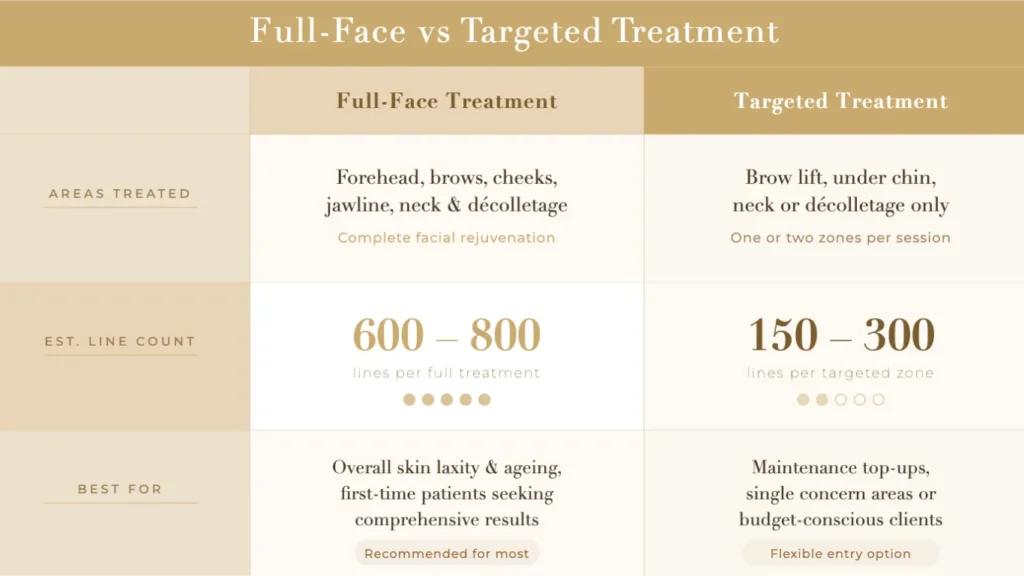
A full-face Ultherapy session covers multiple anatomical zones — the forehead, brow, cheeks, jowls, and submentum — requiring a substantially higher line count and more clinical time. Targeted treatments address a single zone and are priced accordingly. Patients with moderate overall skin laxity may opt for a combination of two to three areas at a mid-range cost, rather than a full-face protocol.
Explore our non-surgical face-lifting options to understand which areas may be most relevant to your concerns.
A transparent Ultherapy fee should cover the pre-treatment consultation, the procedure itself (including all ultrasound lines as agreed), and any post-treatment review. Some clinics charge separately for consultations; others bundle them into the total. Always confirm exactly what is included before comparing quotes across providers. Hidden costs — such as top-up lines charged mid-session — are worth asking about specifically.

Understanding how Ultherapy is measured and priced requires understanding what ultrasound lines are and how they relate to your treatment outcome.
In Ultherapy, treatment is measured in “lines” — individual ultrasound pulses that deliver focused energy to specific tissue depths beneath the skin. Each line creates 16 discrete thermal coagulation points, which trigger the body’s natural collagen regeneration response. These points accumulate across the treatment area to produce a gradual lifting and tightening effect over two to three months following the procedure.
The total number of lines prescribed directly influences the treatment cost. More lines mean greater tissue coverage and, generally, more pronounced clinical results. They also require more clinical time and place greater demands on the transducer. A standard full-face protocol may involve anywhere from 500 to 1100 or more lines, whereas a targeted brow lift may require considerably fewer.
Clinics that advertise unusually low full-face prices often achieve this by reducing the line count — a compromise that may significantly diminish results. Then, once you are in the clinic, they may upsell you to a larger number of lines, claiming that the offer you came in for is insufficient. Confirming the exact number of lines included in a quoted price is essential when comparing providers.
A full-face treatment covers the brow, periorbital area, mid-face, lower face, and often the submental (under-chin) region. Smaller, targeted treatments are designed for patients with localised concerns — for example, mild brow descent or early jowling — where treating the entire face is not clinically indicated. The right scope of treatment should be determined by clinical assessment, not by budget alone. However, we would always recommend a full face treatment, as clinical trial results, as well as our own clinical experience, show that it produces far greater results overall.
Ultherapy is clinically applied across the following areas:
Each zone has its own recommended line count, transducer depth, and clinical protocol — all of which contribute to the overall treatment plan and cost.
Ultherapy is not an off-the-shelf treatment. The protocol is built around the individual patient’s anatomy, skin condition, and aesthetic goals. This personalisation is central to both its efficacy and its pricing.
Before any Ultherapy session, a qualified doctor should conduct a thorough assessment of the patient’s facial sagging and skin laxity — the degree to which the skin has lost its structural firmness and elasticity. This involves evaluating the extent of tissue descent, skin thickness, and the patient’s age and treatment history.
A proper skin laxity assessment at VIDASKIN forms the clinical basis for all treatment decisions, including the number of lines, the depths to be treated, and the areas of focus. Without this assessment, any quoted price is an estimate rather than a clinical recommendation.
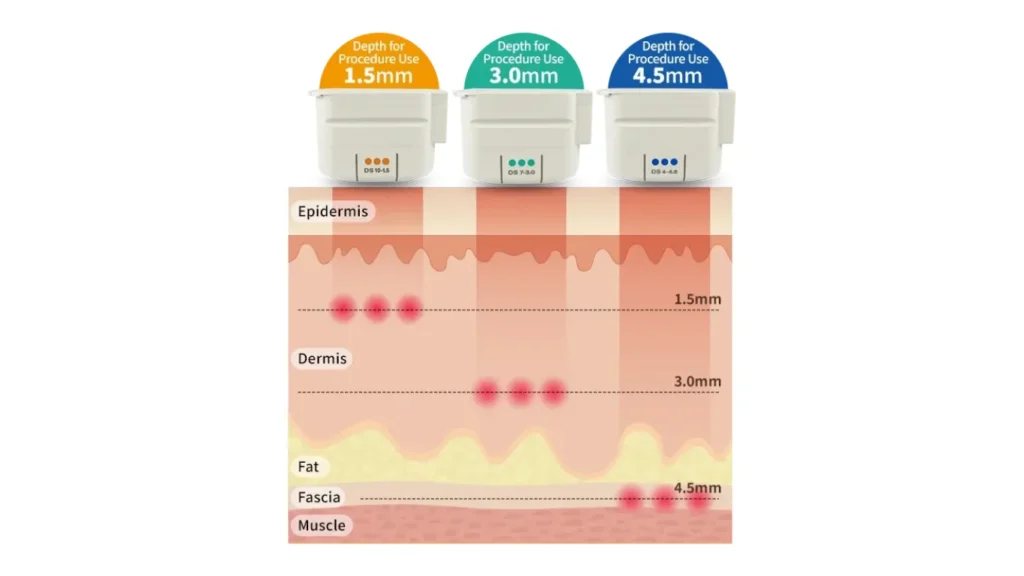
Ultherapy delivers focused ultrasound energy at multiple tissue depths — typically 1.5mm, 3.0mm, and 4.5mm — corresponding to the superficial dermis, the deeper dermis, and the superficial musculoaponeurotic system (SMAS). The SMAS is the foundational tissue layer that plastic surgeons address during surgical facelifts. Targeting it non-invasively is what differentiates Ultherapy from superficial skin treatments.
The appropriate depths and intensity at each level are adjusted by the treating doctor based on individual patient anatomy. Not every patient requires treatment at all three depths — and selecting the correct combination is a clinical judgement that experienced practitioners make based on what the ultrasound imaging reveals.
Patients with more advanced facial sagging and descent, more skin laxity, larger facial surface areas, or specific anatomical considerations may require a higher line count to achieve clinically meaningful results. This reflects clinical necessity rather than commercial upselling. Undertreating with too few lines reduces efficacy; the correct line count, accurately placed, delivers the outcomes that make Ultherapy a worthwhile investment.
Some patients also return for supplementary lines in specific areas following an initial full treatment — for example, to address asymmetries or areas that responded less noticeably than others.
The technology used during an Ultherapy session has a direct bearing on both the safety and the effectiveness of the treatment — and on the cost.
Transducers are the handheld components that deliver focused ultrasound energy during a session. Authentic Ultherapy transducers are precision-engineered to exacting FDA specifications, ensuring consistent energy delivery at the correct tissue depth with each pulse. They are manufactured, calibrated, and quality-controlled by Merz Aesthetics, the brand behind Ultherapy.
Counterfeit and non-original transducers exist in the aesthetic market. These devices cannot guarantee the same energy calibration, depth accuracy, or safety profile as authentic components — meaning patients treated with them are receiving a fundamentally different procedure, regardless of what it is called. The use of counterfeit transducers is more common than you may think.
Ultherapy’s FDA clearance applies specifically to the Ulthera System and its associated transducers. This clearance is the result of rigorous clinical trials demonstrating both safety and efficacy. Using non-cleared components under the Ultherapy name is both clinically and legally problematic — and more importantly, it exposes patients to unvalidated treatment parameters.
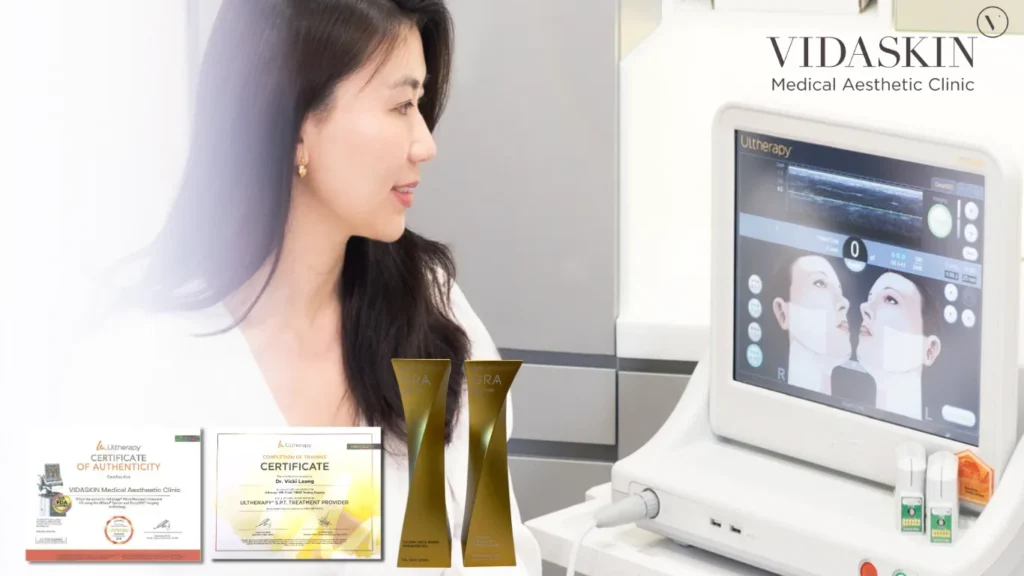
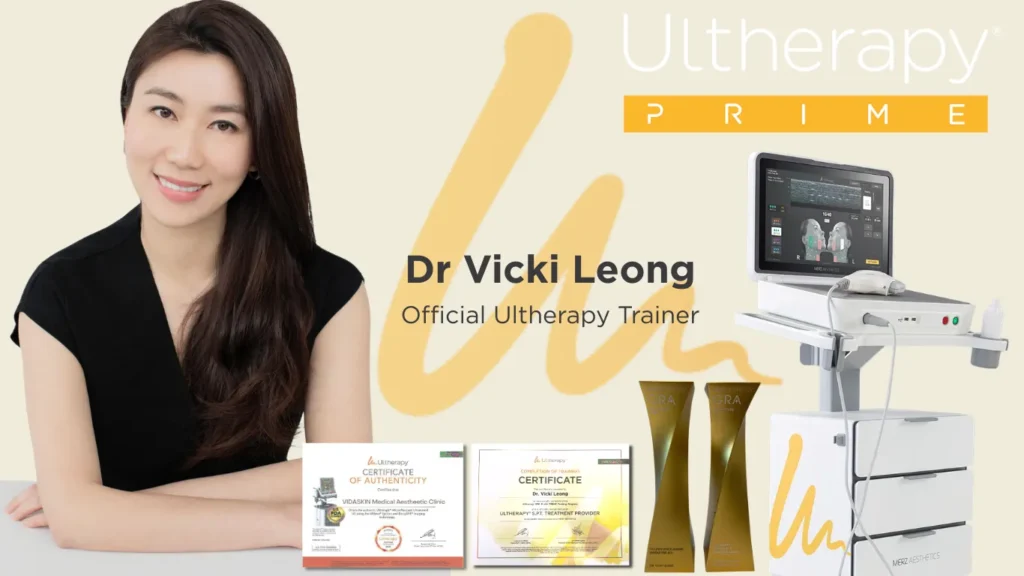
When evaluating clinics, ask directly whether they use genuine, manufacturer-certified transducers. This is one of the most important questions to raise before committing to treatment. You can confirm that VIDASKIN Clinic uses an authentic FDA-cleared Ultherapy device as part of our clinical standards. We are also consistently one of the highest users of Ultherapy in Singapore, as evidenced by the annual awards that we receive from Merz.
Genuine transducers are subject to manufacturer usage limits and must be replaced regularly to maintain performance standards. Each transducer has a finite number of pulses it can deliver before it must be retired. This is an ongoing operational cost that reputable clinics absorb as part of their treatment fee.
Clinics offering significantly below-market prices may be extending transducer use beyond recommended limits or substituting non-original components. Both practices compromise treatment integrity and, potentially, patient safety. Understanding this helps contextualise why a higher price at a reputable clinic may represent better clinical value than a lower price elsewhere. One telling sign that a clinic may be using counterfeit transducers are clinics offering Ultherapy at lower prices are not recipients of such awards.
Beyond the technology itself, the expertise of the doctor performing your Ultherapy treatment is one of the most significant variables affecting both your outcome and your cost.
Ultherapy’s built-in real-time ultrasound imaging is what sets it apart from other energy-based devices. Before and during treatment, the doctor can visualise the layers of tissue beneath the skin surface — confirming the depth of the dermis, the SMAS, and identifying any anatomical structures to avoid, such as nerves and superficial blood vessels.
This visualisation capability is what makes targeted treatment possible. Without it, energy delivery is essentially blind — a significant limitation in a procedure where depth accuracy determines both safety and results.
Accurate in-depth targeting is critical. Energy delivered too superficially risks surface skin reactions; energy delivered too deeply misses the intended tissue structures. An experienced Ultherapy practitioner reads the ultrasound imaging in real time, confirming correct transducer placement at each treatment depth and adjusting as the tissue landscape varies across different facial zones.
This level of clinical attentiveness requires both training and experience — it is not a skill that comes automatically with operating the device.
Doctors with extensive Ultherapy experience bring a higher degree of clinical judgement to each session. They recognise anatomical variations that affect treatment depth, adjust protocol mid-session where needed, and manage patient comfort and expectations effectively. This expertise is often reflected in the treatment fee and is a legitimate factor to weigh when comparing providers.
A lower price from a less experienced practitioner — or from a clinic where the procedure is delegated to a non-doctor — may not represent equivalent clinical value. In a treatment where precision directly determines outcome, the experience of the person holding the transducer matters considerably.
When evaluating clinics, look for doctors with documented training in aesthetic medicine and specific experience with energy-based devices. Ask how many Ultherapy procedures the doctor has personally performed, and confirm that the treating doctor — not a therapist or nurse — will be administering your procedure.
In Singapore, Ultherapy should be performed by a licensed medical professional. Meet our team of qualified doctors at VIDASKIN and learn about their experience with Ultherapy and other energy-based treatments. Our founder and principal physician, Dr Vicki Leong, is also an official Ultherapy trainer, training other doctors in Singapore on the See-Plan-Treat protocol.
How much does Ultherapy cost in Singapore?
Ultherapy in Singapore typically ranges from SGD 1800 to SGD 5,000 or more, depending on the number of treatment areas, the total line count prescribed, and the clinic’s technology and practitioner expertise. A personalised quote can only be given following a clinical assessment.
Is Ultherapy worth the cost?
For patients with mild to moderate facial sagging and skin laxity seeking a clinically proven non-surgical lifting option, Ultherapy can deliver meaningful results — particularly in the jawline, neck, and brow area. The value of the treatment depends heavily on whether authentic FDA-cleared technology and an experienced medical practitioner are used. A discounted session using fewer lines or non-original transducers is unlikely to produce comparable outcomes. Ultherapy remains one of the most popular treatments performed here at VIDASKIN.
Why is Ultherapy more expensive at some clinics?
Pricing differences reflect the use of genuine transducers (which must be regularly replaced), the total number of lines included in the protocol, and the experience level of the treating doctor. Clinics offering significantly lower prices may be compromising on one or more of these factors, which can affect both safety and results.
How many Ultherapy sessions will I need?
Most patients achieve noticeable results with a single session, with full results visible at three to six months post-treatment. Maintenance sessions are typically recommended annually, though this varies based on individual skin condition, age, and lifestyle factors. There has been some increasing evidence that repeating the treatment at 9 months can enhance the results exponentially. Your doctor will advise on the appropriate treatment frequency during consultation.
Is there any downtime after Ultherapy?
Ultherapy is a non-invasive procedure with no required downtime. Most patients experience mild redness or swelling immediately following treatment, which typically resolves within a few hours. Some patients report temporary tenderness or tingling in treated areas, which subsides within days. You can return to normal activities immediately after the session.
Is Ultherapy safe?
When performed by a trained medical professional using authentic, FDA-cleared equipment, Ultherapy has a well-established safety profile built on extensive clinical data. Real-time ultrasound visualisation allows the doctor to target the correct tissue layers while avoiding sensitive anatomical structures. As with any medical procedure, risk increases when treatment is performed outside appropriate clinical standards.
Can Ultherapy be combined with other treatments?
Yes. Ultherapy is commonly combined with injectables such as botulinum toxin or dermal fillers to address complementary concerns — Ultherapy lifts and tightens, while fillers restore volume. Your doctor will advise on the most appropriate combination and sequencing based on your overall treatment goals.
How soon will I see results from Ultherapy?
Initial tightening may be noticeable within the first few weeks, but the primary lifting effect develops gradually as new collagen is produced — typically peaking at three to six months following treatment. Results can last up to twelve to eighteen months, depending on the individual’s skin condition and ageing process.
Ultherapy pricing in Singapore reflects far more than a session fee — it encompasses the clinical scope of your treatment, the authenticity of the technology used, and the expertise of the doctor delivering it. Understanding these components allows you to evaluate quotes with clarity and choose a provider based on clinical value rather than price alone.
At VIDASKIN, every patient begins with a comprehensive assessment to determine the most appropriate Ultherapy protocol for their individual anatomy and goals. Our doctors use only authentic, FDA-cleared Ultherapy technology and perform every procedure personally, with real-time ultrasound visualisation guiding the entire session.
To receive an accurate, personalised cost estimate, book a consultation at VIDASKIN Clinic. We will assess your skin laxity, discuss your concerns in detail, and outline a treatment plan tailored specifically to you — with full transparency on line count, treatment areas, and what your investment includes.
