- 501 Orchard Road, #04-08 Wheelock Place, Singapore 238880
- (65) 6235 4429
- hello@vidaskinclinic.com
- (65) 9830 0597


Healthy skin is, at its core, well-hydrated skin. Yet even with a disciplined skincare routine, topical products can only penetrate so far — they work at the surface, not within the dermal layer where lasting hydration and structural integrity are determined. Skin booster treatments address this limitation directly, delivering active hydrating agents into the skin itself through a series of precise micro-injections.
For patients in Singapore navigating a crowded aesthetic market, understanding exactly how skin boosters work — and what to expect before, during, and after treatment — is essential to making an informed decision. This guide covers the mechanism, treatment areas, recovery, and maintenance cycle in clinical detail.
Skin boosters are not surface treatments. Their defining characteristic is the depth at which they work — within the dermis, the layer of skin responsible for firmness, elasticity, and moisture regulation. Understanding the mechanism helps set realistic expectations and distinguishes genuine skin booster treatments from superficial alternatives.
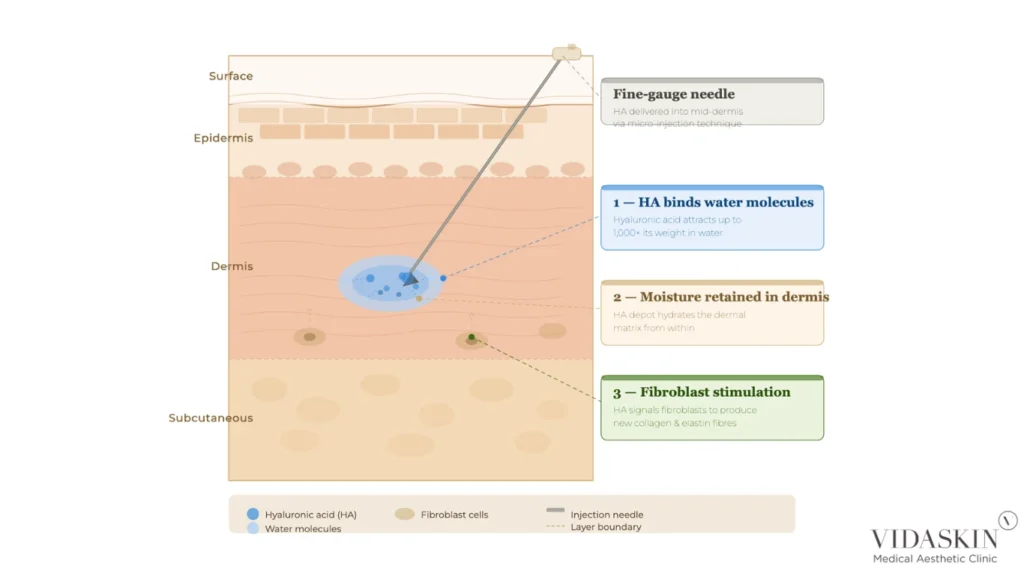
The active ingredient in most skin booster treatments is hyaluronic acid (HA) — a naturally occurring molecule found throughout the body, with particularly high concentrations in the skin, joints, and eyes. HA is remarkable for its capacity to attract and retain water molecules: a single gram of hyaluronic acid can hold up to six litres of water.
In a skin booster treatment, stabilised HA is delivered directly into the mid-to-deep dermal layer via a series of small, precisely spaced micro-injections. Unlike dermal fillers, which are designed to add volume or structure to specific areas, skin booster HA is formulated to disperse evenly within the tissue — integrating with the surrounding dermal matrix to create a reservoir of moisture from within.
This intradermal delivery is what separates skin boosters from topical hyaluronic acid serums. Topically applied HA sits on the skin surface and draws moisture from the environment into the outermost skin layers. Injected HA works within the dermis itself, where it can directly influence the tissue environment that determines skin quality at a structural level. At VIDASKIN, our doctors assess each patient’s skin condition to determine the most appropriate HA formulation and injection depth for their individual presentation.
As intradermal HA integrates into the dermal matrix, it draws water into the tissue and maintains it there — progressively improving skin hydration, plumpness, and suppleness over the weeks and months following treatment. Patients typically notice that their skin feels softer and more resilient, with a reduction in the fine lines and dullness associated with dehydrated skin.
Beyond hydration, HA also contributes to the mechanical properties of the dermis. The dermis relies on an extracellular matrix — a scaffold of collagen, elastin, and glycosaminoglycans (of which HA is one) — to maintain its structure and elasticity. Restoring HA levels within this matrix supports the overall integrity of the scaffold, improving the skin’s ability to spring back after deformation — in other words, its elasticity.
This is why skin boosters are described as improving skin quality rather than simply adding moisture. The effect is a structural one, not just a surface one. Learn more about the skin booster treatments available at VIDASKIN and how they are tailored to individual skin conditions.
Beyond the direct hydrating effect of HA, skin booster treatments have been shown to stimulate fibroblast activity within the dermis. Fibroblasts are the cells responsible for producing collagen and elastin — the structural proteins that give skin its firmness and resilience.
The micro-injury created by each injection, combined with the presence of the HA matrix, triggers a mild wound-healing response that encourages fibroblasts to increase collagen synthesis. This means the benefit of skin boosters extends beyond the lifespan of the HA itself — over time and across multiple sessions, treated skin develops a more robust collagen network, improving texture, firmness, and long-term hydration capacity.
This collagen-stimulating effect is cumulative, which is why a structured treatment programme — rather than a single session — yields the most significant and lasting results.
One of the advantages of skin boosters is their versatility. While the face remains the most common treatment site, the same principles of intradermal HA delivery apply across multiple body areas where skin quality concerns are present.otocol — all of which contribute to the overall treatment plan and cost.

The face benefits from skin boosters across several zones, each with specific concerns that intradermal hydration addresses effectively:
Facial skin booster treatments are suitable for a broad patient demographic — from younger patients seeking preventative hydration to older patients addressing established dehydration lines and skin quality decline. A doctor’s assessment determines the most appropriate approach for each individual.
The neck and décolletage are frequently overlooked in aesthetic treatment planning, yet they are among the first areas to show visible signs of ageing and sun damage. The skin in these areas is thinner than facial skin, often receives less diligent sun protection, and tends to develop crepey texture and horizontal lines earlier than comparable facial zones.
Skin boosters are well-suited to both areas. Intradermal HA improves the hydration and texture of thin, crepey neck skin, while the décolletage responds well to the combined hydrating and collagen-stimulating effects of a structured treatment programme. Patients who invest in facial skin booster treatments often find that extending the treatment to the neck and décolletage creates a more harmonious overall result — particularly when the face has been significantly improved, and the neck and chest have not been addressed.
The hands are another area where skin quality decline is often disproportionate to the patient’s overall appearance. Thin skin, visible tendons, and a crepey texture on the dorsum of the hand are common concerns that respond to intradermal HA treatment, improving skin thickness, smoothness, and a more youthful appearance.
Beyond the hands, skin boosters can be applied to any area where skin laxity, crepiness, or dehydration is a concern — including the inner arms, knees, and other body areas where skin quality has declined. As with all treatment areas, the appropriate protocol is determined through clinical assessment. Book a personalised skin assessment at VIDASKIN to discuss which areas would benefit most from treatment.
Skin booster treatments are minimally invasive, but they do involve needle injections into the skin, and patients should have accurate expectations about the immediate post-treatment period before scheduling their appointment.
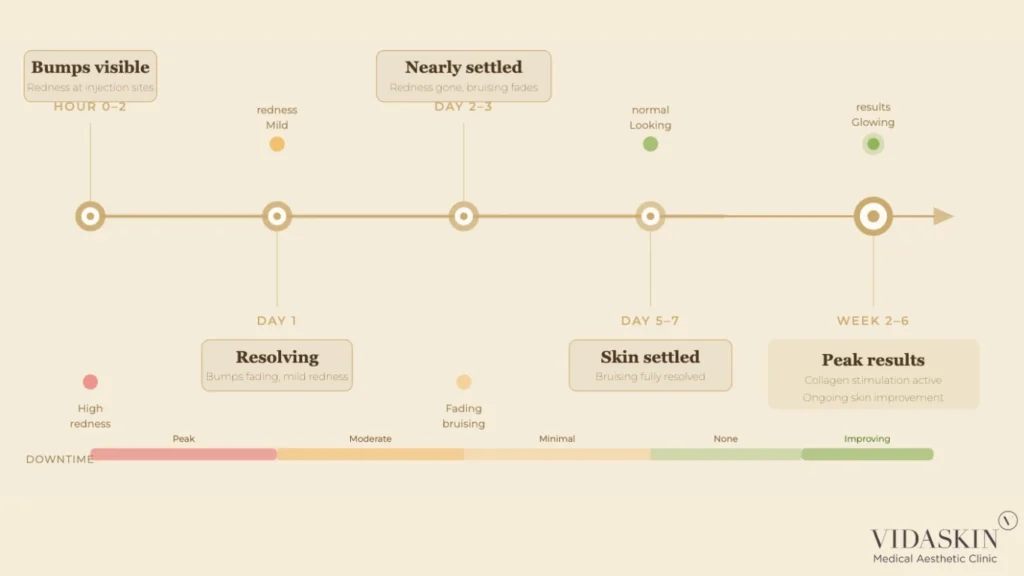
Immediately following a skin booster session, small raised bumps — sometimes called “blebs” — are typically visible at each injection site. These are a normal and expected responses to the intradermal HA deposits and indicate that the product has been correctly placed within the dermal layer. They are not a sign of incorrect technique or adverse reaction.
In addition to the injection-site bumps, mild bruising may occur — particularly in areas with more superficial vasculature, such as the under-eye zone, the perioral area, and the backs of the hands. The degree of bruising varies between patients and is influenced by individual skin fragility, any blood-thinning medications or supplements being taken, and the specific injection technique used.
Redness and mild swelling at the treatment sites are also common in the hours immediately following the session. Most patients describe the overall appearance immediately post-treatment as slightly uneven or blotchy, which can be minimised with makeup after a short settling period.
For most patients, the injection-site bumps resolve within 12 to 24 hours as the HA begins to integrate into the surrounding tissue. Redness typically subsides within a few hours to one day. Bruising, where it occurs, generally resolves within three to seven days — consistent with the natural timeline of superficial bruising anywhere on the body.
By the end of the first week, the vast majority of patients have no visible signs of treatment. The skin at this stage may already feel noticeably softer and more hydrated, though the full aesthetic improvement continues to develop over the following four to six weeks as collagen stimulation progresses.
Patients planning to attend social or professional engagements should ideally schedule their skin booster session at least one week in advance, to allow for any bruising to fully resolve.
Several practical measures can reduce both discomfort during treatment and the likelihood of post-treatment bruising:
Our doctors at VIDASKIN provide detailed post-treatment care instructions tailored to each patient’s skin type and treatment area before every session.
Skin booster treatments are not a one-time procedure. The most meaningful and lasting improvements come from following a structured treatment programme that includes an initial loading phase followed by regular maintenance sessions.
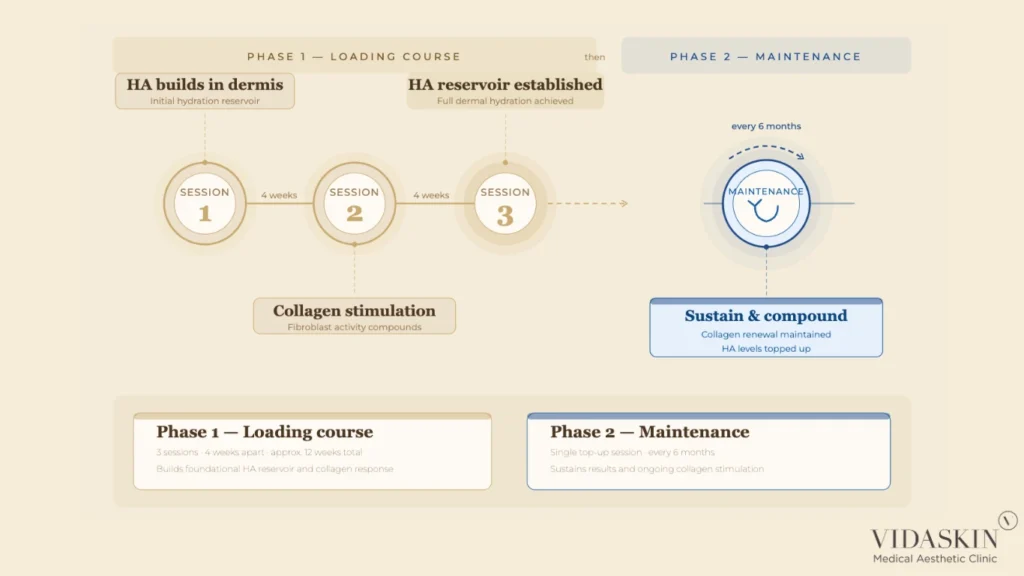
The standard recommended protocol for skin boosters begins with an initial phase of three sessions, spaced approximately four weeks apart. This loading phase is designed to build up the HA concentration within the dermal matrix to a therapeutically meaningful level, and to initiate the collagen-stimulating cascade across multiple treatment cycles.
The rationale for multiple initial sessions is that a single treatment, while beneficial, delivers a relatively modest quantity of HA into the dermis. Three sessions in close succession allow the dermal HA reservoir to accumulate progressively — each session adding to and reinforcing the effects of the previous one. By the end of the third session, patients typically observe a more pronounced and consistent improvement in skin texture, hydration, and radiance than would be achievable from a single treatment.
The collagen-stimulating effect also compounds across sessions — each cycle of micro-injury and healing contributes to the overall increase in fibroblast activity and collagen synthesis, with results continuing to develop in the weeks following the final loading session.
Following the completion of the initial three-session phase, most patients are recommended to return for a maintenance session every six months. This interval aligns with the approximate lifespan of stabilised HA within the dermis — as the body gradually metabolises the injected HA, a maintenance session replenishes the dermal reservoir and sustains the collagen-stimulating activity initiated during the loading phase.
Without maintenance sessions, the improvements achieved during the initial phase will gradually diminish as the HA is reabsorbed and collagen stimulation slows. With regular maintenance, the results are cumulative — patients often report progressive improvement in their baseline skin quality over successive treatment cycles, as the dermal collagen network continues to strengthen over time.
The six-month interval is a general guideline. Some patients with faster HA metabolism or more advanced skin quality concerns may benefit from more frequent maintenance; others may find that their results are well sustained at longer intervals. Your treating doctor will advise on the appropriate maintenance schedule based on your individual response to treatment. Explore the full range of treatments available at VIDASKIN and how they can be combined with skin boosters for a comprehensive skin quality programme.
An important and often underappreciated aspect of a structured skin booster programme is the value of ongoing clinical monitoring. At each maintenance visit, the treating doctor should assess the current condition of the skin — comparing it against baseline photographs, evaluating the degree of hydration and texture improvement, and adjusting the treatment protocol where necessary.
This monitoring serves several purposes. It allows the doctor to track the cumulative benefit of treatment over time, identify any areas that may require additional attention, and adapt the HA formulation or injection technique as the patient’s skin evolves. It also provides the patient with objective evidence of improvement, which is particularly valuable in a treatment where changes are gradual and may be difficult to self-assess without photographic reference.
At VIDASKIN, every patient’s treatment journey is documented and reviewed at each visit. Our doctor-led approach means that protocol adjustments are made on clinical grounds — not based on standardised packages or commercial schedules.
What is a skin booster treatment?
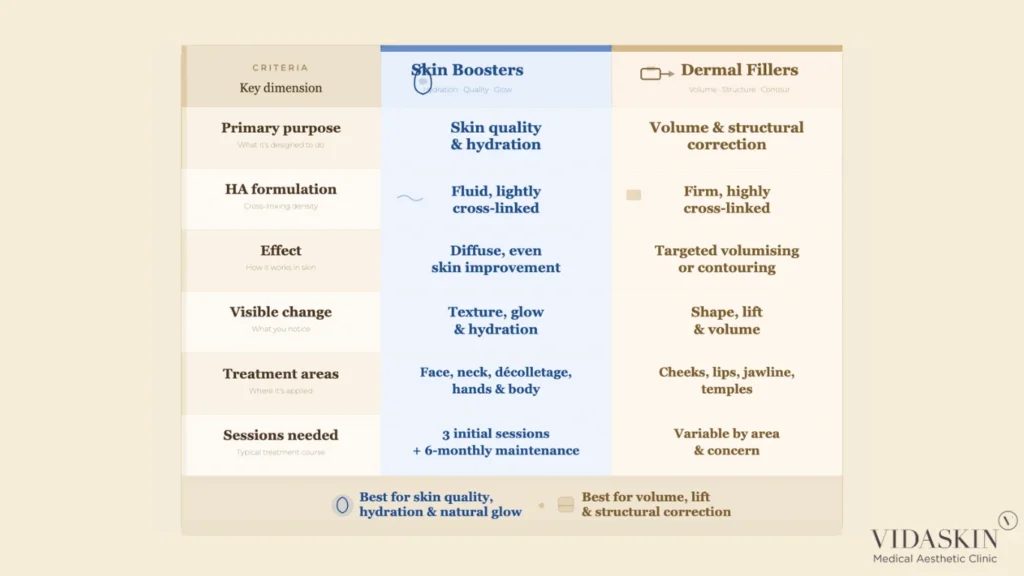
A skin booster treatment involves micro-injections of stabilised hyaluronic acid (HA) directly into the dermal layer of the skin. Unlike dermal fillers, which add volume to specific areas, skin boosters are designed to improve overall skin quality — enhancing hydration, elasticity, and radiance from within. The HA integrates into the dermal matrix, attracting and retaining water while stimulating natural collagen production.
How is a skin booster different from a dermal filler?
Dermal fillers are formulated to add structural volume or contour to specific facial areas — such as the cheeks, lips, or jawline. Skin boosters use a more fluid, less cross-linked form of HA that disperses evenly within the dermis to improve skin quality broadly. They do not add visible volume; they improve the texture, hydration, and resilience of the skin itself.
Is skin booster treatment painful?
Most patients describe the sensation as mild to moderate discomfort. Topical anaesthetic cream is typically applied before the session to reduce sensitivity at the injection sites, and the needles used are very fine. The level of discomfort varies by treatment area — thinner skin areas, such as the under-eye zone and hands, tend to be more sensitive than the cheeks or forehead.
How long do skin booster results last?
Following an initial course of three sessions, results typically last six months before a maintenance session is recommended. Individual results vary depending on the patient’s metabolism, skin condition, lifestyle factors such as sun exposure and hydration, and the specific HA formulation used. With regular maintenance, many patients experience progressive improvement in their baseline skin quality over successive treatment cycles.
Who is a suitable candidate for skin booster treatment?
Skin boosters are suitable for a wide range of patients — from younger individuals seeking preventative hydration and skin quality maintenance, to older patients addressing established dehydration, fine lines, and skin texture decline. They are particularly well-suited to patients whose primary concern is overall skin quality rather than specific structural changes. A consultation with a doctor is required to assess individual suitability and determine the most appropriate treatment protocol.
Are there any side effects from skin booster injections?
The most common side effects are temporary and localised to the injection sites — small raised bumps (blebs), mild redness, and occasionally bruising. These typically resolve within a few days. Serious adverse effects are rare when the treatment is performed by a qualified doctor using appropriate technique and clinically approved HA formulations. A thorough consultation before treatment should include a discussion of all potential risks and side effects.
How many sessions of skin boosters do I need?
The standard recommended protocol is an initial phase of three sessions spaced four weeks apart, followed by maintenance sessions every six months. The total number of sessions required long-term depends on the individual patient’s skin condition, treatment goals, and response to the initial phase. Your doctor will advise on the most appropriate programme during your consultation.
Can skin boosters be combined with other treatments?
Yes. Skin boosters are commonly combined with other aesthetic treatments — such as botulinum toxin, dermal fillers, Ultherapy, or laser treatments — as part of a comprehensive skin rejuvenation programme. The sequencing and combination of treatments should be determined by a doctor based on your individual skin condition and goals. At VIDASKIN, our doctors take a holistic approach to treatment planning, ensuring that all recommended treatments are clinically complementary.
Skin booster treatment offers a clinically grounded approach to skin hydration — one that works at the dermal level to improve moisture retention, stimulate collagen production, and enhance overall skin quality in a way that topical skincare alone cannot achieve.
As with any injectable treatment, the quality of your outcome depends significantly on the expertise of the doctor performing it and the clinical rigour of the assessment that precedes it. At VIDASKIN, every skin booster treatment begins with a thorough consultation conducted by one of our doctors — assessing your skin condition, discussing your goals, and designing a treatment programme that reflects your individual needs.
As a doctor-owned and doctor-led practice, our recommendations are based entirely on clinical judgement. There are no standardised packages, no commercially driven protocols, and no compromise on the standard of care we provide.
To begin your skin booster journey with a properly conducted clinical assessment, book a consultation at VIDASKIN. Our doctors will advise you honestly on whether skin boosters are the right treatment for your skin — and if so, exactly what a programme designed for you should look like.
To receive an accurate, personalised cost estimate, book a consultation at VIDASKIN Clinic. We will assess your skin laxity, discuss your concerns in detail, and outline a treatment plan tailored specifically to you — with full transparency on line count, treatment areas, and what your investment includes.