- 501 Orchard Road, #04-08 Wheelock Place, Singapore 238880
- (65) 6235 4429
- hello@vidaskinclinic.com
- (65) 9830 0597
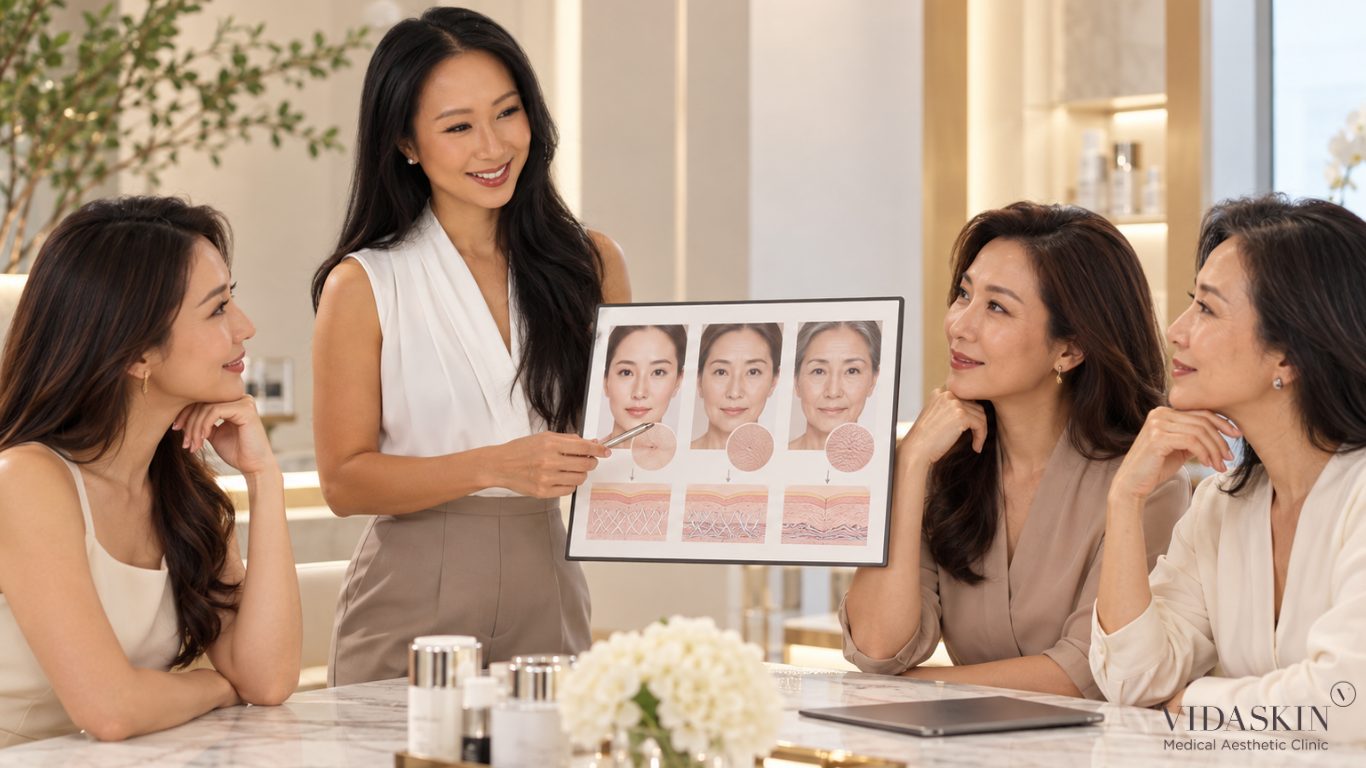
By Dr Kay Low, Senior Aesthetic Physician, VIDASKIN
Your skin at 35 is not the same as your skin at 45 or 55, and the treatments that suit it best change too. Yet many people choose skin boosters as though one approach fits every age.
As an aesthetic doctor with a special interest in skin boosters and women’s skin across life stages, I find that understanding how skin changes with each decade is one of the most useful ways to plan treatment. It helps patients start at the right time, choose the right booster, and avoid treatments they do not yet need.
This guide explains how skin typically changes through your thirties, forties and fifties, and how skin boosters can support it at each stage. Everyone ages differently, so these are general patterns rather than rules.
Three processes drive most changes in skin quality:
Sun exposure, smoking, sleep, stress, weight changes, pregnancy and hormones all influence how quickly these happen. In Singapore, year-round UV exposure is one of the biggest accelerators.
The focus in your thirties is usually hydration, skin quality and early support:
Much of my practice involves patients in their thirties who are noticing early change. Often, the most valuable thing at this stage is not more treatment, but the right treatment, alongside excellent skincare and daily sun protection. Skin boosters are not essential in your thirties, but for the right concerns, they can help maintain skin quality as collagen begins to decline.
Skin boosters are generally not recommended during pregnancy or breastfeeding. I often see women soon after this stage, when they want to address changes gently.
The focus shifts towards firmness and resilience, while maintaining hydration:
The forties are often when a combined plan becomes most useful. Skin boosters for quality, energy-based treatments such as Ultherapy or RF skin tightening for laxity, and targeted treatment for pigmentation can work together. Perimenopause also deserves attention, because skin can change quickly during this time.
The focus is on rebuilding structure and supporting thin, dry skin:
In the fifties, skin boosters work best as part of a broader plan. Some patients will also benefit from structural treatments, lifting procedures or, in some cases, a surgical opinion. Being honest about what skin boosters can achieve at this stage is essential.
| 30s | 40s | 50s and beyond | |
|---|---|---|---|
| Main skin changes | Dehydration, dullness, early fine lines | Loss of firmness, hormonal changes | Thinning, dryness, laxity, volume loss |
| Main focus | Hydration and skin quality | Firmness and resilience | Structure and skin thickness |
| Commonly used boosters | HA, polynucleotides, PDLLA | 5 Point, PDLLA, CaHA, polynucleotides | Collagen stimulators, HA–CaHA hybrids, polynucleotides, HA |
| Often combined with | Skincare, sun protection | Energy-based lifting, pigment treatment | Lifting, structural treatments |
Two people of the same age can have very different skin. Genetics, sun exposure, smoking, weight changes, hormones and skincare habits all matter. I have seen thirty-year-olds with significant sun damage and fifty-year-olds with remarkably resilient skin.
This is why treatment should be guided by an assessment of your skin, not your birth year.
Skin boosters work best when these foundations are in place.
There is no fixed age. Many people start in their late twenties or thirties, when they first notice dehydration, dullness or fine lines.
For concerns such as dehydration, early fine lines or texture, skin boosters can be helpful. They are not essential, and good skincare remains the foundation.
HA boosters are often a good starting point for hydration and glow. Polynucleotides or PDLLA may be considered for crepiness, sensitivity or texture.
The 5 Point Skin Booster and collagen-stimulating boosters are often used for early laxity, alongside HA or polynucleotide boosters for skin quality.
Collagen-stimulating boosters, HA–CaHA hybrids and polynucleotides are often used to support thin, dry and less firm skin.
They cannot prevent ageing, but they can support skin quality and may help the skin age more gradually, especially with good sun protection.
Yes. It is never too late to improve skin quality, although a combined approach is often needed for laxity and volume loss.
Yes, although results may be more gradual. Mature skin often benefits from collagen-stimulating boosters and a combined plan.
Falling oestrogen reduces collagen, hydration and skin thickness, leading to drier, thinner and less firm skin.
Skin boosters are generally not recommended during pregnancy or breastfeeding. Your doctor can advise on safe skincare during this time.
It depends on the type and your skin, but many patients have maintenance treatments every six to twelve months after an initial course.
Older skin may need a longer initial course or more regular maintenance, and often benefits from combining boosters with other treatments.
If your main concern is sagging rather than skin quality, Ultherapy or other lifting treatments may be more appropriate. The two can also be combined.
Yes. The neck, décolletage and hands often show ageing early and respond well to skin boosters and collagen stimulators.
No. Genetics, sun exposure, smoking, hormones and lifestyle all affect how quickly collagen declines.
Yes. Your skin’s needs change over time, so your plan should be reviewed and adjusted rather than repeated unchanged.
The best skin booster plan is not fixed. It evolves as your skin changes, focusing on what matters most at each stage of life.
To plan skin boosters for the stage you are at, book a consultation with Dr Kay Low.
Dr Kay Low is a Senior Aesthetic Physician at VIDASKIN with a special interest in skin boosters and skin quality. She graduated in medicine from the University of Cambridge (MA, MB BChir) and is registered to practise in both Singapore and the United Kingdom. Her clinical interests include early facial ageing in the 30s and 40s, pregnancy and postpartum skin changes, perimenopausal and menopausal skin, and women’s skin across life stages.
This article is for general education and does not replace an individual medical consultation. Suitability and results vary between patients.

Dr. Kay Low is a UK-trained medical doctor with over 7 years of clinical experience across the UK and Singapore, specialising in aesthetic medicine. A graduate of the University of Cambridge, she has worked across multiple medical and surgical disciplines in the UK and Singapore before completing postgraduate training in Family Medicine and advanced training in aesthetic medicine.
