- 501 Orchard Road, #04-08 Wheelock Place, Singapore 238880
- (65) 6235 4429
- hello@vidaskinclinic.com
- (65) 9830 0597

Preventive lifting refers to treatments performed before significant sagging develops, with the aim of maintaining structural support and slowing visible changes rather than reversing them.
At this stage, the focus is typically on:
Energy-based treatments such as micro-focused ultrasound (e.g., Ultherapy) are commonly used in this phase to stimulate collagen at deeper structural layers without adding volume. The intention is to help the skin retain its natural framework while aging progresses gradually.
Preventive approaches are generally subtle and progressive. The goal is not to change how someone looks, but to help the skin age along a more stable trajectory.

Corrective lifting is introduced when structural changes—such as tissue descent, volume redistribution, or skin laxity—have already become visible.
Here, treatments aim to restore support and improve definition rather than maintain it.
This may involve a combination of:
Fillers in this context are not used simply to “fill lines,” but to rebuild underlying architecture—for example, restoring cheek support that indirectly improves the nasolabial fold or jawline contour. These treatments are often layered on top of energy-based devices such as Ultherapy. Collagen biostimulators such as CaHA may also be beneficial to target superficial skin laxity.
Corrective treatments are often more comprehensive because multiple aging mechanisms are already in play.
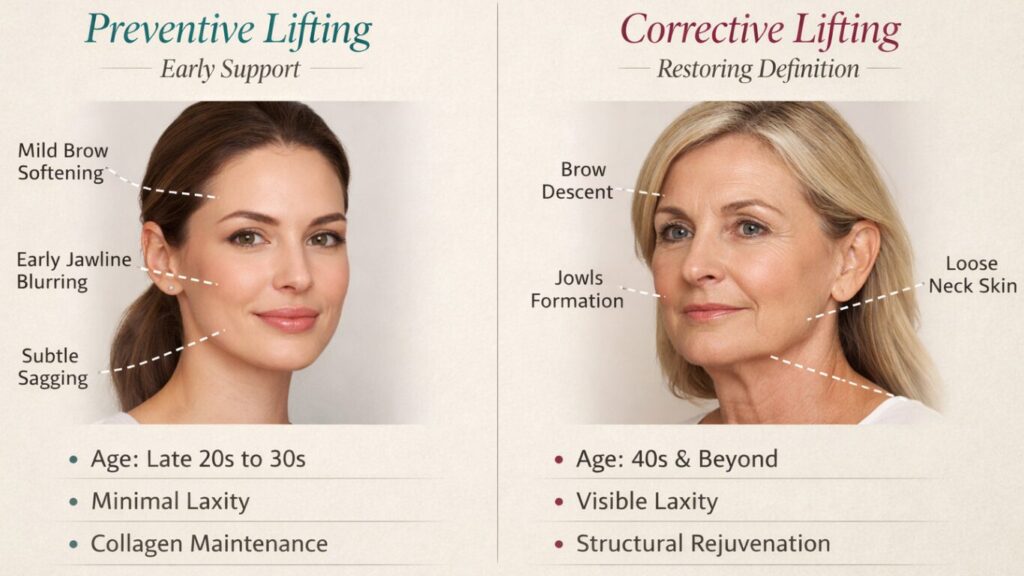
Chronological age does not always reflect biological skin age. Two individuals of the same age may show very different levels of laxity depending on:
Because of this variability, treatment timing is better guided by skin behavior and structural changes, not just a number.
From around the late 20s to early 30s, collagen production gradually declines. This does not immediately result in visible sagging, but the foundation that keeps skin firm begins to weaken.
Over time:
At this stage, collagen-stimulating treatments such as ultrasound-based lifting can help reinforce these deeper support layers while they are still responsive.

A common misconception is that preventive treatment is unnecessary if visible aging has not yet appeared. In reality, preventive strategies are designed to work with the body’s existing repair mechanisms when regeneration is still efficient.
Preventive use of treatments like Ultherapy focuses on:
This does not mean starting as early as possible. Instead, it means intervening when early laxity is detectable but not advanced.

There is no universal “correct age” to begin lifting-focused treatments. The right time is usually identified when subtle structural changes begin to appear, such as:
At this stage:
The emphasis is on doing the right treatment at the right stage, not doing more treatment.At VIDASKIN Medical Aesthetic Clinic, treatment planning is guided by anatomical assessment, skin quality, and long-term aging patterns rather than age alone, allowing preventive and corrective strategies to be introduced appropriately and progressively.