- 501 Orchard Road, #04-08 Wheelock Place, Singapore 238880
- (65) 6235 4429
- hello@vidaskinclinic.com
- (65) 9830 0597
Patients often ask which skin booster offers the best value or return on investment. The honest answer is that hyaluronic acid skinboosters, polynucleotide injectables, and PDLLA collagen stimulators are designed for different jobs, so the best ROI depends on what your skin actually needs.
If your main goal is hydration and glow, the answer may be very different from someone whose priority is resilience, repair, or long-term collagen support. This is why the best booster is not simply the newest or most expensive one, but the one that matches your skin goals most accurately.
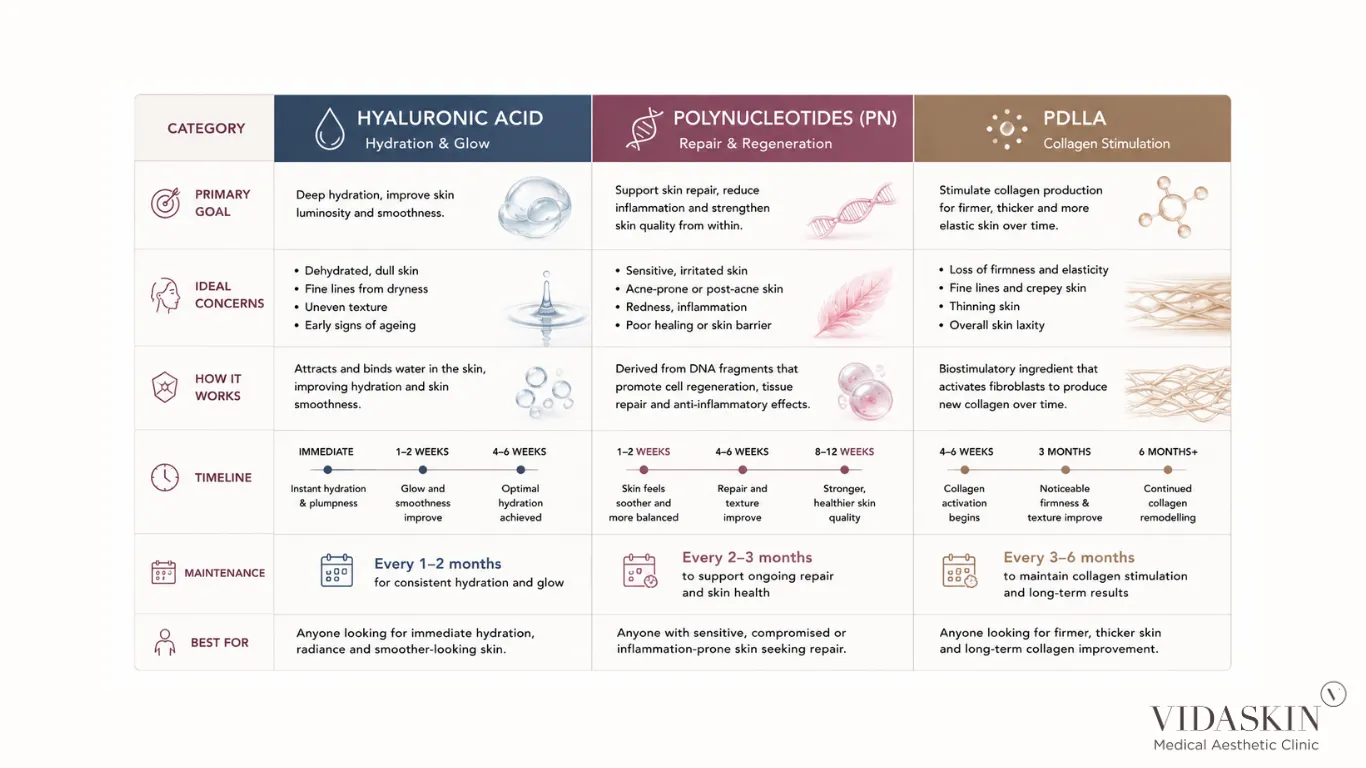
In aesthetics, ROI is not just about upfront price or how long a treatment lasts. It is about how effectively the treatment addresses your main concern, how well it fits into your long-term skin plan and whether the results justify the maintenance required.
A treatment may seem impressive on paper, but if it is poorly matched to your skin or your expectations, the return is lower. At VIDASKIN, the discussion around ROI is therefore not only about cost, but about treatment logic, durability, suitability and how the skin is expected to age over time.

Hyaluronic acid skin boosters are usually what people first think of when they hear the term “skin booster”. They involve microinjections of hyaluronic acid into the skin to improve hydration, smoothness, radiance, and overall skin quality.
These treatments are usually chosen for their hydration-led effect. They are particularly useful for skin that looks dull, dehydrated, tired, or slightly crepey, and they can help improve glow and suppleness without changing facial shape.
Hyaluronic acid often gives the best ROI when the main concerns are dryness, lack of glow, and early fine lines. Patients who want fresher-looking skin relatively quickly often find HA skinboosters rewarding because the benefits are easy to appreciate.
They also make sense for patients who are new to injectables and want to start with a skin quality treatment rather than a structural filler. If the aim is hydration-first improvement, HA usually offers a very logical return.
HA skinboosters are less about deep repair or longer-term collagen remodelling. If skin is fragile, highly reactive, significantly textured, or showing early laxity, hydration alone may not fully address the problem.
In those situations, the ROI of HA drops if it is being asked to do more than it was designed to do. It remains useful, but may need to be combined with or followed by another category of treatment.
Polynucleotide-based injectables are often selected when the goal is more regenerative than purely hydrating. They are typically discussed in the context of skin repair, resilience, dermal health, and support for a healthier skin environment.
Patients often gravitate toward polynucleotides when their skin feels thinner, more tired, more textured, or less resilient. Rather than simply making the skin look wetter or glowier, the aim is often to help it behave better over time.
Polynucleotides often offer a strong ROI when the patient’s goal is not just glow, but better skin quality over months. They can be especially relevant in patients who feel their skin is ageing in a more “fragile” way, or who want support after repeated procedures, environmental stress, or ongoing sensitivity.
Their return is often more cumulative than instant. This means they may appeal most to patients who think in terms of long-term skin behaviour and resilience rather than an immediate event-ready result.
Polynucleotides are not usually the first choice when the only goal is quick hydration or luminous glow before an occasion. They may improve texture and quality, but that is a different kind of return from what a classic HA booster delivers.
Their ROI can therefore feel lower if they are judged by the wrong standard. They perform best when the treatment goal is repair-led or resilience-led rather than simply cosmetic dewiness.
PDLLA sits in the collagen stimulator or remodelling category. At VIDASKIN, PDLLA-based skin boosters are considered when the goal is deeper support for skin firmness, quality and long-term collagen regeneration rather than short-term hydration alone.
This category is often associated with gradual improvement in skin density, elasticity and fine crepiness. The changes tend to build over time, which is why PDLLA is often viewed through a longer-term collagen banking lens.
PDLLA can offer strong ROI for patients who are thinking beyond glow and into structural skin quality. If the concern is early laxity, thin skin, fine crinkling or the desire for longer-term improvement in firmness, PDLLA may make more sense than repeated hydration-only treatments.
It may also be attractive for patients who are willing to commit to a series and value improvements that unfold gradually and potentially last longer. For the right patient, the longer arc of benefit can make the return feel very worthwhile.
PDLLA is not automatically the best first step for everyone. If the skin barrier is unstable, pigment is poorly controlled or the patient is mainly chasing quick radiance, a collagen stimulator may not be the most efficient opening move.
Its ROI is highest when the patient understands that the goal is gradual collagen support, not instant plumpness. In some cases, the skin may first need hydration, barrier support or a more stabilising phase before PDLLA is introduced.

A helpful first question is: what do you want most from treatment right now?
This is why choosing the “best” booster without defining the goal first usually leads to confusion.
Some treatments are appreciated relatively quickly, while others reward patience. HA boosters often satisfy patients who want a more immediate visible improvement, whereas polynucleotides and PDLLA usually make more sense in a medium- to longer-term plan.
Maintenance style also matters. Some patients prefer lighter but more regular maintenance, while others prefer a deeper collagen-building strategy with more gradual visible change. The better ROI often depends on what kind of treatment journey you are realistically willing to maintain.
The best ROI never comes from judging one syringe in isolation. Skin quality treatments work best when barrier care, inflammation control, pigment management, sun protection and treatment sequencing are considered together.
At VIDASKIN, the best booster is selected as part of a wider plan. That means your age, skin behaviour, lifestyle, previous procedures, and long-term goals all matter just as much as the product category itself.

For some patients, the smartest route is to start with hydration-led support using hyaluronic acid, then move into polynucleotides or PDLLA as the skin becomes more stable and the goals shift toward resilience or collagen support.
This staged approach can create a better return because each category is used for the role it performs best.
In patients with more fragile or mature skin, it may make more sense to focus on skin quality first before considering more structural interventions. In that context, polynucleotides or PDLLA may provide better ROI by improving the foundation before more contour-based treatments are added.
Trying to do everything simultaneously can make it harder to understand what is working and can complicate both expectations and maintenance. A more staged approach usually gives cleaner feedback and often better long-term value.
At VIDASKIN, the discussion is never framed as “which trendy injectable should we do next?” The approach is to choose only treatments that have a clear scientific role, a responsible safety profile, and a logical place within a patient’s long-term plan.
That means the answer to “which booster gives the best ROI?” is always individualised. For one patient, the best return may come from classic hydration. For another, it may come from repair or collagen banking. The point is not to force one winner, but to match the right category to the right skin.

Choosing between hyaluronic acid, polynucleotides, and PDLLA is easier when the decision is anchored in your actual skin behaviour rather than general marketing claims. A proper consultation helps identify whether your skin needs hydration, resilience, remodelling, or a combination over time.
At VIDASKIN, the goal is to recommend a booster plan that fits your skin now and supports where you want it to be in the future. That is what creates the most meaningful return on investment.
Learn more or book a consultation with us today.
Hyaluronic acid usually gives the most obvious hydration and glow effect when that is the main goal. Polynucleotides and PDLLA are more often chosen for repair, resilience and collagen-focused improvement over time.
Not necessarily. They serve different purposes. Polynucleotides are often more repair-focused, while hyaluronic acid is more hydration-focused. The better option depends on what your skin needs.
PDLLA is better understood as a collagen stimulator that can be used in a skin quality or skinbooster-style treatment plan. Its role is more about remodelling and long-term support than immediate hydration alone.
In some patients, yes. A staged or combination approach can make sense depending on whether the immediate need is hydration, repair or collagen support. The sequence should be planned medically rather than guessed.
The best return depends on your main concern, your skin condition, your preferred maintenance style and your long-term goals. A consultation helps determine whether hydration, resilience or collagen remodelling should take priority first.

Founded in 2015, Dr Vicki has grown with the clinic, to become one of the leading aesthetic clinicians in Singapore. She is an appointed key opinion leader and trains other aesthetic doctors on how to best use prestigious brands and treatments.
