- 501 Orchard Road, #04-08 Wheelock Place, Singapore 238880
- (65) 6235 4429
- hello@vidaskinclinic.com
- (65) 9830 0597

Chin projection has a major influence on how balanced the face looks from both the front and the side. A chin that is too recessed, too short, or poorly integrated with the jawline can affect facial harmony, profile definition, and the overall proportions of the lower face.
This is why chin enhancement is not just about making the chin bigger. In many patients, the goal is to improve structural balance, reduce the appearance of a weak lower face, and create a more harmonious relationship between the chin, lips, nose, and jawline.

A balanced facial profile is not based on one feature alone. It depends on the relationship between the forehead, nose, lips, chin, and jawline, as well as how the upper, middle, and lower thirds of the face work together.
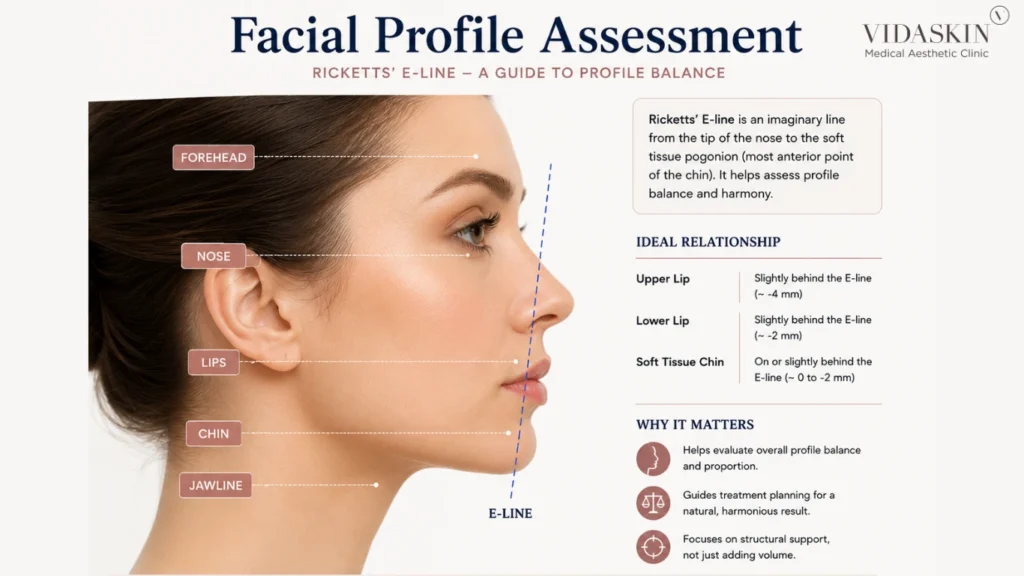
Ricketts’ E-line, also known as the esthetic line, is an imaginary line drawn from the tip of the nose to the soft tissue of the chin. It is commonly used as one of the profile reference points when assessing how the lips and chin relate to the rest of the face.
Although ideal values vary by ethnicity, sex, and facial structure, the E-line remains a useful concept for understanding whether the lips appear relatively protrusive or whether the chin appears retruded. It is a guide rather than a rigid beauty rule.
Facial harmony is assessed by looking at both profile and frontal balance. This includes chin projection, lower facial height, lip posture, jawline definition, chin width, symmetry, and how the chin relates to the midface.
Assessment is not only about measuring one angle or line. It also involves understanding how the face moves, how soft tissue drapes over the bone, and whether a structural imbalance is affecting the overall impression of the face.
The lower face plays a major role in defining maturity, structure, and overall contour. When the chin is under-projected, the jawline can look less crisp, and the nose or lips may appear relatively more prominent.
A balanced lower face helps create a smoother transition from the lips to the chin and from the chin to the neck. This can make the profile look more refined and proportionate without a dramatic change.
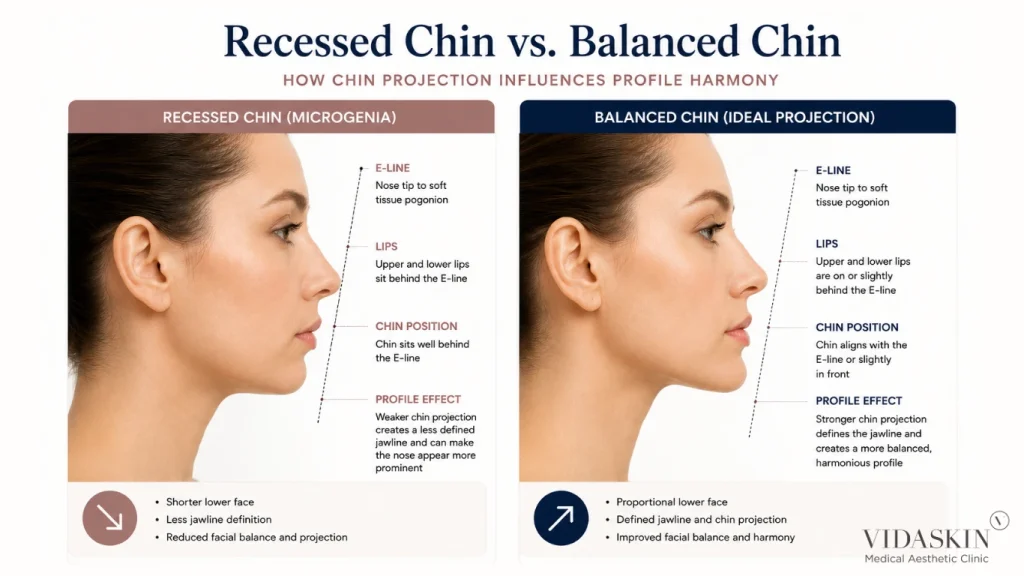
A recessed chin can happen for several reasons, including inherited bone structure, developmental pattern, soft tissue characteristics, and age-related changes in the lower face.
Microgenia refers to a chin that is under-projected or relatively small compared with the rest of the facial profile. It may be mild and mostly aesthetic, or it may be more pronounced and contribute to a visible lower face imbalance.
Some patients describe this as a weak chin or receded chin. Even a subtle deficiency can affect the profile by making the lips or nose appear more prominent and by reducing lower face definition.
The bony chin is the foundation of chin projection. If the mandibular symphysis is retruded or underdeveloped, the soft tissue chin will also tend to sit further back.
This is why the bony structure is such an important part of chin assessment. Soft tissue treatments can improve contour and projection, but the treatment plan should always be based on the underlying framework and not just the visible skin surface.
Soft tissue also affects how the chin looks. Skin laxity, reduced support, altered fat distribution, and age-related changes around the lower face can all influence chin contour and definition over time.
As ageing progresses, the relationship between the chin and jawline may become less distinct. In some patients, this makes a naturally recessed chin appear even weaker because the lower face loses crispness and support.
The chin and jawline should not be treated as separate features. They work together to create continuity, lower face shape, and structural balance.
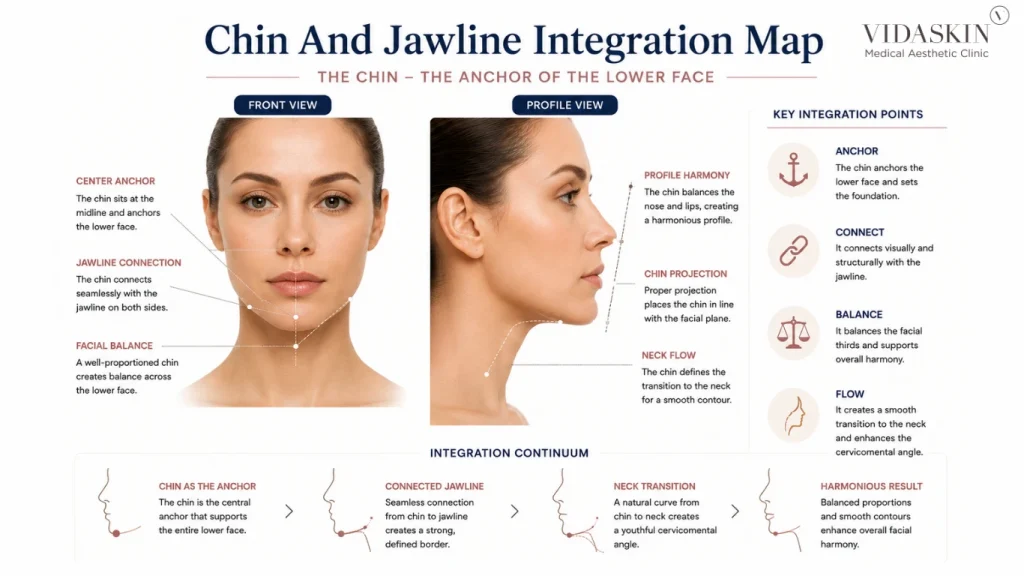
A well-projected chin usually helps the jawline appear more continuous and defined. When the chin is better supported, the lower face often looks more structured even without excessive treatment along the mandible.
This is why chin filler can sometimes improve perceived jawline definition indirectly. The chin acts as an anchor point for the lower facial contour.
When the chin and jawline are not in balance, the lower face may look short, weak, or less structured. In profile, the jawline can appear less crisp, and the face may seem to lack definition.
In some patients, chin retrusion coexists with a wider or softer lower face contour. In others, the chin is too short relative to the rest of the lower third. This is why treatment planning must look at the lower face as a whole.
Lower face structural harmony refers to how the chin, jawline, lips, and neck contour relate to each other. A harmonious lower face usually looks stable, supported, and proportionate rather than sharp or exaggerated.
The goal is not to create an artificially pointed or overly projected chin. It is to restore enough projection and continuity to support a more balanced facial framework.
Chin projection is not only an aesthetic issue. In selected patients, a recessed or short chin may also influence how the lower lip and surrounding muscles behave.
The mentalis is a muscle in the chin area that helps elevate the lower lip and soft tissue of the chin. In some people with a recessed or short chin, this muscle becomes overactive at rest or during lip closure, creating visible chin dimpling or tension.
This is often referred to as mentalis muscle strain. It may be more noticeable when the lips are trying to come together or when the lower face lacks adequate support.
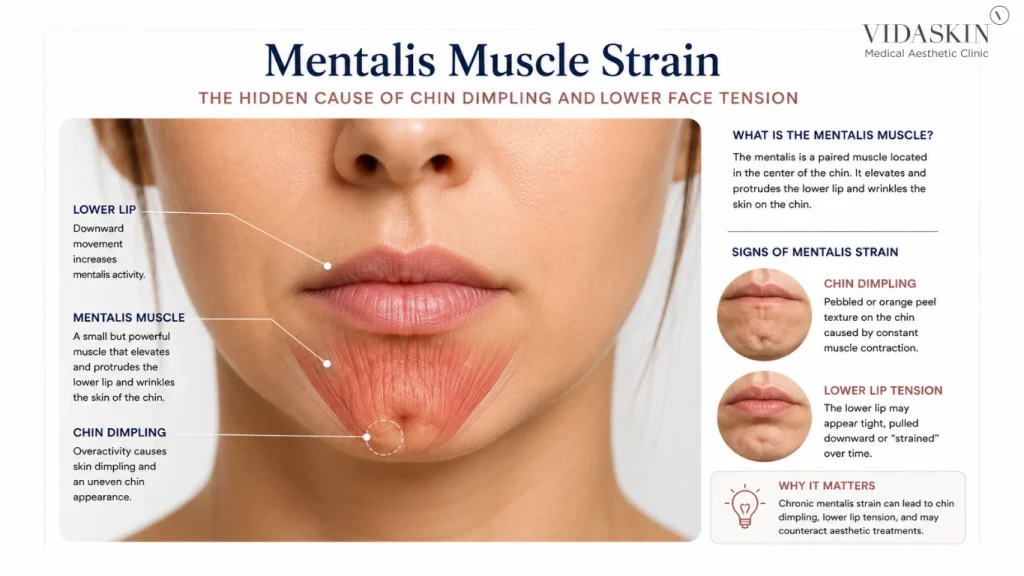
Excess mentalis activity can make the chin look puckered, strained, or uneven. It may also contribute to the impression of lower face tension and make the chin appear shorter or more irregular.
For some patients, this adds to the appearance of facial imbalance even if the underlying structural deficiency is not severe. This is why a chin assessment should include both static appearance and dynamic muscle movement.
Function and aesthetics often overlap in the lower face. The way the lips rest, how the chin muscles activate, and how the jawline supports the soft tissues can all influence appearance.
A treatment plan that respects both form and function is more likely to create results that look natural. In some cases, improving structural support may also reduce the strained look of the chin area.
Chin enhancement can be approached surgically or non-surgically, depending on the severity of the deficiency, the patient’s goals, and the underlying anatomy.
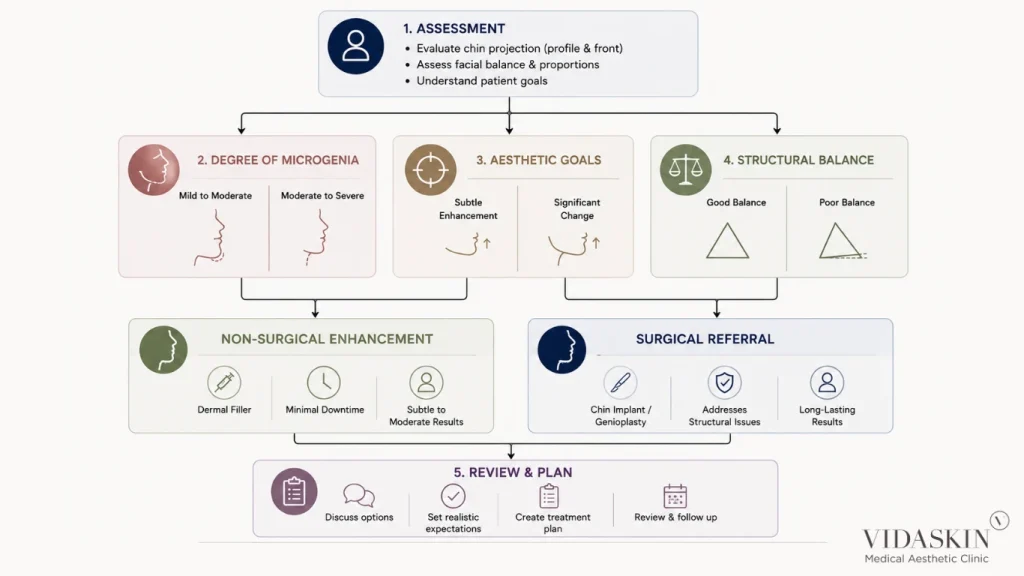
Mild to moderate microgenia may be improved with non-surgical methods such as chin fillers, while more significant skeletal deficiencies may require surgical options such as genioplasty or orthognathic assessment. The right choice depends on how much projection change is needed and whether there are bite or skeletal issues involved.
This is why proper consultation matters. Not every recessed chin should be managed the same way, and not every patient seeking chin enhancement is best served by filler alone.
Yes, in selected patients, chin projection can be improved non-surgically with dermal fillers. Chin fillers can enhance projection, improve contour, support the lower face, and create better profile balance without surgery.
The aim is usually a subtle structural improvement rather than an obvious enlargement. A non-surgical plan may be particularly helpful for patients with mild microgenia, those seeking temporary enhancement, or those who want to preview a more projected chin before considering surgery.
The chin does not exist in isolation. Facial balance also depends on the cheeks, lips, jawline, and nose, which is why lower face planning is often considered together with the midface.
For example, a face with strong cheeks but a recessed chin may still look unbalanced from the side. Likewise, improving the chin can sometimes change how prominent the nose or lips appear relative to the rest of the profile.
At VIDASKIN, chin filler treatment is planned as part of a full facial assessment rather than a one-point correction. The focus is on understanding profile balance, chin-jawline integration, lower face proportions, and whether a recessed chin is contributing to aesthetic or muscular strain.
Dr Vicki and the medical team will assess your facial profile, discuss your goals, and advise whether chin fillers, broader facial contouring or referral for other structural options may be more appropriate. The aim is to create a natural-looking result that improves harmony without overcorrection.
Learn more about Cheek Fillers or book a consultation with us today.
Ricketts’ E-line is an imaginary line from the tip of the nose to the soft tissue chin used as one reference point in profile assessment. It helps clinicians evaluate how the lips and chin relate to the rest of the face.
Microgenia refers to a chin that is relatively small or under-projected compared with the rest of the face. It is often described as a recessed or weak chin.
Yes. In suitable patients, chin fillers can improve lower face balance, strengthen profile definition and create a better relationship between the chin, lips and jawline.
Mentalis muscle strain refers to overactivity or tension in the chin muscle, often seen as dimpling or puckering of the chin. It can be associated with a recessed or short chin in some patients.
They can. Because the chin and jawline work together, improving chin projection can enhance the continuity and definition of the lower facial contour.