- 501 Orchard Road, #04-08 Wheelock Place, Singapore 238880
- (65) 6235 4429
- hello@vidaskinclinic.com
- (65) 9830 0597

Cheek fillers in Singapore are not only about creating higher cheekbones; they also play a key role in restoring midface volume, supporting facial structure, and softening folds around the mouth. When used thoughtfully, cheek fillers can lift and rebalance the face in a way that looks natural rather than filled.
This article explains how midface ageing happens, why deep and superficial fat pads matter, and how targeted malar volume restoration can indirectly improve areas such as the nasolabial fold while preserving natural facial character.

Midface ageing is more than just a flat cheek. It involves changes in bone, deep and superficial fat pads, ligaments, skin quality, and overall facial proportions.
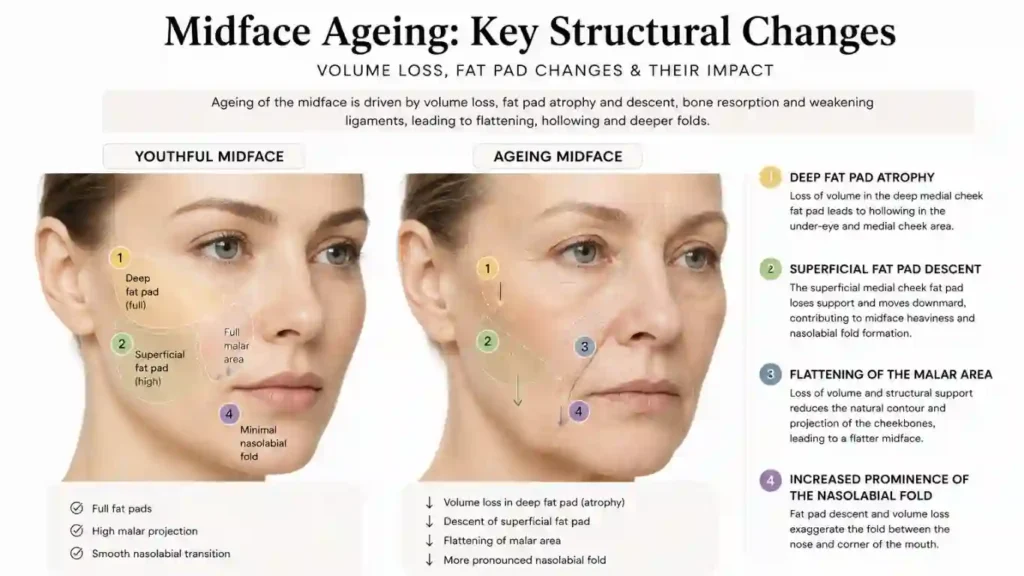
Deep fat pads sit closer to the bone and provide foundational support for the overlying cheek and midface. With age, these deeper fat compartments can shrink and descend, reducing the scaffold that keeps the midface lifted and projecting.
As deep fat pad volume decreases, the overlying tissues no longer have the same support. This loss of internal cushion contributes to a flatter midface, hollowing under the eyes, and a heavier appearance around the nose and mouth.
When the midface loses volume, light no longer reflects off the cheeks in the same way. The face can look more tired or drawn, with a less defined cheek contour and more prominent shadows under the eyes and along the nasolabial fold.
The lower face may appear heavier because tissues that were once supported by the cheek begin to descend. This can make the nasolabial folds deeper and contribute to early jowling, even if the lower face itself has not yet lost much volume.
The cheek is a central structural point in the face. It sits at the intersection of the under-eye area, the nasolabial fold, the lateral face, and the midface contour.
By restoring support in the right areas of the cheek, it is often possible to improve the appearance of several adjacent regions at once. This is why midface assessment is such an important starting point for many filler treatment plans.
The face contains multiple layers of fat, each with different roles in support, contour, and expression.
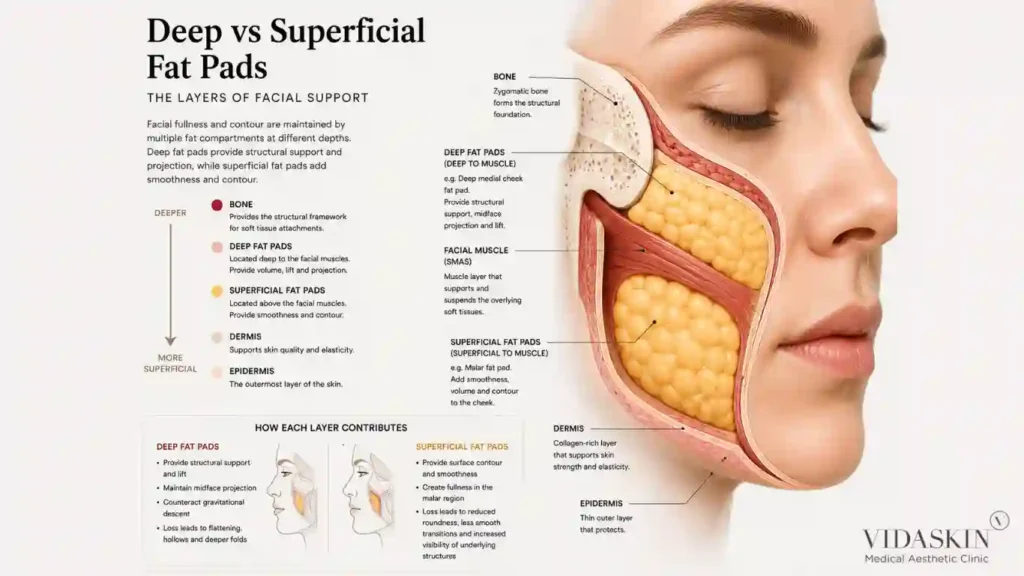
Broadly, the midface has deeper fat pads that sit close to the bone and more superficial fat pads that lie closer to the skin. Deep fat compartments tend to provide structure and projection, while superficial fat contributes to soft contours and smooth transitions.
With age, these compartments do not all change at the same rate. Some deflate earlier, some descend, and some remain relatively stable. This layered pattern is why volume loss can be quite specific to certain areas and depths.
When deep fat pads lose volume, the cheek platform flattens and drops. The overlying superficial fat and skin then have less support, which can make folds and shadows more noticeable.
Superficial fat pads can also thin and become less evenly distributed. This may cause irregularities in contour or make skin laxity more apparent. Addressing only the superficial plane without considering the deeper support may not give the most natural or durable result.
Layer-specific treatment means considering which depth is most responsible for the visible change. In many cases, restoring deep support first with structural cheek fillers can create a more subtle and effective lift.
After deep volume is addressed, more superficial refinement can sometimes be added if needed. This staged, layered approach helps to avoid excessive bulk in one plane and supports a more natural transition between facial regions.
Cheek fillers can do more than fill a hollow. When placed strategically, they can restore malar volume and indirectly improve nearby features such as the nasolabial fold and midface contour.
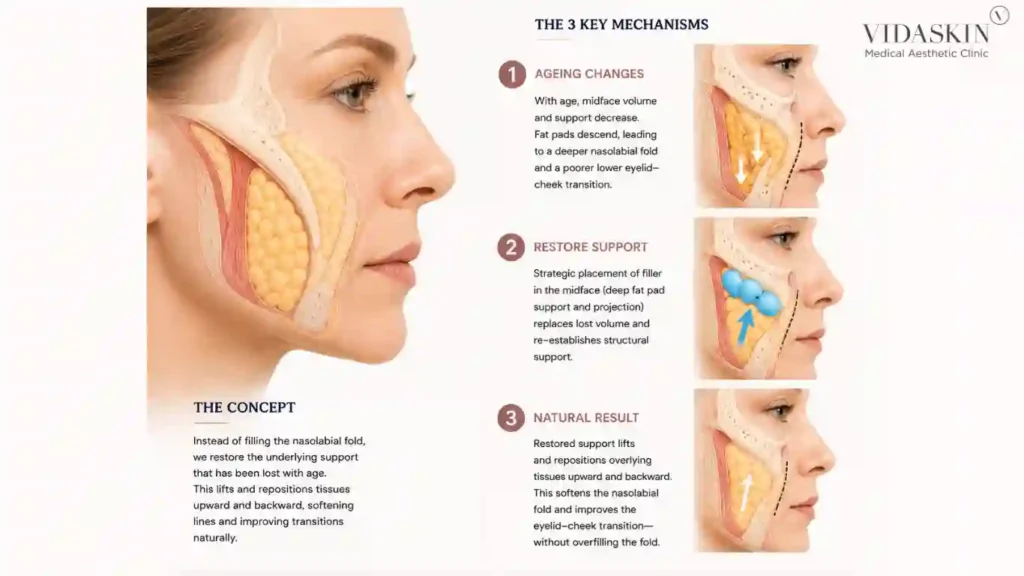
The malar area refers to the bony cheek region that helps define the midface. Restoring volume in this zone can bring back the gentle, youthful convexity that reflects light across the cheek.
By using fillers with suitable structural support in the correct planes, it is possible to rebuild this foundation without creating an obvious pillow look. The aim is to re-establish a smooth, natural-looking cheek curve rather than a sharp or exaggerated prominence.
The nasolabial fold often becomes more prominent when the midface above it loses support. If the cheek platform is lifted and re-supported, some of the heaviness that weighs on the fold can be relieved.
In many cases, treating the cheek first can soften the appearance of the nasolabial fold indirectly. This may reduce the amount of filler needed directly in the fold itself, which can help maintain a more natural facial expression and avoid an overfilled look around the mouth.
By restoring support to the midface, cheek fillers can help rebalance the relationship between the under-eye region, cheek, and lower face. This can create a smoother transition from the lower eyelid to the cheek and from the cheek to the nasolabial area.
The goal is to improve the overall facial contour rather than focusing on a single line or shadow. When proportions are rebalanced, the face often looks fresher and more rested, even if the change in any one area is subtle.
Beyond volume, cheek fillers can be used to enhance structural landmarks such as the zygomatic arch and lateral cheek, which contribute to facial definition.
The zygomatic arch is the bony ridge that runs from the cheek towards the ear. A well-defined zygomatic area can create a gentle, elegant contour along the side of the face.
In selected patients, adding subtle volume along this arch can improve facial definition and enhance the perception of lift. The key is to respect the natural anatomy and avoid placing the product too superficially or in a way that looks sharp or unnatural.
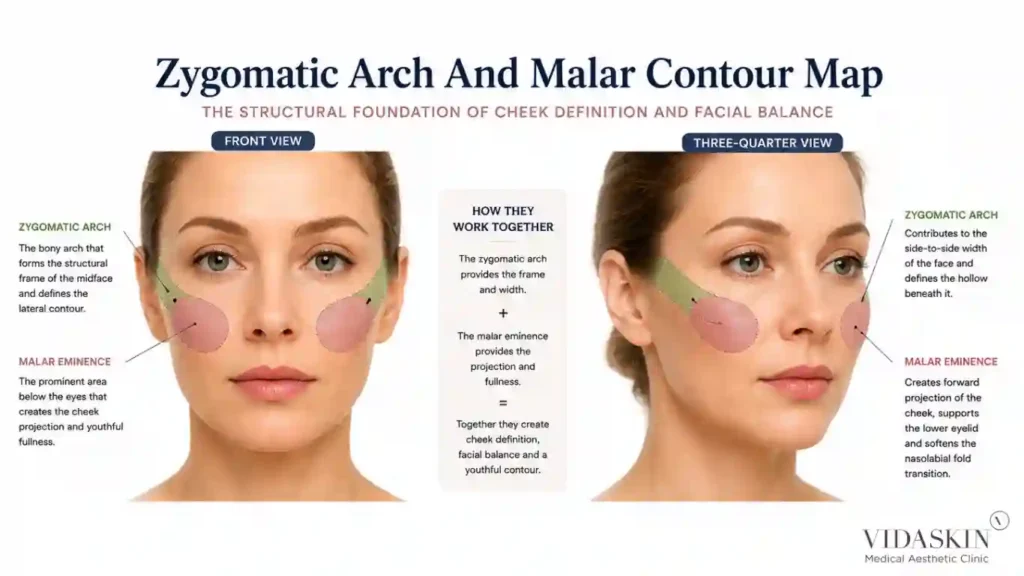
As bone and deep fat diminish with age, the upper midface can lose its structural framework. Cheek fillers can help to restore some of this support, improving how soft tissue drapes over the underlying structures.
This structural reinforcement can also influence how light and shadow fall across the face, often leading to a more youthful and harmonious appearance without needing to chase every fine line.
Natural-looking results come from working with the face rather than against it. That means understanding where lift will contribute to harmony and where restraint is more appropriate.
By focusing on strategic support points and respecting facial proportions, cheek fillers can create lift and softening without making the face look puffy or unrecognisable. Often, the most successful results are the ones that simply make others say you look well-rested and refreshed.
A good midface filler treatment begins with careful assessment and planning rather than starting with a syringe.
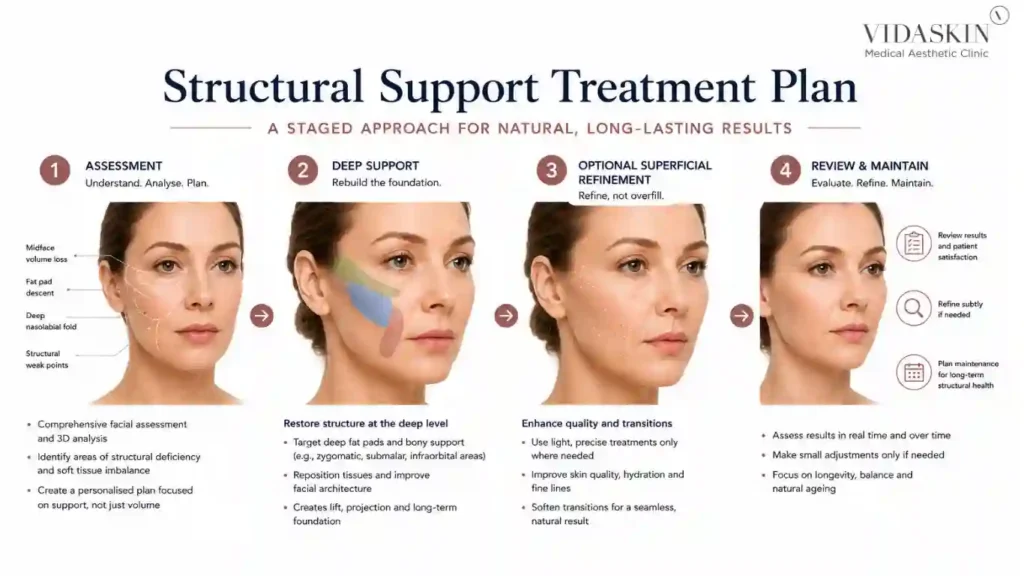
Assessment includes evaluating bone structure, existing volume distribution, ligament support, skin quality, and asymmetries. The same amount of filler will look different on two faces with different skeletal foundations.
Looking at the face from multiple angles—front, oblique, and profile—helps to understand where support is needed most. It also helps anticipate how changes in the midface will influence adjacent areas such as the tear troughs, nasolabial folds, and jawline.
There is no single template for cheek fillers. The exact placement, depth, type of filler, and amount used should be tailored to the individual’s anatomy, age-related changes, and goals.
Some patients may benefit mainly from deep structural support, while others may need a combination of deep and more superficial refinement. The plan may be staged across more than one session to allow for subtle adjustment and to avoid overcorrection.
The best cheek treatments often combine structural logic with aesthetic subtlety. This means providing enough support to make a meaningful improvement, while still keeping changes in tune with the rest of the face.
Small adjustments can have a significant impact when placed in key support points. Working gradually, with regular review, helps to ensure that the result looks refined, proportionate, and in line with the patient’s preferences.
At VIDASKIN, cheek filler treatment is approached as part of a broader facial assessment, not as an isolated procedure. The focus is on understanding how midface volume, deep and superficial fat pads, bone structure, and skin quality interact in your unique facial anatomy.
Dr Vicki and the medical team will evaluate your midface from different angles, discuss your concerns and goals, and design a personalised treatment plan that may include cheek fillers, other facial fillers, or complementary treatments as appropriate. The aim is to restore support, enhance definition, and create a natural-looking lift that still feels like you.
Learn about Cheek Fillers or book a consultation with us.
Cheek fillers restore support in the midface by replacing age-related volume loss and reinforcing structural areas such as the malar region. This can improve cheek contour, soften shadows and create a more lifted appearance.
Yes, in some patients cheek fillers can soften the nasolabial fold indirectly by restoring support higher in the midface. This may reduce the need to place large amounts of filler directly into the fold.
Deep fat pads sit closer to bone and provide foundational support, while superficial fat pads lie closer to the skin and contribute to soft contours and transitions. Both can change with age, but they do not age in exactly the same way.
Malar volume restoration refers to rebuilding support in the cheek prominence area to restore youthful contour and midface projection. It is often an important part of facial rejuvenation and structural filler planning.
When planned properly, cheek fillers should support and lift the face without making it look overfilled. A layered, anatomy-based approach helps maintain natural proportions and avoid bulkiness.