- 501 Orchard Road, #04-08 Wheelock Place, Singapore 238880
- (65) 6235 4429
- hello@vidaskinclinic.com
- (65) 9830 0597
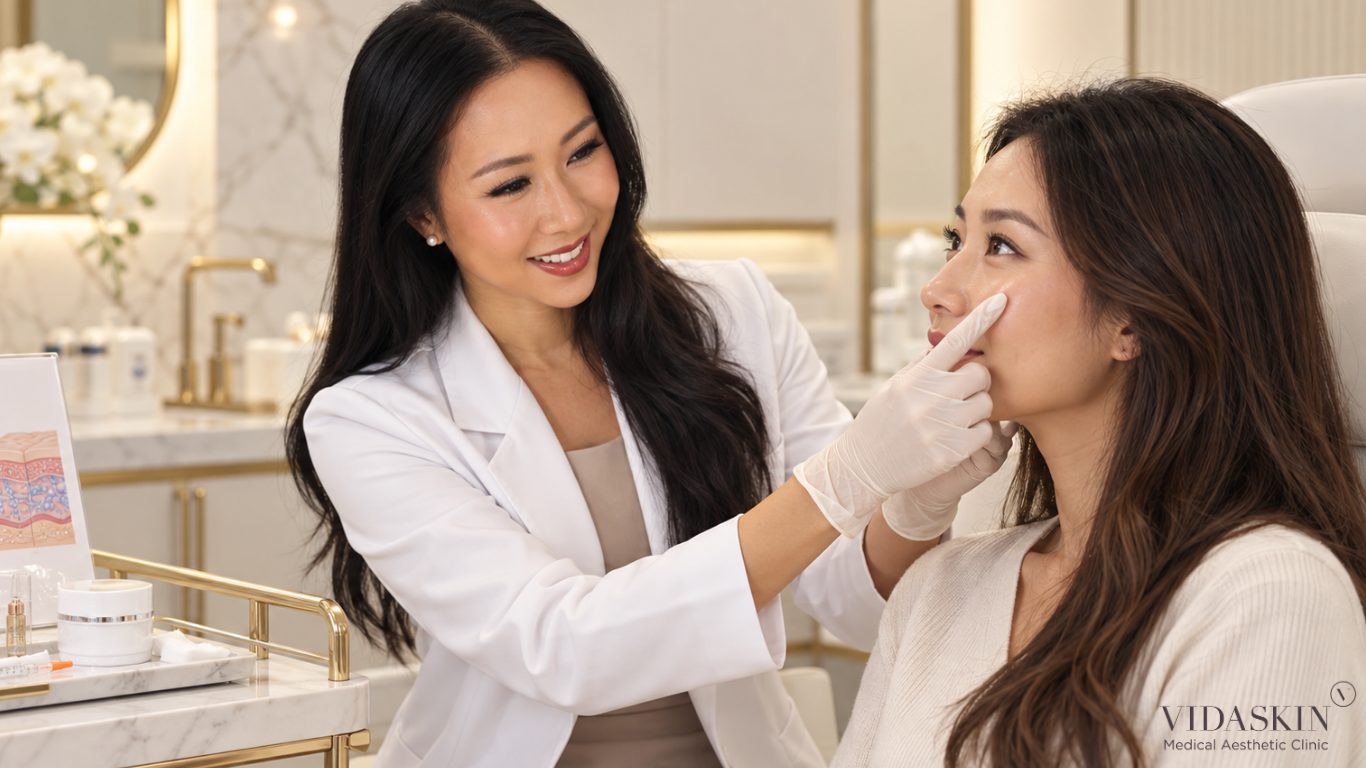
By Dr Kay Low, Senior Aesthetic Physician, VIDASKIN
Hyaluronic acid, polynucleotides and collagen stimulators are the three main families of skin boosters. All three are injected into the skin, all three aim to improve skin quality, and all three are often described in similar marketing language. Yet they work in fundamentally different ways.
Understanding these differences is the most useful thing a patient can know before choosing a skin booster. As an aesthetic doctor with a special interest in skin boosters, I find that once patients understand the mechanism behind each one, the right choice for their skin often becomes obvious.
This article compares the three side by side: how they work, what the evidence shows, how quickly they act, how long they last, and who each suits best.
One adds water, one supports repair, and one rebuilds structure. Everything else follows from this.
Hyaluronic acid (HA) is a natural component of the skin’s extracellular matrix. It binds large amounts of water, helping keep the dermis hydrated and supple. With age and sun exposure, the skin’s natural HA declines.
HA skin boosters deliver stabilised HA into the dermis. The HA attracts water, improving hydration, smoothness and radiance. There is also evidence that HA in the dermis may provide mechanical support that encourages fibroblasts to produce collagen, so HA boosters may offer some collagen benefit over time.
HA skin boosters are the most established category, with a substantial body of clinical studies, including randomised trials, showing improvements in hydration, elasticity and fine lines.
Polynucleotides are purified DNA fragments, most commonly from salmon or trout. Laboratory studies suggest they stimulate fibroblasts, act as a scaffold for tissue repair and reduce inflammation. Shorter fragments, known as PDRN, are thought to act partly through adenosine A2A receptors, which are involved in tissue repair.
In simple terms, polynucleotides are thought to help the skin repair and regenerate itself, rather than adding something to it.
Laboratory and animal evidence is strong. Clinical studies in people are encouraging but generally small and short-term. Real-world clinical experience, including my own, is positive, particularly for thin, sensitive and scarred skin. Larger trials are still needed.
Collagen stimulators, also called biostimulators, contain microparticles that trigger a controlled tissue response. Fibroblasts are activated and produce new collagen around the particles over several months. The particles are gradually broken down, while the new collagen remains.
The collagen-stimulating effect of these materials is well documented, including in histological studies. Evidence for specific uses, such as improving pores or acne scars, is more limited and varies by product.
| Hyaluronic Acid | Polynucleotides | Collagen Stimulators | |
|---|---|---|---|
| Main action | Hydration | Repair and regeneration | New collagen production |
| Speed of visible results | Fast (one to two weeks) | Gradual (weeks) | Gradual (two to three months) |
| Typical course | One to three sessions | Three to four sessions | Two to three sessions |
| Typical longevity | Around six to twelve months | Around six to twelve months | Often a year or more |
| Best for | Dehydration, dullness, fine lines | Thin, crepey, sensitive skin, scars | Laxity, thinning, pores, texture |
| Downtime | Minimal | Bumps may last one to three days | Minimal to moderate swelling |
| Strength of clinical evidence | Strongest | Promising, still developing | Strong for collagen effect |
Longevity varies with the specific product, your skin and lifestyle.
Your main concern is dehydration, dullness or fine lines, or you want visible improvement relatively quickly, for example before an event.
Your skin is thin, crepey, sensitive or redness-prone, you are concerned about the under-eye area, or you have acne scarring.
You are noticing loss of firmness, thinning skin, enlarged pores or uneven texture, and you are happy to wait a few months for gradual, longer-lasting results.
Yes, and for many patients, combining them gives the best results. The three categories address different layers of the skin’s needs, so they complement rather than duplicate each other.
A typical approach in my practice might be:
The exact order and spacing depend on the skin, the products and the patient’s priorities. Combining well is about sequencing thoughtfully, not layering everything at once.
“Polynucleotides are just a fancier HA.” They are not. They work through different biological pathways and do not primarily hydrate.
“Collagen stimulators are fillers.” Most are not used to add volume. They stimulate your own collagen gradually.
“Newer means better.” Newer treatments may be exciting, but HA boosters remain among the best-supported options for hydration.
“One type is right for everyone.” Each type suits different skin concerns, and the best choice is individual.
HA skin boosters mainly hydrate the skin by binding water. Polynucleotides are thought to support the skin’s repair processes and calm inflammation.
Polynucleotides support repair and regeneration, while collagen stimulators trigger new collagen production through a controlled tissue response.
No. Fillers add volume immediately. Collagen stimulators prompt your skin to build collagen gradually over months.
HA boosters usually show results fastest, within one to two weeks. Polynucleotides and collagen stimulators work more gradually.
Collagen stimulators often last longest, typically a year or more after a full course. HA and polynucleotide results usually last around six to twelve months.
Polynucleotides are often chosen for sensitive or redness-prone skin because of their potential calming effects.
Polynucleotides are commonly used for thin, crepey under-eye skin. Light HA boosters may also be used carefully.
Collagen stimulators are usually the best choice for early loss of firmness. Significant sagging may need lifting treatments.
HA skin boosters have the most established clinical evidence. Collagen stimulators are well studied for their collagen effect. Polynucleotide evidence is promising but still developing.
Yes. Some formulations combine them, and they can also be used in the same treatment plan. Your doctor will advise on timing.
Some studies suggest HA in the dermis may support collagen production through mechanical stimulation of fibroblasts, though this is a secondary effect.
PDRN refers to shorter DNA fragments with similar origins to polynucleotides. It has been studied for tissue repair and wound healing.
When injected by an experienced doctor, they have a good safety profile. The main risk is small lumps or nodules, which are closely linked to technique.
HA boosters generally have minimal downtime. Polynucleotide bumps may last slightly longer, and collagen stimulators may cause mild swelling.
A doctor’s assessment of your hydration, skin thickness, sensitivity, texture and laxity is the best way to decide.
Yes. Your plan can change as your skin changes. Many patients use different boosters at different stages.
The difference between HA, polynucleotides and collagen stimulators is not a matter of which is better. It is a matter of which is right for your skin, right now.
To discuss which approach suits your skin, book a consultation with Dr Kay Low.
Dr Kay Low is a Senior Aesthetic Physician at VIDASKIN with a special interest in skin boosters and skin quality. She graduated in medicine from the University of Cambridge (MA, MB BChir) and is registered to practise in both Singapore and the United Kingdom. Her clinical interests include early facial ageing in the 30s and 40s, sensitive and redness-prone skin, and women’s skin across life stages.
This article is for general education and does not replace an individual medical consultation. Suitability and results vary between patients.

Dr. Kay Low is a UK-trained medical doctor with over 7 years of clinical experience across the UK and Singapore, specialising in aesthetic medicine. A graduate of the University of Cambridge, she has worked across multiple medical and surgical disciplines in the UK and Singapore before completing postgraduate training in Family Medicine and advanced training in aesthetic medicine.
