- 501 Orchard Road, #04-08 Wheelock Place, Singapore 238880
- (65) 6235 4429
- hello@vidaskinclinic.com
- (65) 9830 0597
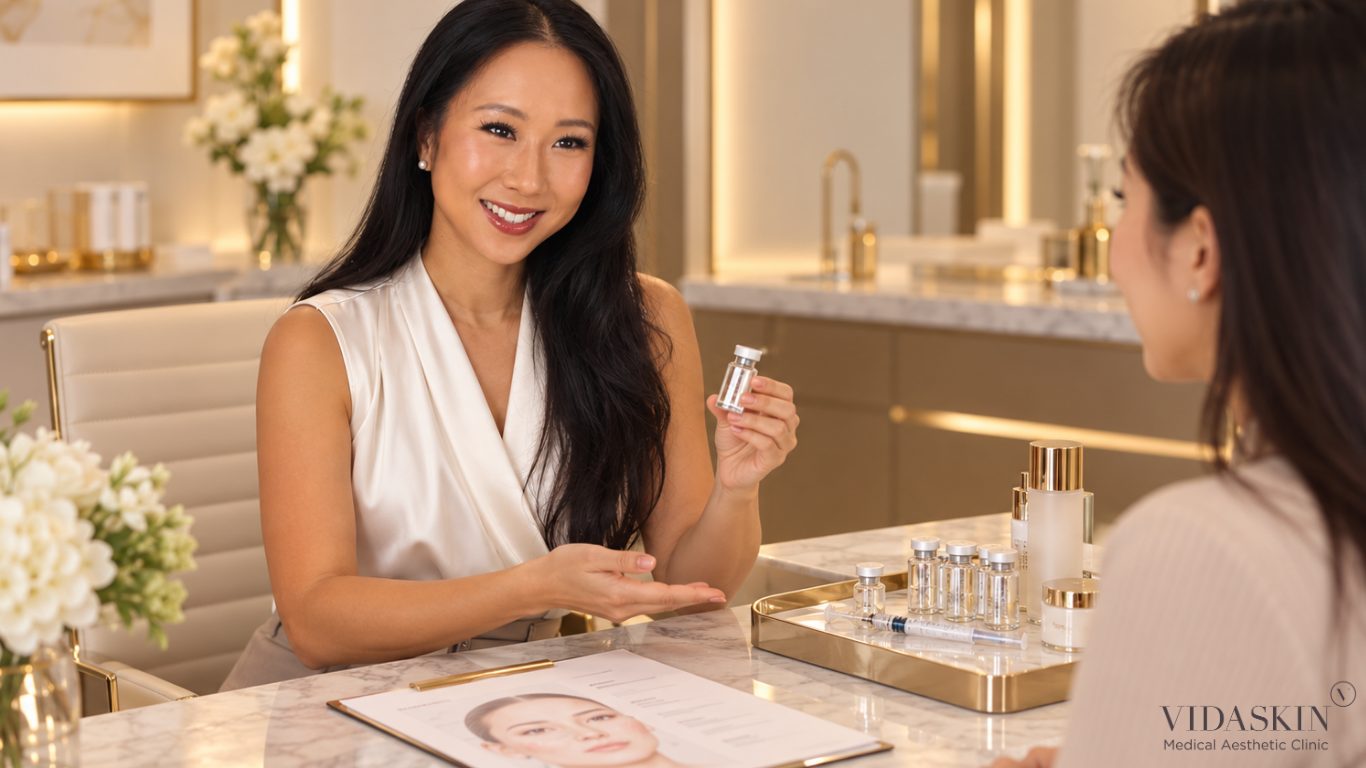
By Dr Kay Low, Senior Aesthetic Physician, VIDASKIN
“ECM skin boosters” is one of the newest terms in aesthetic medicine. You may have seen it alongside phrases like “skin regeneration”, “regenerative aesthetics” or “rebuilding the skin’s foundation”.
Behind the marketing is a real and important scientific idea. The extracellular matrix, or ECM, is the structural framework that holds the skin together. As we age, it weakens. Many modern skin treatments, including most skin boosters, are ultimately about supporting the ECM.
As an aesthetic doctor with a special interest in skin boosters, I find the ECM is the most useful framework for understanding why different boosters work, and for separating the science from the hype. This article explains what the ECM is, how it changes with age, how current skin boosters support it, and what the emerging research does and does not show.
The extracellular matrix is the network of molecules that surrounds and supports the cells in the dermis. If skin cells are the “workers”, the ECM is the building they work in.
Its main components are:
The ECM is not just scaffolding. It sends signals to fibroblasts, the cells that produce collagen and other matrix components. A healthy, well-organised ECM helps keep fibroblasts active. A weakened ECM can lead to less active fibroblasts, creating a cycle of decline.
From early adulthood, collagen production gradually slows while breakdown continues. Hyaluronic acid levels fall, and elastin fibres become less organised. For women, this accelerates after menopause.
Ultraviolet exposure increases the activity of enzymes called matrix metalloproteinases (MMPs), which break down collagen. Over time, sun-damaged skin develops fragmented, disorganised collagen and abnormal elastin. In Singapore, with year-round UV exposure, photoageing is a major factor.
Research suggests fibroblasts need mechanical tension from a healthy matrix to stay active. When collagen becomes fragmented, fibroblasts lose this tension and produce less collagen, which further weakens the matrix. Interrupting this cycle is one of the goals of regenerative skin treatments.
“ECM skin booster” is not a strict medical category. It is a term used to describe treatments that aim to support or rebuild the extracellular matrix, rather than only hydrating the skin surface.
In practice, it is used in two ways:
HA is a natural part of the ECM. HA boosters replenish it, improving hydration and cushioning. There is also evidence that HA in the dermis may restore some mechanical support to fibroblasts, encouraging collagen production. Some HA boosters include amino acids, antioxidants, or minerals intended to support matrix production.
Polynucleotides are thought to act as a scaffold and to stimulate fibroblasts while reducing inflammation. In ECM terms, they support the environment in which repair and matrix production happen.
PDLLA Skin Boosters, CaHA biostimulators, and HA–CaHA hybrids trigger new collagen production. They directly address one of the most important ECM components and help restore mechanical support to the dermis.
Treatments such as Ultherapy, RF skin tightening, and RF microneedling also stimulate ECM remodelling by creating controlled heat that triggers new collagen and elastin formation.
Interest in regenerative aesthetics is growing quickly. Several newer approaches are being researched or marketed:
Injectable collagen products, including those using animal-derived or recombinant (lab-produced) collagen, aim to replace or support collagen directly. Some early studies are promising, but evidence varies widely by product, and long-term data are limited.
Some injectables contain peptides or amino acids intended to signal fibroblasts or provide building blocks for collagen. Laboratory evidence suggests biological plausibility, but robust clinical trials are limited.
Growth factors and exosomes are heavily marketed as regenerative treatments. While the biology is interesting, clinical evidence in aesthetic medicine is still early, product quality and consistency vary considerably, and regulatory status differs between countries. In my view, patients should be cautious about bold claims in this area.
When considering any “regenerative” or “ECM” treatment, it helps to ask:
Biological plausibility is a reasonable starting point, but it is not the same as proven clinical benefit.
When I plan skin booster treatment, I think in terms of the ECM:
The most important ECM treatment is still daily sunscreen. No injectable can keep up with ongoing UV damage.
The extracellular matrix is the network of collagen, elastin, hyaluronic acid and other molecules that supports skin cells and gives skin its strength, elasticity and hydration.
It is a term for treatments that aim to support or rebuild the skin’s extracellular matrix. It is not a strict medical category, and it can describe several types of injectables.
Collagen production slows, hyaluronic acid decreases and elastin becomes disorganised. Sun exposure accelerates these changes by increasing collagen breakdown.
Many skin boosters support the ECM in different ways: HA replenishes hydration, polynucleotides support repair, and collagen stimulators rebuild structure.
Regenerative aesthetics refers to treatments that aim to stimulate the body’s own repair and renewal processes, rather than only adding volume or hydration.
Not necessarily. HA boosters are among the best-studied skin boosters. Newer ECM-focused products may be promising, but evidence varies.
The biology is interesting, but clinical evidence in aesthetics is still early, and product quality and regulation vary. Caution is advisable.
Injectable collagen products aim to deliver collagen directly into the skin. Some are animal-derived, and some are produced in laboratories. Evidence varies by product.
They are enzymes that break down collagen. Sun exposure increases their activity, which is one reason UV causes premature ageing.
Yes. Sunscreen, retinoids and antioxidants have good evidence for protecting and supporting collagen in the skin.
Collagen-stimulating boosters such as PDLLA, CaHA and HA–CaHA hybrids most directly stimulate new collagen. The right choice depends on your skin.
Some of it is grounded in solid science, and some is ahead of the evidence. It is important to ask what type of evidence supports each claim.
No treatment reverses ageing. ECM-supporting treatments can improve skin quality and resilience, and help skin age more gradually.
Treatments that stimulate collagen typically take weeks to months to show results, because new matrix forms gradually.
Established skin boosters have good safety profiles when used appropriately. For newer products, check regulatory approval and evidence carefully.
A doctor’s assessment of hydration, skin thickness, laxity, sun damage, and sensitivity helps determine which part of the matrix needs the most support.
Understanding the extracellular matrix helps explain why some skin treatments work, and why others are more marketing than medicine. The goal is not to chase the newest trend, but to support your skin’s structure using the best available evidence.
To discuss a science-led plan for your skin, book a consultation with Dr Kay Low.
Dr Kay Low is a Senior Aesthetic Physician at VIDASKIN with a special interest in skin boosters and skin quality. She graduated in medicine from the University of Cambridge (MA, MB BChir) and is registered to practise in both Singapore and the United Kingdom. Her clinical interests include early facial ageing in the 30s and 40s, skin longevity, and women’s skin across life stages.
This article is for general education and does not replace an individual medical consultation. Suitability and results vary between patients.

Dr. Kay Low is a UK-trained medical doctor with over 7 years of clinical experience across the UK and Singapore, specialising in aesthetic medicine. A graduate of the University of Cambridge, she has worked across multiple medical and surgical disciplines in the UK and Singapore before completing postgraduate training in Family Medicine and advanced training in aesthetic medicine.
