- 501 Orchard Road, #04-08 Wheelock Place, Singapore 238880
- (65) 6235 4429
- hello@vidaskinclinic.com
- (65) 9830 0597
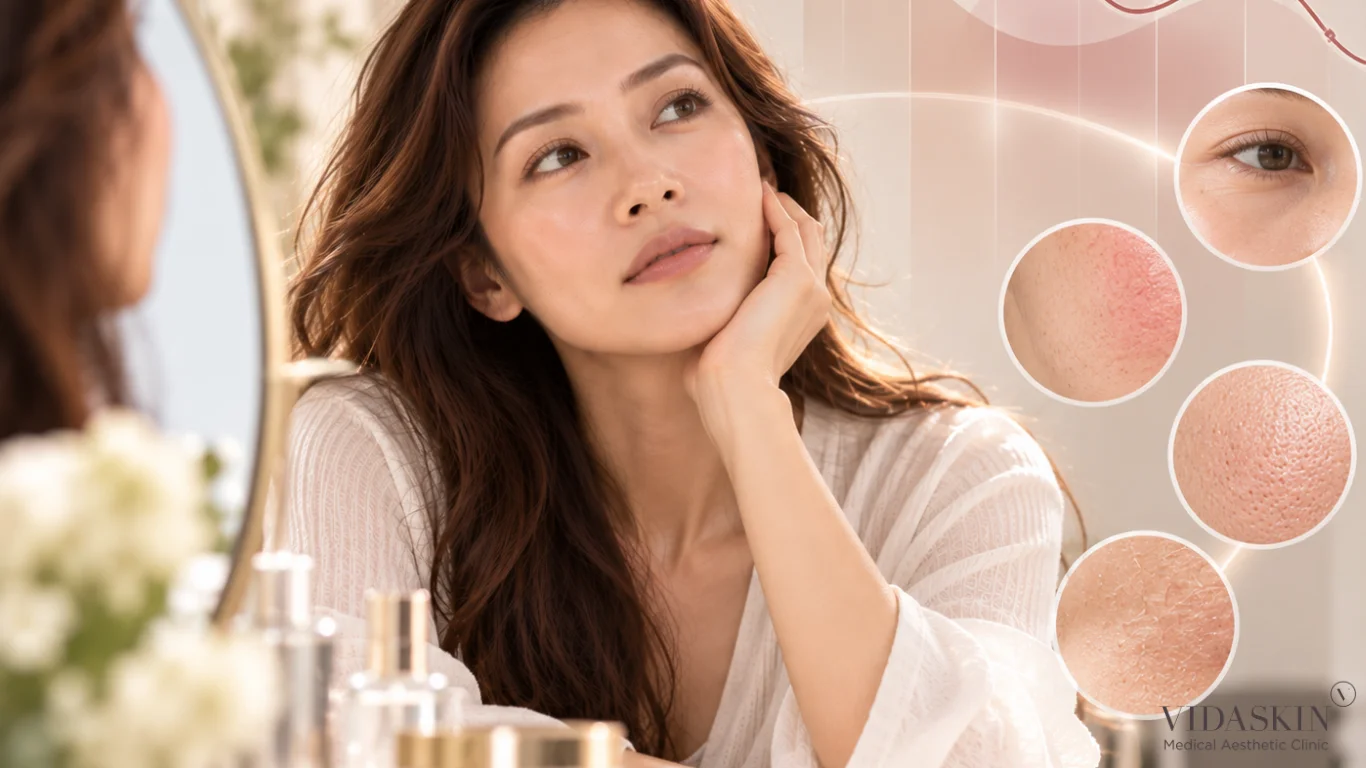
One of the things I hear increasingly from women in their 40s is:
“I don’t understand what is happening to my skin.”
Perhaps they have developed acne again after having clear skin for years.
Their face suddenly flushes more easily.
Products they have used for years now sting.
Their skin feels dry, itchy, or sensitive.
An old tendency towards eczema seems to have returned.
And at the same time, they may be sleeping badly, experiencing changes in their periods, feeling warmer at night, noticing changes in body composition, or simply feeling that their body is behaving differently.
Very often, these women think they have suddenly developed “bad skin”.
But sometimes the more useful question is:
Could this be part of perimenopause?
As I study healthy longevity medicine more deeply, I have become increasingly interested in the relationship between hormones, inflammation and the skin.
Perimenopause doesn’t happen only to our reproductive system.
Our skin experiences it too.
We often think of oestrogen as a reproductive hormone.
But oestrogen receptors are found throughout the body, including in the skin.
Oestrogen influences several aspects of skin physiology, including collagen, hydration, vascularity, sebaceous activity, wound healing and barrier function. As oestrogen declines around menopause, studies describe reductions in collagen and elasticity alongside increasing dryness, atrophy and changes in barrier function.
But perimenopause is particularly interesting because hormones don’t simply switch off one day.
They fluctuate.
For some women, this period of hormonal transition can coincide with skin that suddenly feels much less predictable.
And this is where inflammation enters the conversation.
A healthy skin barrier does much more than keep our skin looking smooth.
It helps retain water, protects us from environmental irritants and participates in immune defence.
When that barrier becomes compromised, the skin can lose water more readily and become more susceptible to irritation.
At the same time, hormonal changes can influence immune signalling, vascular behaviour and sebaceous function.
So rather than thinking:
Perimenopause → inflammation → eczema, acne and rosacea
I think a more accurate way to visualise it is:
Hormonal change
↓
changes in barrier + sebum + vascular reactivity + immune signalling
↓
a different skin environment
↓
in susceptible individuals, inflammatory skin conditions may appear or behave differently.
That distinction matters because these conditions are not all the same disease, and we should not treat them as though they are.
This can be particularly frustrating.
You finally leave teenage acne behind—and decades later, it comes back.
Adult female acne is a chronic inflammatory disorder of the pilosebaceous unit, and hormones play an important role.
During the menopausal transition, oestrogen declines while the influence of androgens can become relatively more prominent. Alongside inflammation, changes in sebum, follicular keratinisation, the microbiome and other individual factors, this can contribute to acne in susceptible women.
Perimenopausal acne may also look different from the acne we remember from our teenage years.
We may see inflammatory lesions concentrated around the:
Sometimes there are relatively few lesions—but they are deep, painful and persistent.
And there is another problem.
The skin around the acne may simultaneously be becoming drier and more sensitive.
So treating a 45-year-old woman’s acne exactly as we treated her at 16 may not make sense.
Her skin biology has changed.
This is another common story.
A woman tells me:
“I’ve suddenly become sensitive to everything.”
The moisturiser she has used for ten years stings.
Retinoids she previously tolerated are suddenly unbearable.
Her skin feels tight after washing.
She develops itchy or eczematous patches.
This is where the skin barrier becomes particularly important.
Lower oestrogen states are associated with changes in hydration and barrier function, and xerosis—dry skin—and pruritus are recognised skin concerns around menopause.
But I would be careful about saying menopause directly causes eczema.
Eczema is a complex inflammatory disease involving genetics, immune dysregulation, barrier dysfunction, and environmental triggers.
What hormonal transition may do in some women is alter the background environment of the skin, potentially making an already susceptible barrier less resilient.
That is a very different—and more useful—way of thinking about it.
Rosacea is even more interesting.
Many women associate perimenopause with flushing because vasomotor symptoms—hot flushes—are so common.
And a woman who is already prone to rosacea may certainly notice that heat, flushing, stress, alcohol or other triggers make her redness more apparent.
But scientifically, we need to be careful.
Rosacea is a complex inflammatory and neurovascular disorder, and current evidence does not establish a simple relationship in which falling oestrogen causes rosacea. In fact, a recent systematic review found that acne and rosacea generally improved after menopause across the studies it assessed, although the evidence is heterogeneous and hormone-therapy findings are more complicated.
So if rosacea appears or worsens during perimenopause, I don’t want to dismiss it as:
“It’s your hormones.”
I want to diagnose and treat the rosacea properly while also understanding what else has changed.
That distinction is important.
Inflammaging describes the chronic, low-grade inflammatory state associated with ageing.
It is a systemic biological concept.
Having acne, eczema or rosacea does not mean that you have “inflammaging”, nor does treating facial inflammation reverse systemic biological ageing.
But studying inflammaging has changed how I think about these patients.
Because I increasingly see ageing not simply as:
loss of collagen → wrinkles → treat the wrinkle.
I see a much more complicated biological environment involving:
And then I look at the woman sitting in front of me who says:
“Everything changed when I turned 45.”
Suddenly, treating only what I can see on her face feels incomplete.
This is probably the most important part of my approach.
If you suddenly develop acne in your 40s, I don’t automatically want to put you on a machine.
If your face is persistently red, I want to know whether it is rosacea.
If your skin is itchy and inflamed, I want to understand whether we are dealing with eczema, irritant dermatitis, allergic contact dermatitis or something else.
And if the skin change is occurring alongside other symptoms—changes in menstrual cycles, hair loss, hirsutism, significant weight or metabolic changes, or other systemic symptoms—we may need to look beyond the skin.
Adult female acne, for example, can occasionally occur in association with endocrine disorders. Most women with a few perimenopausal acne lesions do not have abnormal circulating androgen levels, so indiscriminate hormone panels are not the answer either. Investigation should be driven by the history and clinical findings.
Good holistic medicine doesn’t mean testing everything.
It means knowing what questions to ask.
This is where I see our approach evolving.
Instead of starting with:
“What treatment do you want?”
I would rather start with:
“What has changed?”
We can then work through several layers.
If there is active acne, eczema or rosacea, our priority is to diagnose and manage it appropriately.
Depending on the condition, this may involve prescription topical or oral medication, appropriate skincare, trigger management and, in selected situations, procedural treatments.
We shouldn’t be trying to “rejuvenate” actively inflamed skin while ignoring the disease itself.
Sometimes we actually need to do less.
Patients with newly sensitive perimenopausal skin often arrive with extraordinarily complicated routines:
acid cleanser, vitamin C, exfoliating toner, retinoid, AHA, BHA, scrub, mask…
And then they tell me their skin is burning.
This may be the time to simplify.
A gentle cleanser, appropriate moisturiser, sunscreen and carefully selected active ingredients may be far more useful than continuing to layer increasingly aggressive products onto an unhappy skin barrier.
More skincare is not always better skincare.
Hormonal change is part of the menopausal transition, but that does not mean every skin symptom needs hormone treatment.
If a woman has significant menopausal symptoms, the appropriate discussion may extend beyond dermatology and aesthetics to her gynaecologist or menopause physician.
Menopausal hormone therapy should be prescribed based on an individual’s overall symptoms, health profile, risks and benefits—not simply as a cosmetic treatment for her skin.
There is evidence that menopausal hormone therapy can influence parameters such as skin collagen, thickness, and elasticity, but that is not in itself a reason to prescribe it.
This is where multidisciplinary care matters.
Once inflammatory disease is controlled, and the barrier is functioning appropriately, we can consider what the skin needs aesthetically.
That might include treatments for:
And this is where lasers, energy devices, injectables and regenerative treatments can have a role.
But the order matters.
Diagnose → stabilise → optimise → rejuvenate.
I think that is a much more sensible approach than simply adding another treatment.
This is the part that increasingly interests me as I study healthy longevity.
Perimenopause isn’t only about oestrogen.
A woman at this life stage may simultaneously be dealing with sleep disruption, stress, changes in exercise and muscle mass, changes in body composition, metabolic health and nutrition.
These factors matter to her overall health.
And some can also influence how she experiences her skin.
I don’t want to make the opposite mistake and claim that eating perfectly, sleeping eight hours and exercising will cure someone’s rosacea or eczema.
Medical conditions deserve medical treatment.
But I also don’t think we should look at an organ in isolation from the human being it belongs to.
This is what I ultimately want women to take away from this article.
If your skin suddenly becomes dry, sensitive, acne-prone or prone to flushing in your 40s, you haven’t necessarily done anything wrong.
Your biology may be changing.
And perhaps instead of responding by buying stronger skincare, adding another acid or booking the most aggressive laser we can find, we should first ask:
What is happening to the skin?
What is happening hormonally?
Is there inflammation or barrier dysfunction that needs treatment?
And what else is happening to you as a whole?
Because perimenopause is not simply the end of reproductive years.
It is a biological transition that affects multiple systems in the body.
The skin can be part of that story.
And as doctors, I think our job is not simply to make that skin look better.
It is to understand why it changed in the first place—and then decide what it actually needs.
That is the direction I want us to take at VIDASKIN.
Not just treating ageing skin. Caring for the person who is ageing.
Hormonal changes during the menopausal transition can contribute to adult female acne in susceptible women. Declining oestrogen and the relative influence of androgens may contribute, alongside inflammation, sebum production, follicular changes, microbiome factors and genetics.
Menopause is associated with increasing dryness, itch and changes in skin barrier function, but it would be too simplistic to say that perimenopause directly causes eczema. Eczema is a multifactorial inflammatory skin disease. Hormonal and barrier changes may alter how susceptible skin behaves.
There is no simple established causal relationship. Hormonal transition and vasomotor flushing may interact with symptoms in some individuals, but rosacea is a distinct inflammatory and neurovascular condition and should be assessed and treated as such. Current population-level evidence is mixed.
Changes in skin hydration and barrier function around menopause may make previously tolerated products feel more irritating. However, new sensitivity can have many causes, including overuse of active ingredients, irritant or allergic contact dermatitis, eczema and rosacea, so persistent symptoms deserve assessment.
Not necessarily. Many women with adult or perimenopausal acne have normal circulating androgen levels. Testing is more useful when the clinical history or examination suggests an underlying endocrine issue.
Research suggests menopausal hormone therapy can improve some skin parameters, including collagen content, thickness and elasticity. However, MHT is a medical treatment whose overall benefits and risks need to be considered; it should not be prescribed solely as an aesthetic skin treatment.

Founded in 2015, Dr Vicki has grown with the clinic, to become one of the leading aesthetic clinicians in Singapore. She is an appointed key opinion leader and trains other aesthetic doctors on how to best use prestigious brands and treatments.
