- 501 Orchard Road, #04-08 Wheelock Place, Singapore 238880
- (65) 6235 4429
- hello@vidaskinclinic.com
- (65) 9830 0597
There are some treatments I love because they produce dramatic results.
And then there are treatments I love precisely because they don’t.
Laser Genesis is one of them.
It is not the newest treatment in aesthetic medicine. It doesn’t promise to transform your face overnight. There isn’t usually a dramatic before-and-after photograph after one treatment.
Instead, it is one of those treatments I have returned to repeatedly over the years because of what it can do for something I think we sometimes underestimate: skin quality.
As I study healthy longevity medicine more deeply, I have also become increasingly interested in inflammation and ageing—and in a fascinating concept called inflammaging.
The two should not be confused. Laser Genesis does not “treat inflammaging” in the medical sense.
But understanding inflammaging has made me think differently about the skin we see every day: redness, sensitivity, chronic inflammation, impaired barrier function and the cumulative effects of environmental exposure.
It has reinforced something I have believed for a long time:
Good skin is not simply skin without wrinkles. It is skin that functions well.
Inflammation is not inherently bad.
When we are injured or develop an infection, inflammation is part of the body’s normal defence and repair system. It helps us respond to damage and then, ideally, resolves.
The problem is when inflammation becomes persistent, low-grade and dysregulated.
The term inflammaging was coined to describe the chronic, low-grade inflammatory state associated with ageing. Researchers are increasingly interested in how this persistent inflammatory environment interacts with multiple processes involved in age-related disease and declining physiological function.
Importantly, inflammaging is a whole-body biological concept.
It does not mean that somebody with rosacea, acne or sensitive skin necessarily has systemic inflammaging. Nor can we look at someone’s face and diagnose how quickly they are ageing internally.
But the concept has changed how I think about ageing.
Ageing is not simply about accumulating wrinkles.
It is about what happens to cells, tissues, repair mechanisms, immune regulation and our ability to maintain healthy function over time.
And our skin participates in many of these processes too.
We often think of skin as a covering for the body.
It is much more than that.
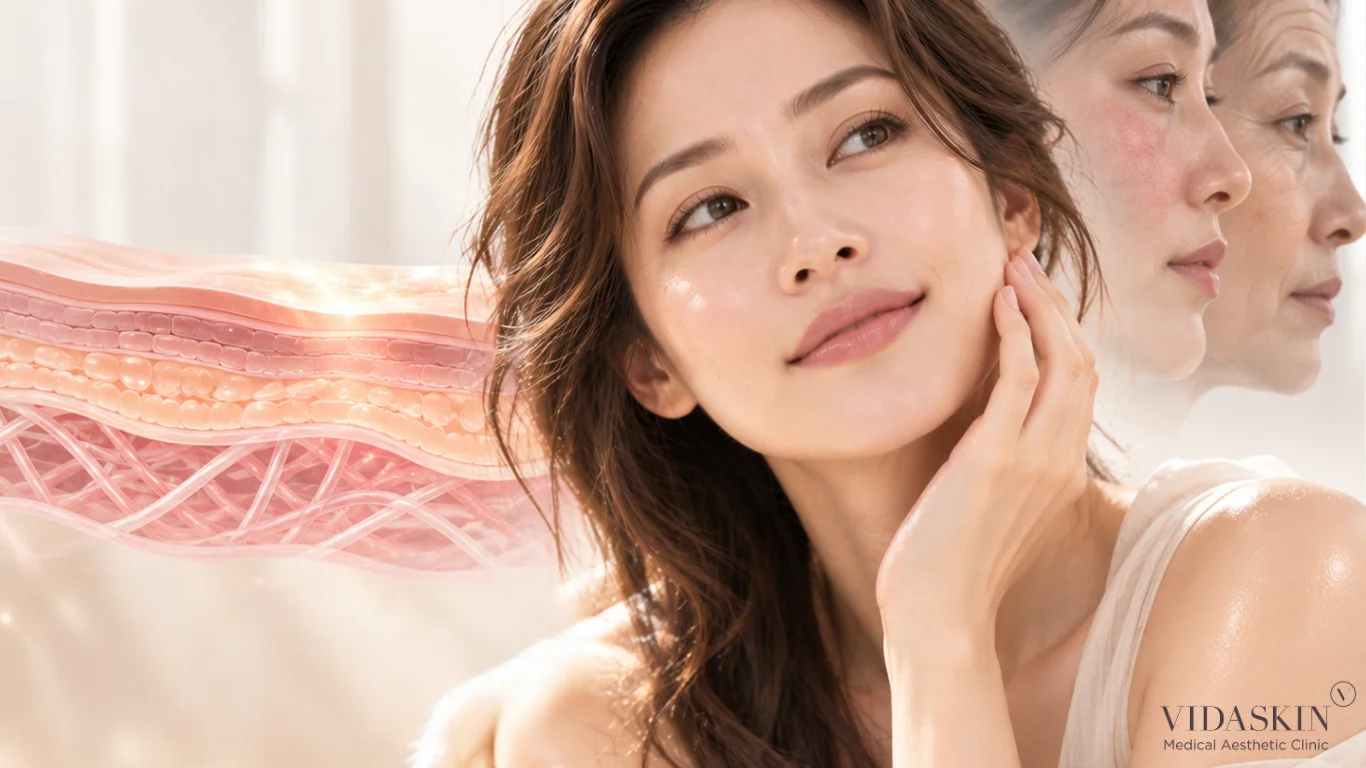
The skin is a metabolically and immunologically active organ. It contains immune cells, blood vessels, nerves, sebaceous glands, structural proteins and a complex microbiome, all interacting with one another.
It also sits at the interface between us and the outside world.
Every day, our skin encounters what researchers sometimes describe collectively as the exposome: ultraviolet radiation, pollution, climate, smoking, lifestyle factors and other environmental influences that accumulate throughout life.
The skin has to respond, repair and adapt continuously.
With ageing, however, some of these regulatory and repair processes become less efficient. Oxidative stress, cellular senescence, altered immune responses and chronic inflammatory signalling are increasingly being studied as interconnected contributors to skin ageing.
This is why I think we need to broaden the way we talk about “anti-ageing”.
When patients think about ageing, they often think about sagging.
And yes, structural ageing matters. We lose bone, fat compartments change, retaining structures change, collagen declines, and the face gradually changes shape.
We have treatments for those concerns.
Ultherapy PRIME can address selected aspects of tissue laxity. Fillers can restore structural support where appropriate. BTX can modify muscular activity.
But there is another component that is much easier to overlook:
What is the quality of the skin itself?
Is it persistently red?
Does it flush easily?
Is the texture rough?
Does it look dull?
Is pigmentation becoming increasingly irregular?
Is the barrier healthy?
Can the skin tolerate treatment appropriately?
You can lift a face beautifully and still have unhealthy-looking skin.
That is why skin quality has always been an important part of how we practise at VIDASKIN.
Laser Genesis has been around for many years. In an industry obsessed with what is new, that might make it seem less exciting.
For me, that is almost part of its appeal.
I don’t believe that a treatment becomes obsolete simply because something newer has launched.
What matters is whether it has a sensible biological mechanism, whether we understand what it can and cannot do, whether it has an acceptable safety profile for the appropriate patient, and whether we continue to see useful clinical outcomes.
Laser Genesis uses a 1064 nm Nd:YAG laser in a non-ablative approach. Rather than removing the surface of the skin, it delivers controlled thermal energy into the skin while leaving the epidermis intact.
It can be useful in appropriately selected patients where our goals include improving redness, uneven appearance, texture, and overall skin quality.
And importantly for many of our patients in Singapore, it generally involves relatively little downtime.
This is where the physics becomes interesting.
Laser treatments are not interchangeable simply because they are all called “lasers”. Different wavelengths interact differently with chromophores in the skin.
The 1064 nm wavelength penetrates relatively deeply and has lower absorption by epidermal melanin than several shorter wavelengths.
That characteristic can be useful when treating patients with more melanin-rich skin—which is particularly relevant to the diverse Asian skin types we see in Singapore.
But wavelength alone does not determine safety.
Fluence, pulse duration, spot size, cooling, treatment technique, indication, and the patient’s skin condition all matter.
Once again, the machine is only part of the treatment.
I prefer to be quite specific here because terms such as “rejuvenation” can become meaningless when they are used to describe everything.
Laser Genesis creates controlled dermal heating without ablating the skin surface.
Depending on the indication and treatment parameters, we may use it as part of a plan for concerns such as:
The treatment is also associated with dermal remodelling, which is one reason it has been used as a non-ablative skin rejuvenation treatment.
But I would not describe Laser Genesis as a facelift, nor would I promise that it removes every pore or wrinkle.
It is a skin-quality treatment.
And that is precisely why I like it.
This is where I want to make an important distinction.
Laser Genesis does not treat systemic inflammaging.
If someone has chronic low-grade systemic inflammation related to metabolic disease, ageing, or another medical condition, performing a laser treatment on their face is not going to solve that biological problem.
However, there is an interesting conceptual overlap.
Many skin conditions we encounter involve inflammatory and vascular components. Chronic UV exposure and environmental stress can contribute to oxidative stress and inflammatory signalling within the skin. Ageing skin itself shows changes in immune regulation and repair.
So studying inflammaging has made me more interested in creating an environment where the skin is less persistently irritated, better supported and able to function well.
That might involve laser treatment in the appropriate patient.
But it also involves something much less glamorous.
We cannot talk seriously about inflammation, skin ageing and longevity without talking about ultraviolet exposure.
UV radiation contributes to oxidative stress, DNA damage, collagen degradation, pigmentation changes and photoageing. Repeated exposure accumulates over decades.
So while we can use sophisticated devices to improve the consequences of ageing, we should not forget the basics.
Good skin ageing still involves:
A laser cannot compensate for everything else we do to our skin.
And I think good aesthetic medicine should be honest about that.
As I learn more about longevity medicine, I find myself increasingly drawn to interventions that make biological sense rather than simply sounding impressive.
I want to know:
What tissue are we targeting?
What biological response are we trying to create?
Is there evidence for it?
What are the limitations?
And is the intervention proportionate to what the patient actually needs?
Laser Genesis fits quite naturally into that philosophy.
It does not try to aggressively resurface every patient’s skin. It does not promise to reverse ageing. It provides controlled energy to encourage changes within the skin while generally preserving the epidermal surface.
For the right patient, sometimes gentle, repeated biological stimulation is exactly what I want.
One of the interesting tendencies in aesthetics is to assume that more powerful must mean better.
More energy.
More downtime.
More peeling.
More dramatic inflammation.
But biology doesn’t always work that way.
There are certainly situations where aggressive resurfacing is appropriate. For significant acne scarring, for example, we may deliberately need a much more intensive treatment strategy.
But if our objective is to maintain healthy-looking skin, reduce redness or gradually improve texture, creating unnecessary injury simply because we can doesn’t necessarily make sense.
Sometimes the appropriate treatment is the one that gives us enough biological stimulus without unnecessary disruption.
That is another reason Laser Genesis remains in my toolkit.
Ultimately, this is where my growing interest in longevity medicine has brought me.
I no longer think about “anti-ageing” simply as making somebody look younger.
I think about skin longevity.
How do we maintain healthy skin structure and function for as long as possible?
That may mean treating acne early so that inflammation does not result in permanent scarring.
It may mean controlling rosacea rather than repeatedly covering the redness.
It may mean recognising hormonal changes during perimenopause.
It means protecting the skin from UV exposure.
It may mean using lasers, energy devices or injectables when they are appropriate.
And sometimes it means recognising that the problem in front of us requires us to look beyond the skin altogether.
Because the skin is not separate from the person.
It is one organ within an extraordinarily complex biological system.
Aesthetic medicine changes quickly.
Every year brings another device, injectable, molecule, or treatment claiming to be the next breakthrough.
But I don’t think our responsibility is to offer everything new.
Our responsibility is to understand what works, why it works, who it is appropriate for, and when not to use it.
Laser Genesis has remained one of the treatments I enjoy using because it fits that philosophy.
It is not about chasing dramatic transformation.
It is about improving the environment and quality of the skin progressively, with relatively little interruption to everyday life.
And perhaps that is also why it resonates with what I am learning about longevity.
Healthy ageing is rarely one dramatic intervention.
It is the cumulative effect of many sensible decisions, repeated consistently over time.
For the skin, I think the same principle often applies.

Founded in 2015, Dr Vicki has grown with the clinic, to become one of the leading aesthetic clinicians in Singapore. She is an appointed key opinion leader and trains other aesthetic doctors on how to best use prestigious brands and treatments.
