- 501 Orchard Road, #04-08 Wheelock Place, Singapore 238880
- (65) 6235 4429
- hello@vidaskinclinic.com
- (65) 9830 0597

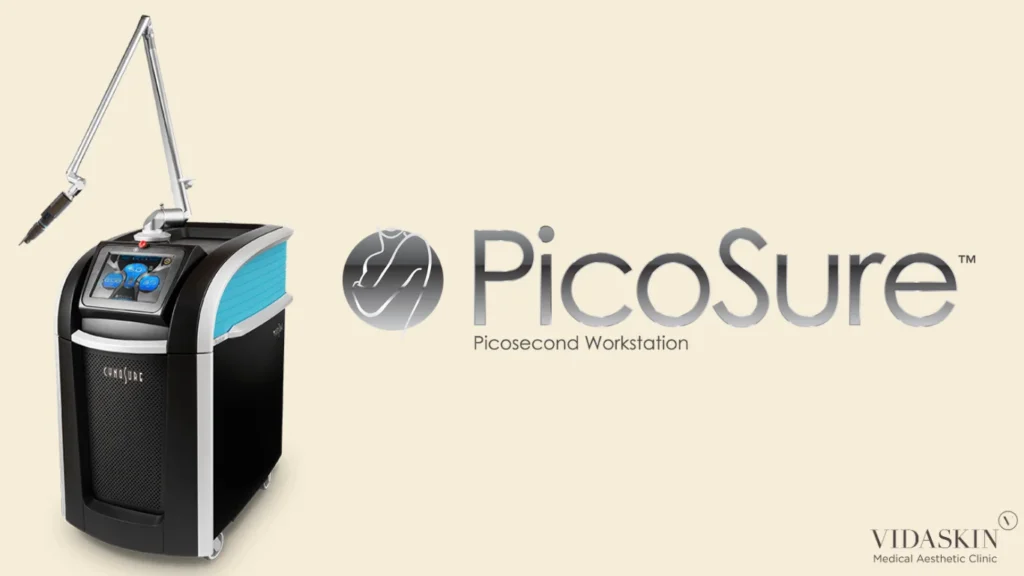
Pico laser has become one of the most widely discussed aesthetic treatments in Singapore — and with good reason. Its ability to address pigmentation, tattoo ink, and overall skin quality without the thermal damage associated with traditional lasers has made it a compelling option for patients who have been cautious about laser treatment in the past. But as with any energy-based procedure, safety depends as much on how and by whom the treatment is delivered as it does on the technology itself.
This guide provides a clinically grounded answer to the question patients ask most often: is Pico laser safe? It covers how the technology works, what conditions it treats, what to expect during recovery, and how the appropriate treatment programme is determined — so you can evaluate your options with the information needed to make a sound decision.
Understanding the mechanism behind the Pico laser is the most direct way to understand its safety profile. The technology is fundamentally different from older laser systems in the way it delivers energy to the skin — and that difference has meaningful clinical implications.
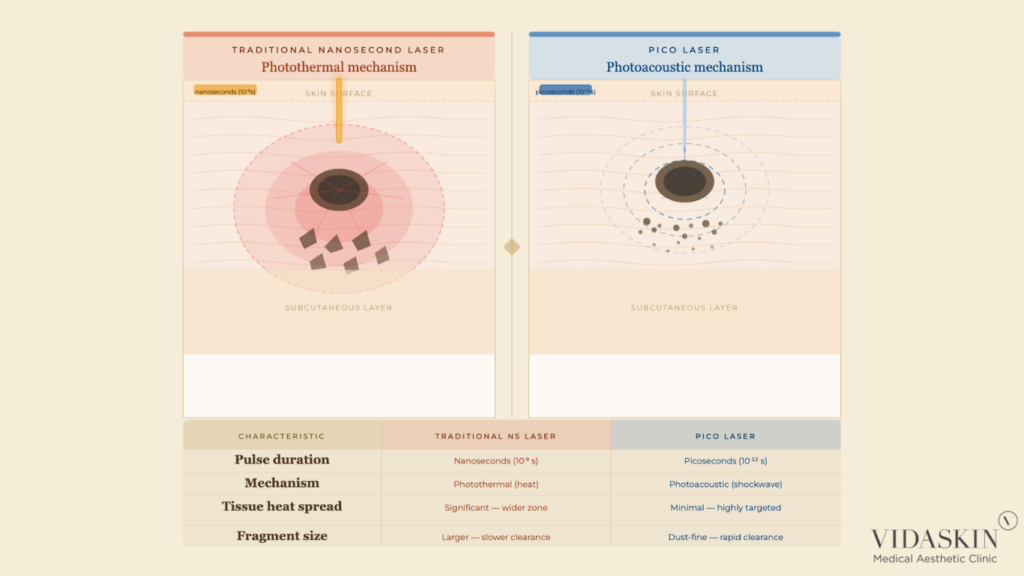
Traditional lasers — including nanosecond Q-switched lasers — work primarily through a photothermal mechanism. They deliver energy as heat, which is absorbed by the target chromophore (such as melanin in a pigment lesion or ink particles in a tattoo), causing it to break down. The limitation of this approach is that heat does not remain perfectly localised — it spreads to the surrounding tissue, creating a risk of collateral thermal damage, post-inflammatory hyperpigmentation (PIH), and, in higher-energy applications, scarring.
Pico laser operates on a fundamentally different principle. Rather than heating the target, it delivers energy in ultra-short pulses — measured in picoseconds, or trillionths of a second. These pulses are so brief that they create a photoacoustic effect: a mechanical shockwave that physically shatters the target pigment or ink particle into microscopic fragments, without generating significant heat in the surrounding tissue.This shift from photothermal to photoacoustic energy delivery is the defining characteristic of Pico laser technology and the primary basis for its improved safety profile compared to older laser systems. Learn more about the laser treatments available at VIDASKIN and how they are selected for individual skin conditions.
The photoacoustic shockwave generated by a Pico laser pulse does not discriminate between different types of tissue — it targets whatever absorbs the laser’s specific wavelength. The clinical value of the technology lies in the precision of that wavelength selection and the brevity of the pulse duration.
Because the pulse is so short, the energy is deposited into the target before it has time to conduct as heat into the surrounding dermis. The target — whether a melanin cluster in a sun spot or an ink particle in a tattoo — absorbs the energy and is mechanically fractured, while the adjacent tissue receives minimal thermal load. The shattered fragments are then cleared by the body’s lymphatic system over the weeks following treatment.This mechanism means that Pico laser can address pigmentation and ink at a lower risk of thermal side effects than older laser technologies — including the risk of PIH, which is a particular concern in darker skin phototypes commonly found in Singapore’s patient population. Our doctors at VIDASKIN assess each patient’s skin phototype, pigmentation pattern, and treatment history before any laser session to ensure the appropriate parameters are selected.
The practical differences between Pico laser and traditional nanosecond lasers are clinically significant for patients evaluating their options:
These differences do not render traditional lasers obsolete — each has clinical applications where it performs well. However, for patients with pigmentation concerns, tattoos, or skin rejuvenation goals in Singapore’s predominantly Asian skin phototype demographic, Pico laser’s photoacoustic mechanism offers a meaningfully improved safety and efficacy profile.
Pico laser’s versatility is one of its most clinically useful characteristics. The same fundamental technology — adjusted for wavelength and delivery mode — addresses a broad range of skin conditions, making it one of the most adaptable energy-based devices in a well-equipped aesthetic practice.
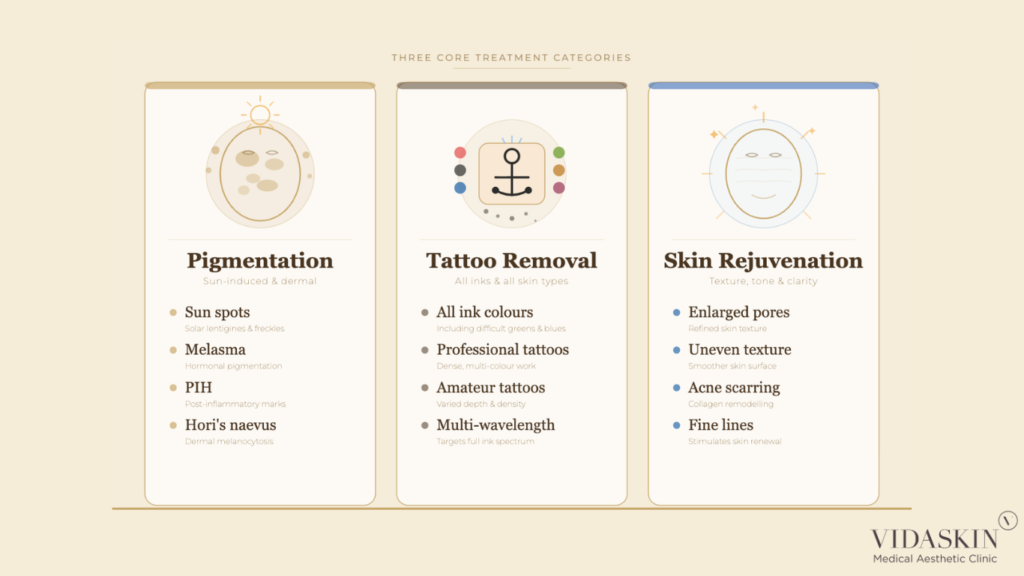
Pigmentation is among the most common aesthetic concerns in Singapore, driven by a combination of high UV exposure, genetic predisposition, and hormonal factors. Pico laser is effective across a broad spectrum of pigmentation types, including:
The photoacoustic mechanism of Pico laser is particularly well suited to the treatment of Asian skin, where the risk of PIH from photothermal lasers is higher. By reducing the thermal load delivered to the tissue, Pico laser can address pigmentation more safely in medium to dark skin phototypes, the majority of patients presenting for pigmentation treatment in Singapore.
Pico laser is currently the most clinically advanced technology available for tattoo removal. Its photoacoustic mechanism shatters tattoo ink into finer particles than nanosecond lasers, which means the immune system can clear the fragments more efficiently, reducing the number of sessions required to achieve clearance.
The effectiveness of Pico laser in tattoo removal depends on several variables: the colour composition of the ink (different pigments require different wavelengths), the age and density of the tattoo, the depth at which the ink was deposited, and the patient’s skin phototype. Professional tattoos — which use a wider range of ink colours and higher ink densities — generally require more sessions than amateur tattoos.
Multi-wavelength Pico laser systems can target a broader range of ink colours within a single treatment session, improving overall clearance rates. The specific wavelengths available at a given clinic, and the clinical experience of the doctor in selecting and applying them, directly influence the outcome of tattoo removal. Book a tattoo removal or pigmentation assessment at VIDASKIN to understand how many sessions may be required for your specific tattoo or pigmentation concern.
Beyond targeted pigmentation and tattoo removal, Pico laser is used in a fractional delivery mode for broader skin rejuvenation — a treatment often referred to as Pico toning or Pico fractional resurfacing.
In this application, the laser energy is delivered through a diffractive lens array (LIOB — laser-induced optical breakdown) that creates microscopic zones of focused energy within the dermis, stimulating collagen and elastin production without ablating the skin surface. The result is progressive improvement in skin texture, pore size, fine lines, and overall skin quality — with minimal downtime compared to ablative resurfacing procedures.
This skin rejuvenation application is particularly suited to patients with generalised skin quality concerns — enlarged pores, uneven texture, mild acne scarring, and early fine lines — who are seeking improvement without the recovery period associated with more aggressive resurfacing treatments. Explore the full range of skin rejuvenation treatments at VIDASKIN and how the Pico laser fits within a comprehensive skin quality programme.
Pico laser has an established safety profile when performed by a qualified doctor using appropriate parameters. However, no laser treatment is entirely without risk, and the post-treatment period requires informed patient behaviour to protect the result and minimise complications.
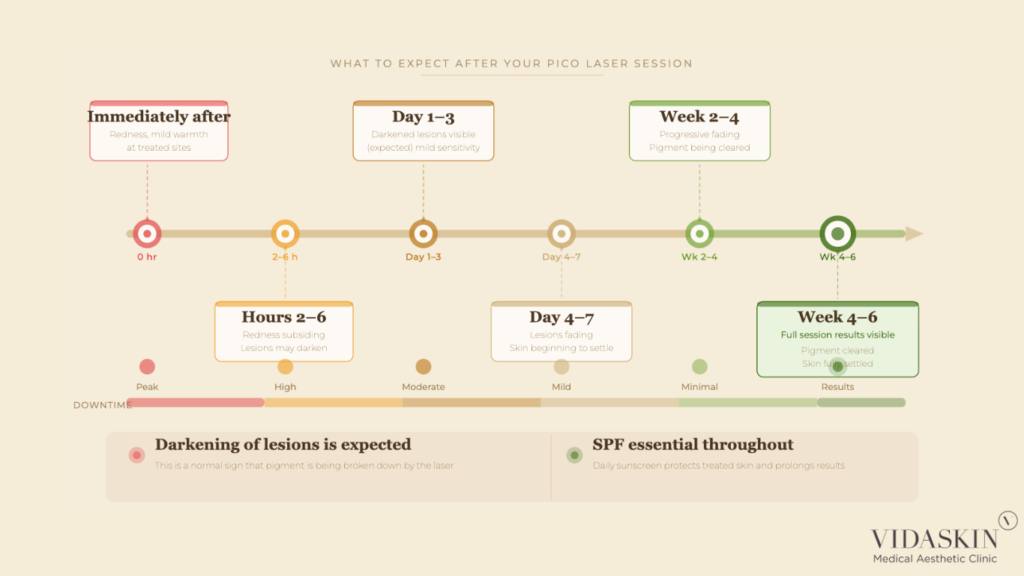
Immediately following a Pico laser session, most patients experience mild to moderate redness and a sensation of warmth at the treated sites — comparable to mild sunburn. This is a normal inflammatory response to the laser energy and typically resolves within a few hours for low-to-moderate energy sessions, or within 24 to 48 hours for higher-energy applications.
In pigmentation treatments, the targeted lesions may darken in the days immediately following treatment — a phenomenon known as “greyish” or “ash” reaction — before gradually lightening and fading over one to three weeks as the fragmented pigment is cleared. Patients should be counselled to expect this progression and to avoid picking or manipulating the treated skin during the healing phase.
For fractional skin rejuvenation applications, a fine pinpoint bleeding or “petechiae” pattern may be visible immediately post-treatment, which resolves within 24 to 48 hours. Mild swelling in the treated area is also common and typically subsides within one to two days.
Sun protection is not optional following Pico laser treatment — it is a clinical requirement. Treated skin is temporarily more vulnerable to UV-induced pigmentation changes in the weeks following a laser session. Exposure to UV radiation during the healing phase can trigger post-inflammatory hyperpigmentation in the treated area, potentially counteracting the results of the treatment.
Patients should apply a broad-spectrum SPF 50 sunscreen to all treated areas every morning — and reapply every two hours if outdoors. Physical sunscreens (containing zinc oxide or titanium dioxide) are generally preferable in the immediate post-treatment period, as they reflect UV radiation rather than absorbing it chemically, and are less likely to irritate sensitised skin.
In Singapore’s year-round high UV environment, sun avoidance during peak hours (10 am to 4 pm) and the use of protective clothing — hats, UV-protective fabric — are strongly advised during the recovery phase. Patients who do not maintain strict sun protection between Pico laser sessions are significantly more likely to experience PIH and are unlikely to achieve the intended treatment outcome. At VIDASKIN, our doctors provide detailed post-treatment protocols tailored to each patient’s skin phototype and the specific treatment delivered.
Several practical measures improve comfort during treatment and reduce the risk of adverse effects in the post-treatment period:
One of the most common questions patients ask before committing to Pico laser is how many sessions they will need. The honest answer is that it depends — and any provider that quotes a fixed number without a clinical assessment is providing an estimate at best.
The number of Pico laser sessions required is determined by the specific condition being treated, its severity, and the patient’s individual response to treatment. As a general reference:
These are reference ranges, not prescriptions. A doctor’s assessment of your specific condition — including the depth of the pigmentation, the composition of any tattoo ink, and your skin phototype — is the only reliable basis for an accurate session estimate.
Several variables influence both the number of sessions required and the recommended interval between them:
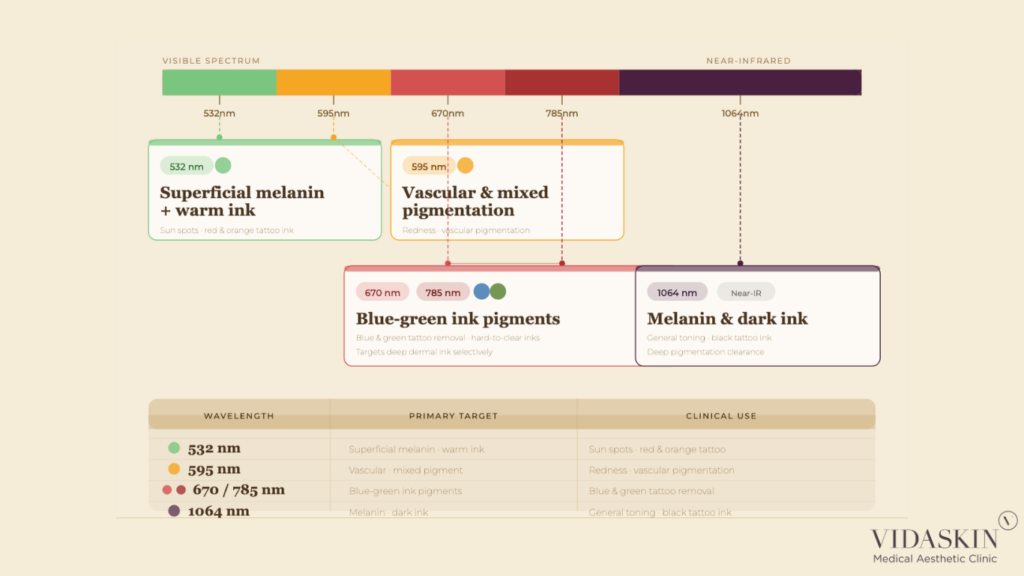
Pico laser systems are available with multiple wavelengths, each designed to target different chromophores — the specific molecules that absorb the laser energy. Wavelength selection is a clinical decision that has a direct bearing on both the safety and efficacy of the treatment.
The most clinically relevant wavelengths in Pico laser platforms are:
A Pico laser system with access to multiple wavelengths offers significantly greater versatility than single-wavelength platforms — particularly in tattoo removal, where multi-colour ink compositions require different wavelengths for comprehensive clearance. The clinical experience of the treating doctor in selecting the correct wavelength combination for a given patient’s presentation is as important as the capability of the device itself. Our doctors at VIDASKIN have extensive experience with Pico laser wavelength selection across a broad range of pigmentation conditions and skin phototypes.
Is Pico laser safe for Asian skin?
Yes — Pico laser is considered one of the safest laser technologies for Asian skin phototypes. Its photoacoustic mechanism generates significantly less heat than traditional nanosecond lasers, reducing the risk of post-inflammatory hyperpigmentation (PIH), which is a known concern in medium to dark skin tones. As with any laser treatment, correct parameter selection by an experienced doctor is essential to minimise risk.
Does Pico laser hurt?
Most patients describe Pico laser as feeling like a series of quick snapping sensations against the skin — similar to a rubber band flick. A topical anaesthetic cream is applied before treatment to reduce discomfort. The level of sensation varies depending on the energy settings used, the treatment area, and individual pain tolerance.
How long does a Pico laser session take?
Session duration varies depending on the size of the treatment area and the condition being addressed. A targeted pigmentation treatment on a small facial area may take 15 to 30 minutes; a full-face skin rejuvenation session typically takes 30 to 45 minutes; tattoo removal sessions vary with tattoo size but are often completed within 15 to 30 minutes per session.
How soon will I see results from Pico laser?
For pigmentation, treated lesions typically darken initially before gradually fading over one to three weeks as fragmented pigment is cleared. Improvement is often visible after a single session for superficial pigmentation, but deeper or more complex conditions require multiple sessions for meaningful clearance. Skin rejuvenation results develop progressively over several weeks as collagen stimulation progresses.
Can Pico laser remove all tattoo colours?
Pico laser can address a broad range of tattoo ink colours, but no single wavelength removes all colours. Comprehensive multi-colour tattoo removal requires a Pico laser system with multiple wavelength options — typically 1064nm for black and dark inks, 532nm for red and warm tones, and 670nm or 785nm for blue and green pigments. A consultation is necessary to assess the specific ink colours in your tattoo and determine the most appropriate wavelength strategy.
Is there any downtime after Pico laser?
Downtime is generally minimal compared to ablative laser treatments. Most patients experience redness for a few hours, with treated pigmentation lesions darkening temporarily before fading. Fractional Pico laser for skin rejuvenation may involve 24 to 48 hours of minor redness or pinpoint marks. The majority of patients return to normal activities the same day or the following day.
Can Pico laser be used to treat melasma?
Yes, but melasma requires a carefully managed approach. It is a complex, hormonally influenced condition that can be aggravated by excessive laser energy or insufficient sun protection. Pico laser — particularly in low-energy toning mode — is one of the more suitable laser technologies for melasma in Asian skin, but it is most effective as part of a comprehensive management programme that includes topical treatment and strict photoprotection. A doctor’s assessment is essential before any laser treatment for melasma.
How is Pico laser different from IPL?
Pico laser and IPL (Intense Pulsed Light) are fundamentally different technologies. Pico laser delivers a single, precise wavelength of energy in ultra-short picosecond pulses with a photoacoustic mechanism. IPL delivers a broad spectrum of light wavelengths and operates through a photothermal mechanism. Pico laser offers greater precision, more controlled energy delivery, and a lower risk profile for darker skin phototypes than IPL — particularly for pigmentation and tattoo removal.
Pico laser is a clinically advanced and well-evidenced treatment — but its safety and efficacy are not guaranteed by the technology alone. They depend on accurate diagnosis of the condition being treated, correct wavelength and parameter selection, an appropriately structured treatment programme, and diligent post-treatment care.
At VIDASKIN, every Pico laser patient begins with a thorough doctor-led assessment. Our doctors evaluate your skin phototype, the nature and depth of your pigmentation or tattoo, your treatment history, and your skin goals — before recommending a protocol that is clinically appropriate for your individual presentation. As a doctor-owned and doctor-led practice, our treatment recommendations are based entirely on medical judgement. There are no standardised packages, no commercially driven session counts, and no compromise on the standard of care we hold ourselves to.
If you are considering Pico laser for pigmentation, tattoo removal, or skin rejuvenation and want an honest clinical assessment of whether it is the right treatment for you, book a consultation at VIDASKIN. Our doctors will provide a clear, transparent recommendation — and if Pico laser is not the most appropriate option for your concern, we will tell you that too.
